







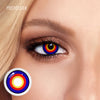
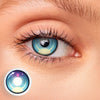
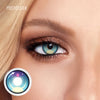
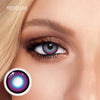
Blue Contacts for Dark Eyes
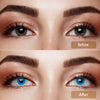
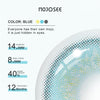
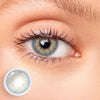
Most blue contacts look dull or muddy on dark brown eyes — unless the lens is designed with an opaque or semi-opaque pigment layer. Every blue lens in this collection is engineered to cover a dark iris fully, so the color you see in the product photo is the color you actually get. Lenses are made from HEMA hydrogel with about 40% water content, use a sandwich (3-layer) pigment structure so the color never touches your eye, and ship free on orders over $49.
Why Most Blue Contacts Fail on Dark Eyes
A dark brown iris absorbs light. Cheap transparent "enhancement" tints simply disappear over it, leaving a faint ring instead of a real color change. What works on dark eyes is pigment density: an opaque or semi-opaque print with enough colored dots per square millimeter to mask the brown underneath. Look for lenses described as opaque, full-coverage, or made for dark eyes — and check real wearer photos on brown eyes, not gray-eyed models. All blue lenses at Mojosee are tested on dark irises before we list them.
Top Blue Contacts for Dark Eyes
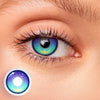
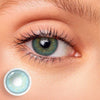
- Pixie Blue — our best-reviewed natural blue. A soft denim tone with a subtle limbal ring that reads as believable in daylight and striking in photos.
- Himalaya Blue — a bright, icy blue with high opacity. The go-to when you want the color change to be unmistakable, even on very dark irises.
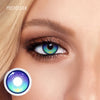
- Love Story 5-HT — a dreamy soft blue with a gentle limbal ring that flatters warm and deep skin tones especially well.
- Rain Forest Gray-Blue — a desaturated, stormy blue that looks like a natural light eye rather than a costume lens. Ideal for everyday and office wear.
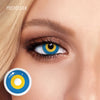
- Sky Blue — classic vivid blue with an enlarging effect, popular for cosplay, stage, and content creation.
Natural Blue vs. Bold Blue: Which Should You Pick?
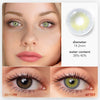
For a natural look, choose desaturated or gray-leaning blues (Rain Forest Gray-Blue) in 14.0mm — they blend with your own iris texture and suit work or daily wear. For a bold look — cosplay, parties, photoshoots — go for saturated, high-opacity blues (Himalaya, Sky Blue) or a slightly larger 14.5mm diameter for extra impact. If it is your first pair, a semi-opaque natural blue is the safest way to see how blue suits your features.
Comfort, Materials & Safety
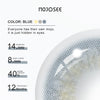
Our blue lenses are made from HEMA hydrogel with roughly 40% water content, with rounded edges for a friction-free fit. The pigment is sealed inside a 3-layer sandwich structure, so color never contacts your cornea. Lens materials are FDA-cleared and lenses carry CE marking; production follows ISO 13485 quality management. Most styles are yearly lenses (replace within 12 months of opening); daily disposable options are available if you prefer a fresh pair every wear. Available with or without prescription power (0.00 plano up to high myopia on most styles). Contact lenses are medical devices: have a valid prescription, never share lenses, and remove them if you feel persistent discomfort.
Choosing Blue by Skin Tone
Fair to light-medium skin: almost any blue works; icy blues give the most contrast. Olive and tan skin: blue-gray and denim tones look the most natural and expensive. Deep skin: saturated royal and sky blues photograph beautifully and stay visible in low light — this is where high-opacity lenses matter most.
FAQ: Blue Contacts on Dark Eyes
Will blue contacts really show up on my dark brown eyes? Yes — every lens in this collection uses an opaque or semi-opaque pigment layer designed to cover a dark iris completely. Transparent-tint lenses will not work on dark eyes; ours are made for them.
Do blue contacts look natural on dark eyes? Desaturated blue-gray tones like Rain Forest Gray-Blue are the most natural; they mimic real light-colored irises with texture and a limbal ring. Vivid blues look intentionally striking.
Can I get blue contacts with my prescription? Yes. Most styles are available from plano (0.00, no power) through a wide range of minus powers. Select your power on the product page.
How long can I wear them? Most are yearly lenses: replace within 12 months of opening and wear up to 8–10 hours a day with proper cleaning. Daily disposable blue lenses are also available — no cleaning needed, single use.
Are colored contacts safe? Worn and cared for correctly, yes. Our lenses use FDA-cleared materials, CE marking, and sandwich pigment technology. Always wash your hands, use fresh solution, never sleep or swim in lenses, and see an eye care professional for fitting.
Torn between colors? Read the gray vs blue vs green on brown eyes comparison.
Frequently Asked Questions
Will blue contacts show up on dark brown eyes?
Yes. Blue contacts with an opaque or semi-opaque pigment layer are designed to fully cover a dark iris, so the blue shows true to color. Transparent enhancement tints do not work on dark eyes — choose full-coverage lenses made for dark eyes, like the ones in this collection.
What are the most natural blue contacts for dark eyes?
Desaturated blue-gray tones such as Rain Forest Gray-Blue look the most natural on dark eyes because they mimic real light irises with texture and a soft limbal ring. Vivid blues like Himalaya Blue or Sky Blue give a bolder, more dramatic change.
Can I get blue colored contacts with prescription power?
Yes. Most Mojosee blue contacts are available from plano (0.00, no power) through a wide range of minus powers for nearsightedness. Choose your power on each product page.
How long do blue colored contacts last?
Most styles are yearly lenses made from HEMA hydrogel with about 40% water content: replace them within 12 months of opening and wear up to 8-10 hours a day with proper cleaning. Daily disposable options are single-use with no cleaning required.
Are blue colored contacts safe for dark eyes?
Yes, when worn and cared for correctly. Mojosee lenses use FDA-cleared lens materials, carry CE marking, and seal pigment inside a 3-layer sandwich structure so color never touches the eye. Wash hands before handling, use fresh solution, never sleep or swim in lenses, and consult an eye care professional for fitting.
Icy blue or deep sapphire — which works better on dark eyes?
Both cover dark irises when printed opaque, so it's about intent. Sapphire and denim blues read closer to natural light eyes and flatter warm skin tones. Icy pale blue is the maximum-contrast statement — stunning in photos, unmistakable in person. Daily wear leans sapphire; editorial moments lean ice.
How do I keep blue lenses from looking fake on dark eyes?
Choose designs with a multi-tone print and a soft limbal ring — real light eyes contain gray, gold, and white flecks, never one flat blue. Keep diameter at 14.0–14.2mm. The 'fake' look almost always comes from single-tone, hard-edged prints, not from the color itself.
What makeup pairs well with blue contacts?
Warm neutrals — bronze, terracotta, soft browns — make blue lenses pop through color contrast, while cool silver and blue shadows compete with them. Keep the eye look grounded and let the lenses be the cool note. A clean winged liner with warm tones is the reliable combination.
Do blue lenses photograph well indoors?
Blue is among the most camera-visible lens colors, but warm indoor lighting can mute it toward gray-blue. For events where photos matter, a slightly more saturated blue than your daily pick compensates. Daylight and ring lights show blue truest.
Can I do a siren-eyes look with blue lenses?
Absolutely — a deep sapphire or gray-blue lens under elongated liner and smoked outer corners is the classic cool-toned siren formula. The lens supplies the piercing focal point the whole look is built around. Avoid pale ice blue here; depth is what makes siren eyes read intense.
How much is shipping?
US orders over $49 ship free; international over $69. Standard delivery typically takes two to four weeks, and Express ($10.99) is available at checkout. Order at least a month ahead of any event date.
How do I clean blue contacts?
Fresh multipurpose solution after every wear — rub gently, rinse both sides, store fully submerged in a clean case. New solution every time, new case every three months, and no water contact ever. That routine is what keeps a yearly lens safe for its full lifespan.
Can I nap in blue contacts?
No — remove lenses before any sleep, naps included. Closed eyes plus a soft lens means the cornea runs short on oxygen, which is how infections and abrasions start. Keep a case and solution in your bag so removal is never inconvenient.
Can I wear blue lenses with astigmatism?
These are spherical lenses without astigmatism correction. Mild astigmatism generally tolerates plano cosmetic lenses well; moderate or higher deserves an eye doctor's sign-off first. If vision blurs when you blink, the lens is rotating on an astigmatic cornea — that's your answer.
Can I mix blue with another color for heterochromia?
Yes — one blue lens and one gray or green is a striking editorial and cosplay look, and dark eyes give both lenses the same deep backdrop so the pairing reads cohesive. You'll be buying two pairs; keep the spares as backups.


