








White and Blackout Contacts: The Complete Costume Eye Guide
The four costume-eye effects that aren't a color: white-out, blackout, mesh and sclera. What each looks like, how much you can see, and which one nails your character.
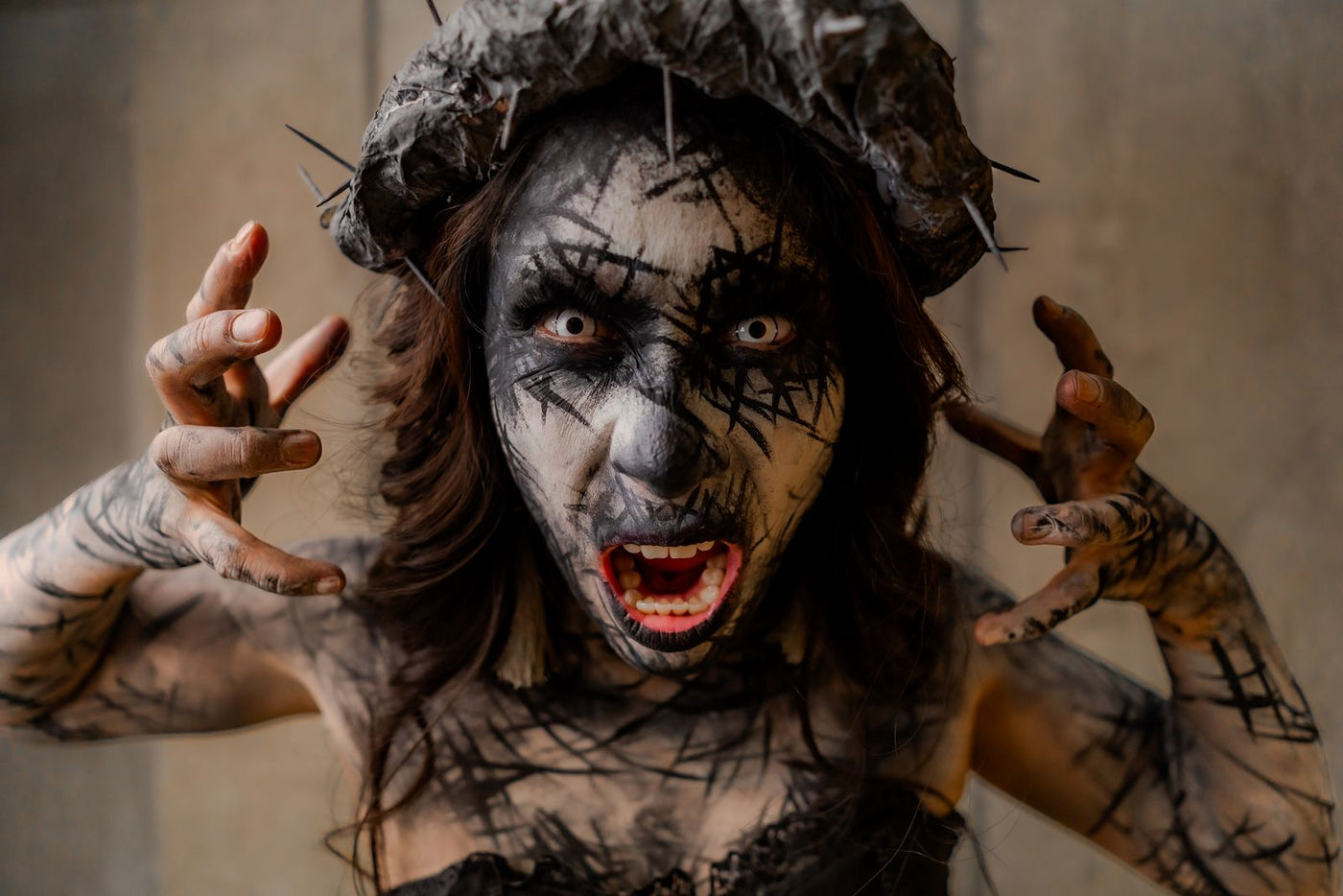
Some costume eyes aren't about color at all — they're about erasing the eye entirely into white, black, or fog. These are the highest-impact costume lenses and the most misunderstood, because "white contacts" covers four very different effects with very different vision trade-offs. Here's the complete map for zombie, demon, ghost and possessed looks. Browse alongside the Halloween collection.

White-out: the ghost / possessed eye
A solid white lens covers the iris in opaque white for the blind-seer, ghost, or possessed look. Full white-out styles block the most light — the pupil is covered, so vision is significantly dimmed — while patterned whites like Spider Web White keep a small clear zone and are far easier to move around in. The current range sits in White Contacts. This is the classic "no visible iris" horror eye, and it reads instantly on camera even under flat lighting. Great for statues, oracles, the possessed, and anything ethereal.

Blackout: the demon / void eye
The inverse — solid black erasing the iris into a bottomless void, like Black Out. Blackout reads as demon, dark-magic, or "the eyes went black" possession, and it's the base for the button-eye doll look too. Vision through a full blackout is dimmed but workable in good light — plan for well-lit venues. This is the most versatile costume effect: one pair covers demon, doll, and generic horror.

Mesh: the milky, clouded undead eye
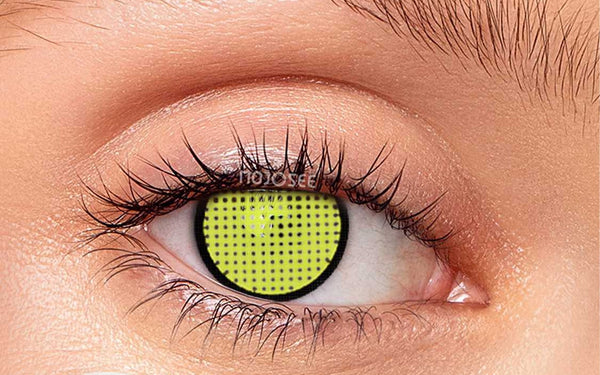
Mesh lenses fog the iris with a fine screen rather than solid coverage — think cataract-clouded zombie eyes or the milky stare of the recently undead. White mesh like White Mesh gives a translucent, textured cloud you can partly see through (the mesh sits over the pupil, so vision is hazy — never drive in these). Mesh is the go-to for zombies and the freshly-dead because it reads as "something's wrong with those eyes" without full blackout's total void.

Sclera: taking any effect full-eye
Sclera lenses scale these effects across the entire visible eye — covering the whites too, for total demon, full-ghost or possessed looks. Maximum impact, and a genuinely different skill and comfort level: bigger insertion, shorter wear time, dimmer vision. Our Sclera collection covers the range: Bloodstained Sclera for vampire and horror, Red Sclera for the demon and villain end, and men's versions of several styles. Full-black and blue sclera move in and out of stock, so check the collection for what is on the shelf right now. Do not make sclera your first costume lens, though — read the dedicated sclera guide first, and build up from the regular-diameter white and blackout lenses above.
Matching effect to character
Zombie / undead → white mesh. Ghost / oracle / possessed → white-out. Demon / dark magic / black-eyed → blackout. Creepy doll → blackout plus stitched makeup. Maximum horror, any of the above → sclera version. Whichever you choose, the costume-wear safety rules matter extra (never share, clean insertion, out before bed, no water) — the framework is in the safety guide, and getting the effect to photograph well is in the photo guide.
Vision and safety: what full-coverage costume lenses actually cost you
Every step toward more dramatic coverage trades away some vision, and planning for that keeps your costume night safe. Standard black/enhancer lenses: near-normal vision, everyday-wearable. Blackout and white-out: the pupil is covered, so vision dims noticeably — fine in a well-lit party, genuinely limiting in a dark venue, and never okay for driving. (At a UV party the trade-off flips in white’s favor — the blacklight guide explains why white is the one color that stays visible.) Mesh: you see through a fog, hazier than blackout, so treat these as photo-and-pose lenses, not walk-around-a-crowd lenses. Sclera: the most dimming of all, with tunnel-ish peripheral vision (see the dedicated sclera guide). Two safety rules apply extra hard to all costume lenses: never share them (infection risk trumps any last-minute favor), and never sleep in them after a long night out — costume lenses cover more surface and starve the eye of oxygen faster than natural lenses do. Plan a lit venue, a handler if you're in sclera, an alarm for removal, and clean hands for insertion. The horror should be in the look, not in the aftermath.
See it worn on camera
Blackout lenses in action: Black Out for men erasing the pupils completely in a gothic transformation — bleached brows, halftone dot art, black lip. The before/after shows why full black-out contacts carry a look even in near darkness: the eye becomes pure silhouette, no iris detail left to read.
See what blackout lenses actually look like worn
Standard delivery: 12–20 days. See order deadline guide.
FAQ
Can you see through white and blackout contacts?
Partly — it depends on the style. Patterned/mesh versions keep a small clear zone; full white-out and blackout cover the pupil and dim vision noticeably. Plan for well-lit venues and never drive in them.
What's the difference between white-out and mesh contacts?
White-out is solid opaque white (ghost/possessed, most coverage); mesh is a translucent fogged screen (milky zombie eyes, partly see-through). Mesh reads "clouded," white-out reads "no iris at all."
What contacts are best for a zombie costume?
White mesh — the fine screen gives the milky, cataract-clouded undead stare while keeping partial vision. Full white-out works for a more ethereal ghost, blackout for demonic.
Are blackout contacts safe to wear?
Yes, as occasional costume lenses from a legitimate source, with clean insertion and normal wear limits — same rules as any lens. Vision is dimmed, so stay in lit areas and never drive; take them out before sleeping.
Are blackout contacts hard to see through?
Full blackout covers the pupil, so vision dims noticeably — workable in good light, limiting in a dark venue, never okay for driving. Patterned or mesh versions keep a small clearer zone. Plan a well-lit setting and you'll be fine for a party.
What white contacts are best for a zombie look?
White mesh — the fine screen gives the milky, cataract-clouded undead stare while keeping partial vision. Full white-out reads more like an ethereal ghost or possessed look; mesh is the specifically-zombie choice.
You might also like
Picked to match this guide — every pair in stock now.
 Circle Block Colored Contact Lenses$18.98per pair (2 lenses)
 Black&White Spiral Swirl Colored Contact Len$18.98per pair (2 lenses)
 Cat Eyes Colored Contact Lenses$17.99per pair (2 lenses)
 Mesh Colored Contact Lenses$18.98per pair (2 lenses)
Explore more: White Halloween Contacts → · Black Halloween Contacts → · Black and White →