








Button Eye Contacts: The Coraline-Style All-Black Look
How button eye lenses flatten an eye into a doll disc, what each colorway does, and how far to go for a full blackout — including the two ways to fake the effect without sclera lenses.
Button eye contacts flatten the eye into a doll-like disc — the look made famous by the Other Mother's world in Coraline, and a staple of doll, puppet and creepy-cute costumes ever since. Two practical facts before anything else: they read clearly on any eye color, dark brown included, because the print is fully opaque; and they are standard-diameter lenses, not sclera, so the pupil zone stays clear and you can see out of them. Below is how the effect actually works, which colorway does what, and how far to go for a full blackout.
What makes an eye look like a button
Two things, and neither is the color. The first is killing the iris detail. A real eye reads as alive because the iris has visible texture — fibers, flecks, a gradient from pupil to rim. A button lens replaces all of that with a flat, matte, uniform field, and the moment the texture is gone the eye stops looking like an organ and starts looking like an object.

The second is flattening the highlight. Eyes normally catch a bright specular dot off the wet surface of the cornea; that dot is a large part of why a face reads as conscious. Matte button prints dull it, so the eye photographs as sewn-on rather than looking back at you.
Both effects come from the print, not the size. These fit like everyday colored contacts at 14.0–14.5 mm, which is the main reason they are so much easier to wear than a 22 mm sclera lens — and why a first-time wearer can realistically manage them for a party. If you are unsure what diameter means in practice, the diameter guide covers it.
Choosing your colorway
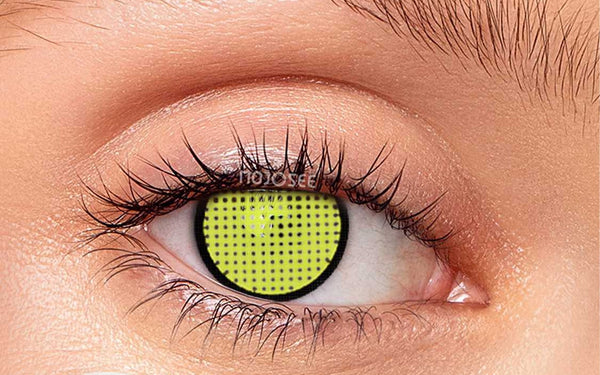
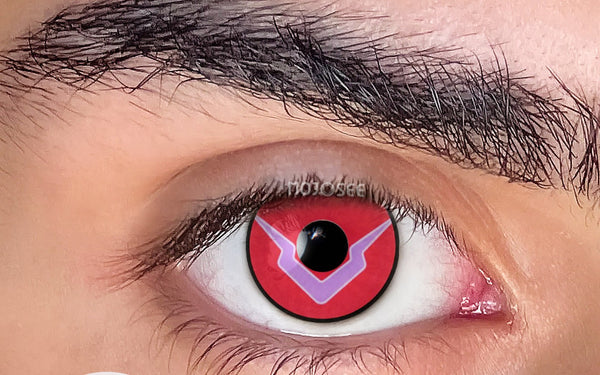
All four designs share the same X-stitched button center. What changes is the ring that frames it, and that ring decides whether the costume reads as sweet, uncanny or outright wrong.

Azalea is the classic — a warm pink stitched ring, closest to the film's doll and the easiest to pair with a rag-doll or porcelain-doll costume. Gray reads porcelain rather than horror and is the strongest of the four under flash, which makes it the pick if there will be photos. Blue gives the coldest contrast against dark hair and features, so it lands as uncanny rather than cute. Green is the most otherworldly of the set — the one to reach for if the character is not meant to be human at all.

If you are torn, the deciding question is what the rest of the costume is doing. A soft, pale, sweet costume needs the ring to supply the wrongness, which points to blue or green. A costume that is already grim — dark fabric, heavy makeup, prosthetics — is better served by a quieter ring that lets the flat disc do the work. The mistake to avoid is matching the ring to your outfit color palette — the button is not an accessory, and a ring that coordinates neatly with your costume reads as styling rather than as something wrong with your face.

Going full black: the Coraline route
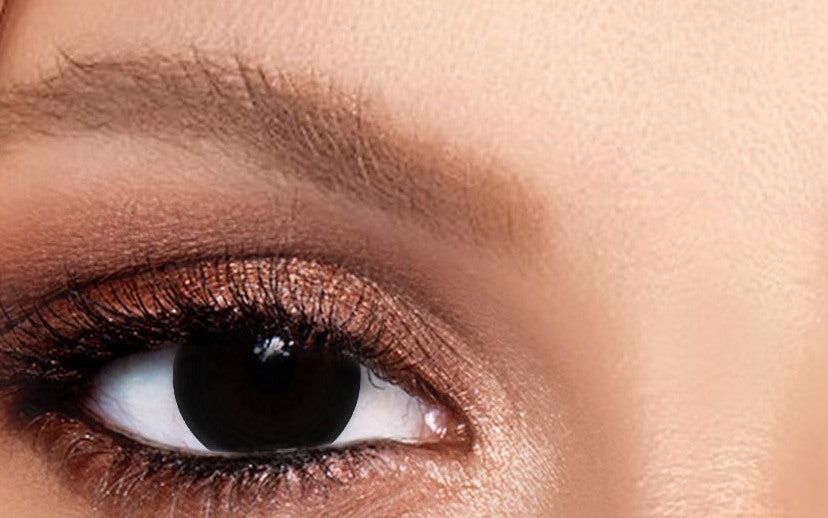
For a true all-black button, what you want is maximum dark coverage, and there are three tiers by commitment level.

Tier one — standard black. A black lens darkens the iris but keeps a normal diameter and a clear pupil. It is the subtle end: everyday-wearable, comfortable for hours, and enough to make an eye look wrong in photographs without committing to anything dramatic. This is the tier to pick if you are also wearing prop glasses or a mask that partly covers the eyes.

Tier two — blackout. A blackout lens erases the iris completely, pupil included, in a regular lens size. For most doll costumes this is the sweet spot: the full flat-disc effect at normal comfort and normal insertion difficulty. It is also the tier that photographs best, because there is no residual iris detail to catch the light and give the game away. It is also the tier most people underestimate: the jump from a dark iris to no iris is far larger in person than it looks in a product photo, and it is usually enough on its own.

Tier three — black sclera. Sclera lenses cover the visible white of the eye as well, which is the only way to reproduce the film's effect literally. The impact is maximum and so is the difficulty: the larger diameter takes practice to insert and the lens is less comfortable over a long night. Do not make a 22 mm sclera lens your first ever contact lens.
Can you actually see in them?
Yes, with one caveat worth planning around. The printed button sits over the iris only, and the optical center stays clear, so vision is normal in ordinary lighting. In a dim room, though, your pupil expands — and it can expand past the clear zone, at which point the edge of your vision goes soft. In practice that means a dark party or a night shoot will feel hazier than your living room did.
The practical answer is sequencing: do your makeup, your photos and anything that needs sharp vision before the lights go down. Blackout styles dim things noticeably even in good light, so skip driving in them entirely. Beyond that the rules are the same as any costume lens — clean hands, fresh solution, never share a pair, never sleep in them, and take them out if your eye stings or waters. The safety guide has the full version.
On the legal side: decorative lenses are regulated medical devices in the US even at zero power, so a prescription is required for plano costume lenses too, and we support prescription verification on orders. Several of the standard-diameter button and black styles offer corrective powers — check the power selector on the product page. Sclera lenses are typically plano only.
The doll look, step by step
- Insert the lenses first, before any face makeup — wash hands, work over a clean surface, and give yourself more time than you think you need.
- Build a matte, pale base with softly shadowed sockets. The flat eyes are the whole effect; everything else should recede.
- Draw four short stitch lines radiating from each corner of the mouth for the sewn-doll read.
- A straight-cut wig and a raincoat land the reference instantly, without needing to name it.
New to lenses entirely? Work through the step-by-step insertion guide a few days before the event, not on the night.
Two ways to fake it without going full sclera
Route one — blackout lens plus painted buttons. A regular-diameter blackout lens flattens the iris into a dark disc; then you paint the button details, small X stitches on the lid and under-eye, with face paint. The lens kills the alive look and the makeup supplies the button. On camera it reads the same as the difficult version, at a fraction of the difficulty.
Route two — the makeup-forward version. Skip maximum coverage and sell the doll through the whole face instead: a dark button-pattern lens, stitched-mouth liner, round rosy blush, wide innocent brows. This is the route that survives a long night, because nothing you are wearing is uncomfortable.
Escalate to sclera only if you have worn lenses before and want the no-white-showing effect for a hero shot. For most costumes, regular-diameter blackout plus button makeup is the better trade: full effect, normal comfort, and you can still find the drinks table.
FAQ
Can you see through button eye and blackout contacts?
Yes. The print sits over the iris area and the optical center stays clear. Blackout styles dim your vision noticeably, and in dark rooms your pupil can expand past the clear zone, so the edges soften — plan for well-lit venues and do not drive in them.
Do button eye contacts work on dark brown eyes?
Yes. The button print is fully opaque, so it covers any iris color completely. Dark eyes actually blend the edge of the print more naturally than light eyes do.
What size are button eye contacts?
Standard 14.0–14.5 mm — they fit like everyday colored contacts, not like 22 mm sclera lenses, which is why first-time wearers can handle them.
Do I need sclera lenses for a doll costume?
No. A regular-size blackout lens plus dark eye makeup reads as a button eye in photographs at a fraction of the difficulty. Save sclera for when you have worn lenses before.
Are they safe to wear for a whole party night?
Treat them like any costume lens: clean hands for insertion, fresh solution, a well-lit venue, and out before you sleep — never nap in them. Worn for an evening from a sealed, dated, legitimate pair, they are a fine occasional costume piece.
Can I get button eye contacts with prescription?
Many of the standard-diameter button and black styles offer power options — check the power selector on each product page. Sclera lenses are typically plano (0.00) only. A valid prescription is required in the US either way.
When should I order for Halloween?
Three to four weeks ahead at minimum; these designs are among the first Halloween styles to sell out. The country-by-country cutoffs are in the order deadline guide.
You might also like
Picked to match this guide — every pair in stock now.
 Button Eye Colored Contact Lenses$22.98per pair (2 lenses)
 Circle Block Colored Contact Lenses$18.98per pair (2 lenses)
 White Mesh Colored Contact Lenses$18.98per pair (2 lenses)
 Circle Block Dark Blue Block Ciel Alois Colo$21.98per pair (2 lenses)
Explore more: Black Halloween Contacts → · halloween → · Cosplay Contacts →