








How to Put In (and Take Out) Colored Contacts: First-Timer Guide
First pair arriving soon? Here is the calm version of insertion and removal: the inside-out check, the two-finger technique, and what to do when it will not go in.

Nobody gets their first lens in on the first try, and that is fine. Insertion is a motor skill — most people go from ten frustrating minutes to ten seconds within a week. This guide walks the exact sequence, plus the troubleshooting that eye-care assistants teach in person.
Before you start (once per delivery)
New lenses ship in sealed vials with storage fluid. Do not wear them straight from the vial. Open, place the lenses in a clean case with fresh multipurpose solution, and let them soak 6–8 hours (overnight is easiest). This replaces the shipping fluid and lets the lens rehydrate to wearing condition.
Putting them in
- Wash and dry your hands with unscented soap and a lint-free towel. Water is the enemy of lenses — dry fingers matter.
- Scoop the lens onto the pad of your right index finger (left, if left-handed). It should sit like a tiny bowl.
- The inside-out check: viewed from the side, a correct lens is a smooth U. If the edges flare outward like a soup plate, it is inside out — flip it. Colored lenses make this easy: the print looks vivid from the front, dull from the back.
- Hold your eye open with two fingers — middle finger of the lens hand pulls the lower lid down, a finger of the other hand lifts the upper lid at the lash line (blinking is triggered by lashes; pin them and the reflex quiets down).
- Look slightly upward and place the lens on the lower white of your eye, not directly on the iris. Release the lower lid first, then the upper. Close the eye and roll it gently — the lens centers itself.
- Repeat on the other side. Always start with the same eye so you never mix left and right powers.
When it will not go in
- You keep blinking: you are holding the lid, not the lashes. Grip at the lash line and the reflex mostly stops.
- The lens sticks to your finger instead of the eye: your finger is too wet. Dab it; the eye must be wetter than the finger.
- It folds or dances around: too much solution on the lens. A nearly-dry outer surface with a moist bowl works best.
- It stings immediately: take it out, rinse with solution (never water) and re-insert. Persistent stinging = stop; see the safety guide.
Taking them out
- Wash hands. Look up. Pull the lower lid down.
- Slide the lens down onto the white with your index fingertip.
- Pinch gently with the pads (never nails) of index finger and thumb — it comes off with a soft fold.
Struggling to pinch? Dry your fingertips more, or use a drop of rewetting solution first — a dehydrated lens grips the eye.
Aftercare in three lines
Rub-rinse the lens in solution, store in fresh solution (change it every time — topping up breeds bacteria), and replace the case monthly. The replacement cycle countdown starts at first opening, not first wear — details in the replacement cycle guide.
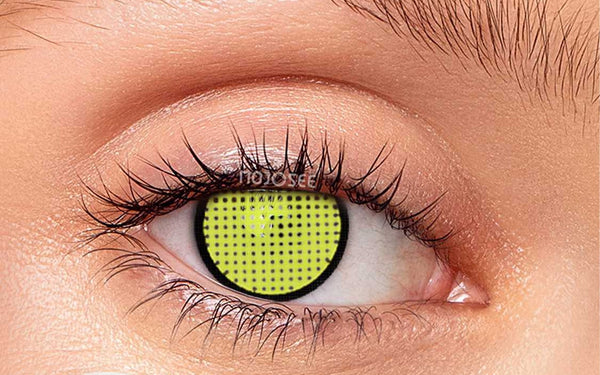
Special geometries play by extra rules: 22 mm sclera lenses need a practiced hand, and mesh styles have session limits — see the effects guide.
The setup that makes everything easier
Most insertion struggles are really workstation struggles. Set up once, properly: a magnifying mirror flat on the counter so you look down into it instead of leaning at the bathroom wall — looking down keeps lids relaxed. Both elbows planted on the counter turns shaky hands into stable ones; fingertip tremor mostly comes from unsupported arms. Plug or cover the drain before anything else, and lay a dark towel on the counter — a dropped lens is nearly invisible on white porcelain and obvious on dark cloth. Same order every time: wash, dry with a lint-free towel, right eye first. Ritual beats talent here.
The full sequence, with the reasons
- Wash and dry your hands — dry matters as much as clean; a wet fingertip will not release the lens.
- Check the lens is the right way round. On your fingertip it should make a clean U; a rim that flares outward like a saucer is inside out. On a printed lens you cannot tell from the colour, so do the profile check every time.
- Check the print is intact — no nicks at the edge, no dots or gaps in the pattern.
- Hold the lids. Middle finger of your free hand pulls the upper lid up against the brow bone; ring finger of the inserting hand pulls the lower lid down. On a hooded eye lift the fold too, not just the lash line.
- Look up, or past the mirror — not at the lens — and place it on the lower white of the eye rather than aiming for the iris.
- Release the lower lid first, then the upper, and blink slowly. The lens slides to centre on its own.
- Check the centring in a mirror. On a printed lens, off-centre shows as a crescent of your own iris at one edge. Blink again until the print is concentric.
The first attempts run ten minutes an eye. By the end of a week it is thirty seconds, and the habit that makes the difference is step five — most beginners aim at the iris and blink the lens away.
The first week, honestly
Day one takes ten minutes an eye and feels like the lens will never go in. Day two is faster because you stop aiming at the iris. By day four the profile check and the centring check are automatic. By the end of the week the whole thing is thirty seconds, and the lens is part of getting dressed. If it is still uncomfortable after a week, the size is wrong for your eye — go back to the prescription and check the diameter — not the technique.
Hooded and smaller eyes
The steps are the same with one change: lift the fold of the hood together with the upper lid, using the middle finger against the brow bone, rather than pulling only the lash line. That exposes enough of the eye to place the lens on the white. A smaller eye also shows off-centre placement instantly — a crescent of your own iris at the edge — so the mirror check at the end matters more, not less.
Insert before or after makeup?
After base and before eye makeup. Foundation and powder shed particles, and a lens inserted afterwards carries them onto the eye; liner and mascara applied after the lens is in can be done with the eye already open and steady. The one thing never to do is insert a lens with product on your fingertips — wash between the base and the lens.
22mm sclera is a different technique
Everything above is for standard 14.0 to 14.5mm lenses, which go in like any soft lens. A 22mm sclera lens is wider than the eye opening and cannot be placed; it has to be tucked under the upper lid first, with the bowl filled with saline to prevent an air bubble, then lowered onto the eye and the lower lid released. Allow half an hour the first time. The sclera guide has the full method; do not use this page's steps for a 22mm lens.
Taking them out, properly
Rewetting drops first if the lens has been in for hours — a dry printed lens grips. Look up, pull the lower lid down, slide the lens down onto the lower white with a fingertip, and pinch the lifted edge between finger and thumb. Never pinch at a lens while it is centred on the cornea, and never force a lens that will not move: more drops, a minute, then try again.
Where a daily disposable makes the first week easier
A daily removes the case and the solution from the learning curve, and it removes the fear of ruining a pair — drop one, bin it, open the next. For a first-time wearer that alone is worth the small extra cost per wear, and it is why the honest first purchase is often a daily in a natural shade rather than the costume pair you were excited about.
Troubleshooting, in order of likelihood
| What happens | Most likely cause | Fix |
|---|---|---|
| Lens folds or sticks to the finger | Wet fingertip, or too much solution on the lens | Dry the finger; let the lens sit a second before placing |
| Blinks straight back out | Lids not held, or aiming at the iris | Hold both lids; place on the white, look up |
| Feels like grit once in | Inside out, or debris under the lens | Out, profile check, rinse with solution, retry |
| Crescent of your own iris visible at one edge | Off-centre | Close the eye and roll the lens with a fingertip on the lid; blink |
| Pain | Damaged edge, or a scratch | Out and stays out; see someone if it persists |
Every row but the last is a first-week problem that goes away with practice. The last is the only one that does not improve with waiting.
When to stop and get help
Frustration is normal; pain is not. If a lens hurts once it is in, it is out — inside out, a damaged edge, or debris underneath, and none of those improves with waiting. Redness that gets worse after the lens is out, light sensitivity, or vision that stays cloudy are reasons to see an eye care professional the same day. And if you have never been fitted, that is the first step, not the last: the size and curve on a prescription are what make these steps work for your eye rather than an average one.
FAQ
How long does it take to learn?
Most first-timers need 5–15 minutes per eye on day one and under a minute by day five. Book 20 relaxed minutes before your first event, never 5 rushed ones.
Can the lens go behind my eye?
No — the conjunctiva physically seals the socket. A dislodged lens can hide under the upper lid; close your eye, massage gently toward the center, and it returns.
Can I nap in colored contacts?
No. Even short sleep drops oxygen to the cornea. Take them out first, every time.
My eyes are watery the first day — normal?
Mild watering and awareness for the first hour is normal adjustment. Pain, redness or blur is not — remove the lens.
Is putting in colored contacts different from clear ones?
The motion is the same for 14.0 to 14.5mm lenses. Two things differ: you cannot tell inside-out from the colour, so check the profile every time; and an off-centre printed lens shows a crescent of your own iris, so check the centring in a mirror before you finish.
How do I put in 22mm sclera contacts?
Not with these steps. A sclera lens is wider than the eye opening and has to be tucked under the upper lid with the bowl filled with saline, then lowered onto the eye. Allow half an hour the first time and follow the sclera guide.
You might also like
Picked to match this guide — every pair in stock now.
 Vika Tricolor Blue Colored Contact Lenses$21.98per pair (2 lenses)
 Polar Lights Blue Gray Prescription Colored $19.98per pair (2 lenses)
 Starry sky Gray Prescription Colored Contact$22.98per pair (2 lenses)
 Polar Lights Brown Prescription Colored Cont$21.98per pair (2 lenses)
Explore more: Colored Contacts for Dark Eyes →