







Gray vs Blue vs Green Contacts on Brown Eyes: Honest Comparison
Gray is the safe default, green the underrated bold-but-believable pick, blue the highest drama and the highest risk. The honest three-way comparison on brown eyes — plus which to buy first if you only buy one.
Gray, blue and green are the three colors almost every brown-eyed shopper considers first, and on a dark iris they behave nothing alike. The short version: gray is the safe default, because it contrasts hard against brown pigment and nobody questions it. Green is the underrated one — bolder than gray, but still a real human eye color, so it reads as rare genetics rather than costume. Blue is the highest drama and the highest risk, because brown-to-blue is the one jump the eye half-knows does not happen naturally. Everything below is how to choose between them, and which to buy first if you only buy one.
The scorecard
| Visibility on dark eyes | Reads as natural? | Best light | Makeup dependency | |
|---|---|---|---|---|
| Gray | High | Very high | Any | None |
| Green | Very high | High | Warm / evening | Low |
| Blue | High (opaque) / poor (tints) | Medium — depends on design | Daylight | Medium |
Gray: the default answer
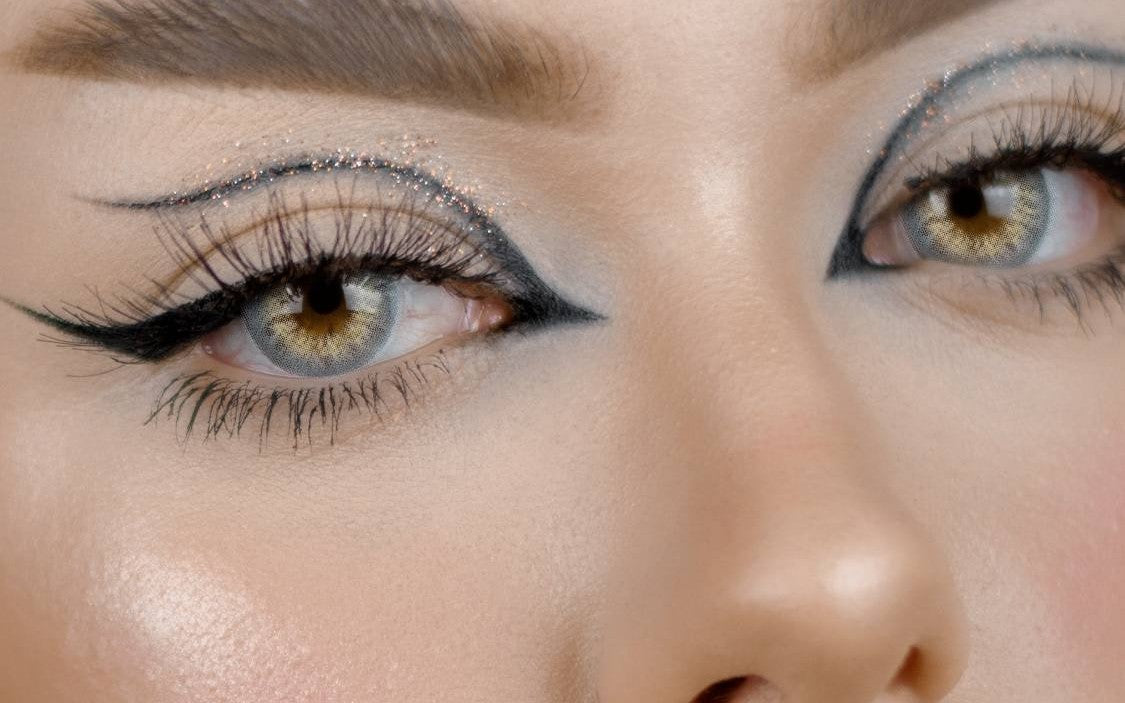
Gray wins on the combination that matters. It contrasts hard against brown pigment, so it actually shows up, and it exists abundantly as a real eye color, so nobody questions it. Cool steel grays read editorial; warm grays with a brown undertone read soft. It is also the least demanding of the three — it needs no particular makeup, no particular lighting, and no particular skin tone to work.


If you are deciding between all three with no other information, this is the one to buy. Within the gray family the split is between a clean cool gray and a gray with a green cast — the second is more forgiving on warm skin, the first is the one people describe as striking.

There is a second reason gray is the default: it is the only one of the three that never needs an explanation. Green and blue both raise a question in the viewer's mind — a small one, but a question. Gray raises none, which is why it is also the color that survives a work environment, a passport-photo-lit meeting room, and your relatives, without ever becoming a topic of conversation. The rest of this guide is about the two colors that do raise questions, and when the question is worth it.

Green vs blue: the decision most people actually face
Once you move past gray, the real question is blue or green — the two colors bold enough to transform, natural enough to consider wearing regularly. Buying the wrong one first is one of the most common regrets we hear about.
Believability: green wins. Green is a real, if uncommon, human eye color that occurs across many ethnicities. Opaque green on brown eyes therefore reads as "rare natural green," and people accept it without working out why. Blue on originally-brown eyes is a much bigger genetic leap; even a beautiful opaque blue invites a second look, because the brain half-knows that brown-to-blue does not happen. Green also sits opposite brown on the color wheel, so even mid-opacity greens pop on a dark iris — you get the visibility without the disbelief.

That combination — high visibility, high plausibility — is why green is the one we restock most often, and why textured multi-tone greens do it better than flat ones: the variation is what sells the idea that the color grew there.

Drama: blue wins. The flip side of blue's implausibility is its impact. Nothing turns heads like vivid blue eyes on a deep complexion, and against dark hair the contrast is genuinely stunning. Blue is the higher-risk, higher-reward pick: less "did she always have those?" and more "wait, those are incredible." If being noticed is the point, blue is the one — and if it is not the point, blue is the one to skip.

Construction is what separates a blue that works from one that looks pasted on. Fully saturated blue with no outer ring is the version that fails; a defined dark rim and a multi-tone print keep the drama inside plausible-eye-color territory.

If blue is what you want but the risk is what worries you, the hedge is a gray-blue hybrid. It keeps the cool cast and most of the contrast while borrowing gray's credibility, and on a dark iris it tends to read as an unusually light eye rather than as a color change. It is the safest way into the blue family and the one we recommend to anyone buying blue first. The trade-off is honest: you give up some of the saturation that made you want blue in the first place. If the whole point was the head-turn, take the full blue and manage the lighting instead.

See it worn: the gray-or-blue dilemma tried on, both ways.
Skin tone and lighting break the tie
Green flatters the widest range of complexions — warm and cool undertones both carry it, and it is especially strong against deep skin, which we covered in the guide to colored contacts for dark skin. Blue leans cooler, so it pops hardest on cool and neutral undertones and against dark hair; if your undertone is warm, a green-leaning teal blue avoids the clash that an icy blue creates.
Lighting behaves differently too, and it is worth matching to where you actually wear lenses. Green holds its character across lighting conditions — brilliant in daylight, deepening richly under warm light, and reliable on camera. Blue is the highest-variance of the three: stunning in bright light, but on a dark base it can drift gray-ish in dim indoor light and then blaze under sun or flash. Gray sits in the middle and barely moves, softening only slightly in warm evening light, which is the whole reason it is the low-effort choice.
All three need an opaque pigment layer to register on a dark iris at all — enhancement tints made for light eyes simply vanish. That, along with a defined limbal ring and a 14.0–14.5 mm diameter, is the construction floor for every color here, and it is covered properly in why colored contacts look fake.
How to decide in 30 seconds
Want people to notice something changed, but not what? Gray.
Want a bold color you can wear often without fielding questions? Green — more believable, more lighting-stable, flatters more skin tones.
Want the boldest transformation for photos and events, and daily plausibility is not the goal? Blue, opaque and dark-rimmed.
Want nobody to notice at all? None of these — go hazel, which the dark-eyes color guide covers.
Cosplaying a specific blue- or green-eyed character? Skip the debate and match the reference directly in the character color table.
Most brown-eyed wearers end up happiest starting with green and adding blue later as the louder, second lens — the two-lens wardrobe logic from styling lenses with outfits.
FAQ
Which color is most popular on dark eyes — gray, blue or green?
Gray, by a wide margin in our order data, followed by green, then blue. Gray is the most versatile and the easiest to wear daily; green is the boldest natural-adjacent pick; blue is the highest-drama and highest-risk of the three on a dark base.
Do blue or green contacts look more natural on brown eyes?
Green. It is a plausible natural eye color, so opaque green reads as genetics. Blue on formerly-brown eyes is a bigger leap and invites more scrutiny, however beautiful it looks.
Do blue contacts ever look natural on brown eyes?
Gray-blue blends with a dark outer ring can. Pure bright blue with no rim is the version that fails — on a dark base it can tip toward costume indoors and on camera, even when it photographs beautifully in daylight.
Will blue or green show up on very dark brown eyes?
Both, provided the lens is opaque or semi-opaque. Enhancement tints designed for light eyes will not register on a dark iris, so check for full-coverage pigment before buying either color.
Can I wear these colors to work?
Gray, comfortably — it reads as light eyes rather than as lenses. Green is fine in its softer shades at 14.0–14.2 mm. Bright blue is the one most likely to draw questions in a conservative office; save it for social settings unless being noticed is the point.
Which should I buy if I can only pick one?
Gray if you want the safest possible first pair. Green if you want a bold color you will actually wear more than twice. Blue only if it is explicitly your event or photo lens.
What about prescription strengths?
Most of these come in plano and corrective powers — check the power selector on each product page. A valid prescription is required in the US either way; the safety guide covers the rules.
You might also like
Picked to match this guide — every pair in stock now.
 Dawn Colored Contacts – 4 Natural Shades for$24.98per pair (2 lenses)
 Stunna Girl Colored Contact Lenses$24.98per pair (2 lenses)
 Rich Girl Colored Contact Lenses$24.98per pair (2 lenses)
 Polar Lights Blue Gray Prescription Colored $19.98per pair (2 lenses)
Explore more: Greenery → · cos-Blue → · cos-Gray →