







Can You Wear Colored Contacts With Astigmatism? The Honest Answer
Astigmatism doesn't automatically rule out colored contacts — it depends how much you have. Where spherical lenses are fine, where they never will be, and the real workarounds.
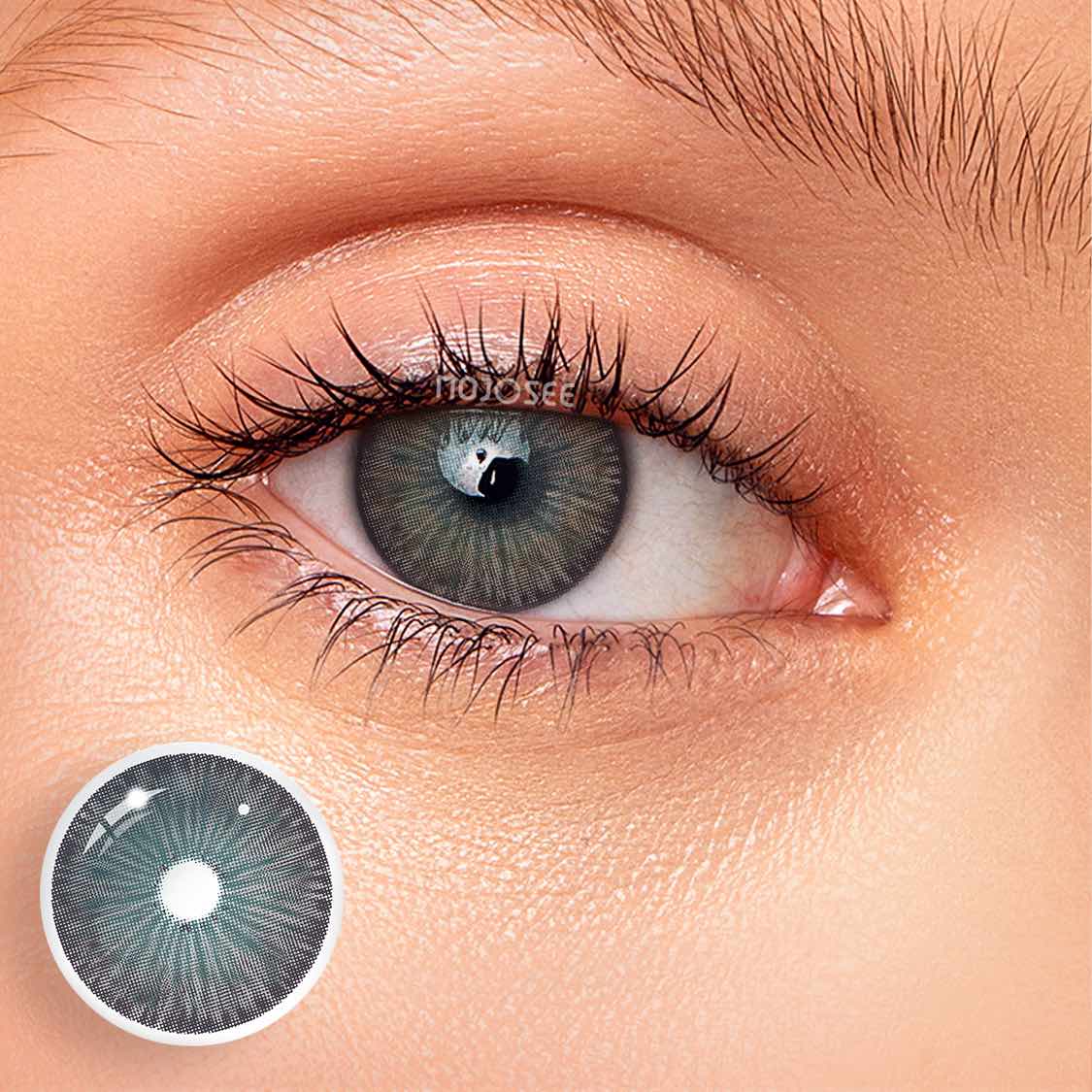
"Can I wear colored contacts if I have astigmatism?" is one of the most-searched lens questions with the least clear answers online. The honest version depends entirely on how much astigmatism you have — for many people it's a non-issue, for others it's a real limit. Here's how to tell which camp you're in and what your options actually are. (This is general info, not a substitute for your eye doctor's measurements.)
What astigmatism is, in one paragraph
A normal cornea is shaped like a basketball; an astigmatic one is shaped more like a rugby ball — curved more in one direction than the other. That uneven curve blurs vision at all distances. Correcting it needs a lens with different powers in different meridians, called a toric lens, marked on a prescription as CYL (cylinder) and AXIS. Standard colored contacts are spherical — one power all around — so they correct near/far-sightedness (SPH) but not the astigmatism itself. The SPH/CYL/AXIS breakdown is in the prescription guide.

Mild astigmatism: spherical lenses often work
If your cylinder is low (roughly under −0.75 CYL), many people wear spherical colored contacts comfortably, accepting a touch of softness — especially for occasional or evening wear where pin-sharp vision matters less than the look. Your brain adapts to minor blur, and for costume, photos or a night out, "slightly soft but great-looking eyes" is a perfectly good trade. Start with a well-made natural lens and see how your eyes handle it.
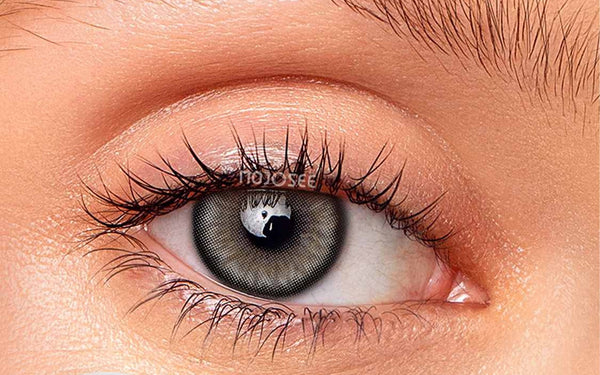
If your number lands in that mild zone, a soft everyday grey is the gentlest way in — barely-there texture, zero drama:

Moderate-plus astigmatism: spherical won't cut it
Above roughly −0.75 to −1.00 CYL, no spherical lens will ever be crisp — the astigmatism is too much for your brain to paper over, and you'll get persistent blur that's the lens's format, not a defect (it's a common cause on the blur checklist). Cranking the SPH power won't fix it; only toric correction will. This is the point where you need one of the real workarounds below rather than forcing a spherical lens.
Your actual options with higher astigmatism
Plano colored lenses over glasses-free short wear: for events where you'll mostly be photographed or socializing, wear the colored lens for the look and accept soft vision briefly. Colored lens for the costume, glasses for the drive: common cosplay approach — lens in for the con floor, glasses when you need to see sharply. Toric colored contacts: they exist but are far less common and outside most costume-lens ranges; a specialty optical route, worth asking your eye doctor about if you want daily colored correction. Clear torics + occasional spherical color: daily clear torics for real life, spherical colored pairs for special occasions.
For a photo-day look worn a few hours, this is the kind of playful shade people reach for.
Fantastic Baby Kitty Pink is the kind of shade that earns a few spherical hours: opaque pink that pops on camera, worn for the shoot rather than the workday.

The safe move
Get your CYL number from a current eye exam before deciding — it's the single figure that determines everything here, and guessing leads to either needless avoidance or frustrating blur. With your number in hand, mild means "try spherical colored lenses," moderate-plus means "colored lens for the look, real correction for daily vision." Either way, the safety rules don't change (the basics).
How to find your number before you decide
Every choice here hinges on one figure most people don't know off-hand: your cylinder (CYL). Here's how to get it and read it. It's on any current glasses or contact prescription, in the CYL column, written as a negative number (e.g. minus 0.50, minus 1.25); if that column is blank or reads 0.00, you effectively don't have astigmatism worth planning around and standard colored lenses will work fine. If you don't have a recent prescription, a basic eye exam gives you the number — and it's worth doing anyway, since guessing leads to either needless avoidance or frustrating blur. Once you have it, the decision is simple: 0.00 to about minus 0.75 gives spherical colored lenses a good chance of working with slight softness, especially for occasional wear; beyond minus 0.75 spherical won't be crisp, so it's toric correction or a look-only approach (lens for photos, glasses for driving). One caveat: astigmatism can change over time, so a number from five years ago isn't reliable — use a current reading. With your CYL in hand, everything else in this guide tells you exactly what to expect.
What we do and do not stock, plainly
We do not sell toric colored contacts. Every design on this site is spherical: the product options are colour and power, and there is no cylinder or axis line anywhere in the catalogue. That is true of most colored-lens ranges, because a toric lens has to be weighted to stop rotating and a printed pattern makes that harder and more expensive to do well. The powered designs run 0.00 to -8.00 in quarter or half steps, with no plus powers. The prescription collection — almost every design in it powered, $19.98 to $34.98 a pair — is the powered range, and it is spherical throughout.
So the honest version of "can I wear colored contacts with astigmatism" is: a spherical colored lens can be worn with mild astigmatism and will give softer-than-glasses vision, and with moderate or higher astigmatism it will not correct you and should be treated as a cosmetic lens for an occasion, not an everyday one.
Reading your prescription for the answer
| Cylinder (CYL) on your prescription | What a spherical colored lens gives you | Sensible use |
|---|---|---|
| None, or a line left blank | Full correction at the listed power | Everyday, in your power |
| Small (commonly under about -0.75) | Usable vision, slightly soft; many people tolerate it | Everyday for some, occasions for others — ask your prescriber about a spherical equivalent |
| Moderate (roughly -1.00 to -1.75) | Noticeably soft, directional blur, eye strain over a day | Occasions only; not for driving |
| Higher | Does not correct you | Cosmetic wear with the understanding that vision is not corrected; clear toric for daily life |
The thresholds are conventions, not rules — how much residual blur a person accepts varies a lot — and the person to set yours is the prescriber who measured you. The American Academy of Ophthalmology makes the general point that any contact lens, coloured or not, should be fitted rather than guessed, and astigmatism is the case where guessing costs you the most.
"Spherical equivalent": what your prescriber means
If you have mild astigmatism and want a spherical lens, your prescriber may write a spherical equivalent — a single power that splits the difference across your cylinder. It does not correct the astigmatism; it centres the blur so that neither direction is badly off. It is a legitimate compromise for an occasional colored lens and it is the number to use in the power selector, not the SPH line copied straight off a glasses prescription. Do not calculate it yourself from a glasses prescription; the vertex distance changes the number, and the prescriber has the tool for it.
How astigmatism blurs a printed lens differently
On a clear spherical lens, astigmatic blur is uniform softness. On a colored lens there is a second effect: the printed iris has a clear window over the pupil, and an astigmatic eye is more sensitive to that window being slightly off-centre, because the eye is already working to resolve two focal planes. The practical consequence is that a colored lens on an astigmatic eye needs to be centred more carefully and re-checked more often than a clear one, and that a 14.5mm lens — which drifts more — is a worse idea for you than for someone with no cylinder. Stay at 14.0mm.
Plano colored contacts with astigmatism
If you wear glasses for astigmatism and want plano colored lenses for an occasion, that works, with one condition: the plano lens goes in and the glasses go on over it. A plano colored lens does nothing to your astigmatism, so glasses are still needed to see, and the two are compatible. What does not work is the reverse — wearing a corrective spherical colored lens and expecting it to replace toric glasses.
Test it before the event, not at it
Whatever your cylinder, wear the pair once at home for a couple of hours before the occasion it was bought for. Read a screen, look across a room, walk a flight of stairs. If the vision is acceptable for an evening, you know; if it is not, you know before you are in costume in a dim venue. The lens is not a fit problem to solve on the night.
Two mistakes that make astigmatism worse in a colored lens
Buying 14.5mm. A larger lens drifts more on every blink, and an astigmatic eye is more sensitive to the clear window moving off the pupil. The costume size is the wrong size for you unless the occasion is short and the vision does not matter. Stay at 14.0mm, where the lens stops at the iris edge and holds still.
Copying the SPH line from glasses. A glasses prescription with a cylinder is not a contact lens power. The vertex distance changes the number, and dropping the cylinder without a spherical equivalent leaves you with the wrong sphere as well as no cylinder. The power in the selector should be the one your prescriber wrote for a contact lens, full stop.
What a colored lens can still do for you
None of this makes colored lenses off-limits. It makes them an occasion lens rather than an everyday one for most people with a meaningful cylinder — worn for the evening, the shoot or the convention, over glasses if the vision matters, and taken out when the occasion ends. Within that frame the whole catalogue is open to you: colour, size and print are chosen the same way as for anyone else, and the only line to ignore is the one that promises correction.
When the blur is a warning, not a limitation
Astigmatism blur is steady, directional and painless, and it is there from the moment the lens goes in. Blur that arrives after hours of wear, that comes with pain or redness, or that stays after the lens is out is a different thing — see the blur guide for the causes, and treat pain as a reason to take the lens out and keep it out.
Shipping to Canada, the UK or Australia?
We ship worldwide with tracked standard delivery, 14–20 days door to door, free over US$49. These country guides cover local delivery times, customs and duties, and the designs that sell best in each market:
- Colored contacts in Canada — delivery windows, duties, and why Canadian shoppers search colour names differently
- Colored contacts in the UK — delivery windows, import VAT, and the designs UK buyers pick most
- Colored contacts in Australia — delivery windows, GST, and the character and effect lenses Australia buys
FAQ
Can you wear colored contacts with astigmatism?
With mild astigmatism (roughly under −0.75 CYL), yes — spherical colored lenses often work with slight softness. With moderate or higher astigmatism, standard colored lenses won't be sharp; you'll need toric correction or a look-only approach.
Do colored contacts come in toric (astigmatism) versions?
They exist but are uncommon and outside most costume-lens ranges. Most colored contacts are spherical only. Ask your eye doctor about specialty toric colored options if you want daily colored correction.
Why are my colored contacts blurry if I have astigmatism?
Spherical lenses don't correct the uneven corneal curve astigmatism causes, so the blur is the lens format, not a fault. Below about −0.75 CYL it's often tolerable; above that, only toric correction sharpens it.
Can I wear plano colored contacts if I have astigmatism and wear glasses?
For short, look-focused wear, yes — many cosplayers wear plano colored lenses for photos and switch to glasses when they need sharp vision. Just don't expect crisp sight from a plano lens if your astigmatism is significant.
Explore more: Blue Contacts → · Green Contacts → · Cosplay Contacts →
Does Mojosee sell toric colored contacts?
No. Every design is spherical, with colour and power as the only options — no cylinder or axis. The powered range runs 0.00 to -8.00; there are no plus powers.
What is a spherical equivalent and should I use it?
A single power your prescriber writes to split the difference across a mild cylinder. It does not correct astigmatism; it centres the blur. Use the number your prescriber gives you in the power selector; do not calculate it yourself from a glasses prescription.
You might also like
Picked to match this guide — every pair in stock now.
 Vika Tricolor Blue Colored Contact Lenses$21.98per pair (2 lenses)
 Polar Lights Blue Gray Prescription Colored $19.98per pair (2 lenses)
 Starry sky Gray Prescription Colored Contact$22.98per pair (2 lenses)
 Polar Lights Brown Prescription Colored Cont$21.98per pair (2 lenses)
Explore more: Colored Contacts for Dark Eyes →