






Do I Need a Prescription for Colored Contacts in the US? (Yes — Here's How It Actually Works)
Yes — in the United States you need a valid prescription for colored contacts, including purely cosmetic ones with no corrective power. This surprises people every October, when someone realizes their Halloween lenses require the same paperwork as vision correction. Here's the actual rule, why it exists, and what it means for how you buy.
The rule in one paragraph
The FDA regulates all contact lenses as medical devices — corrective and plano (0.00) alike. Under the Fairness to Contact Lens Consumers Act, a seller may only dispense lenses against a valid prescription from a licensed eye care professional, and that prescription has to specify power, base curve, diameter and brand. There is no cosmetic exemption. A costume lens sold without any of this is being sold illegally, whatever the packaging says.

Your prescription is also not the same document as your glasses prescription — contacts sit on the eye, so the fitting includes measurements glasses never need (why that matters at strong powers is covered in the high-prescription guide).

Why the rule exists (it isn't bureaucracy)
The requirement is about fit, not vision. Eyes vary in curvature and diameter, and a lens that's too flat or too steep does specific damage: it moves against the cornea, restricts oxygen, or seals down too tightly. None of that depends on whether the lens corrects your sight, which is exactly why plano cosmetic lenses are regulated identically.
The documented harm from unregulated costume lenses is real — corneal abrasions, infections, and in the worst cases permanent scarring, usually from gas-station or novelty-shop lenses sold in one universal size. A prescription is the mechanism that puts a professional between you and a badly fitting lens. Our safety guide goes deeper into materials and what "FDA-cleared" actually covers.
What a seller skipping verification is telling you
Treat prescription verification as a quality signal, not an inconvenience. A store that doesn't ask has already told you something about the rest of its operation — sourcing, storage, packaging integrity. The two failure modes look different but come from the same place:
- "No prescription needed!" — explicitly non-compliant. Whatever else is true about that lens, nobody verified it fits you.
- Silent checkout — no mention of a prescription anywhere in the flow. Same outcome, quieter.
Compliant sellers make this visible: they collect your prescription details or your eye doctor's information, and they hold the order until it verifies.

How ordering actually works
- Get a contact lens exam (not just a vision test) from an optometrist. They measure curvature and diameter and confirm your eyes tolerate lenses.
- Get the written prescription. U.S. law entitles you to a copy — you don't have to buy lenses from the person who fit you.
- Match the parameters when you order. Power, base curve and diameter appear on every product page; ours are listed in the specifications block.
- Expect verification. The order goes through after your details check out. Prescriptions expire, usually in one to two years — an expired one needs renewing before it can be used.
A practical note for cosplay and Halloween: build the exam into your timeline. If your prescription has lapsed and the event is a week away, that is a scramble you can avoid by booking now — and it's the single most common reason people end up tempted by a non-compliant seller.
What to buy once you're set up
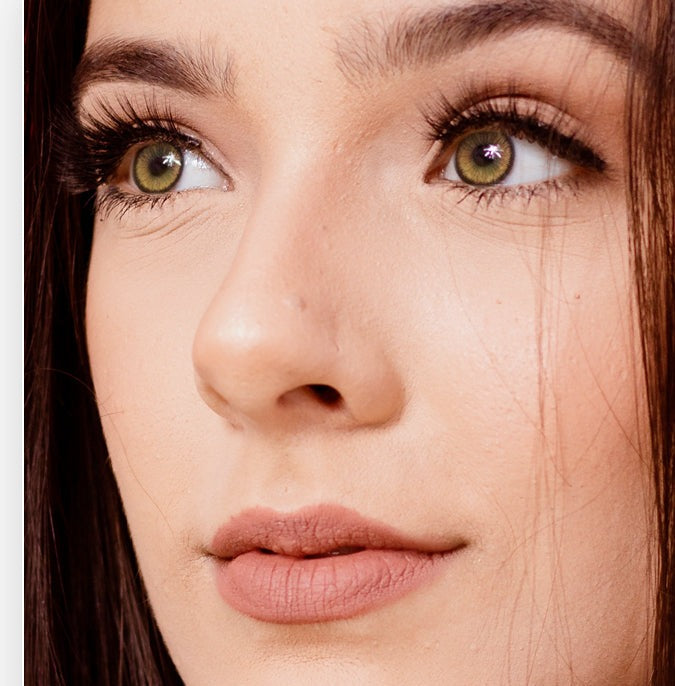
With plano, the same rules apply and the choice becomes purely aesthetic. The safest first purchase is a lens whose effect doesn't depend on perfect conditions — a soft three-tone that reads well in office light, daylight and flash alike:

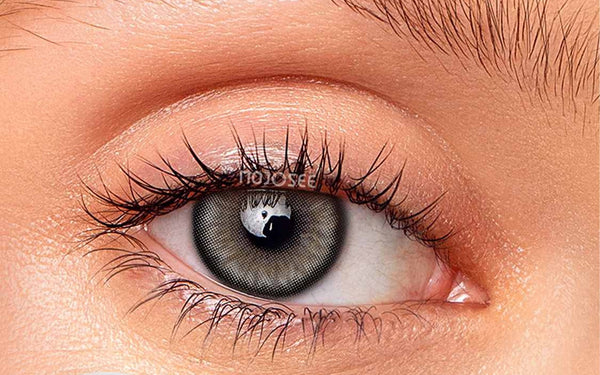
If you'd rather the change be visible rather than invisible, a multi-tone gray is the other reliable direction. It shifts the eye further than hazel does while staying inside the range people read as genetic, and — the part that matters for a first purchase — it behaves predictably across lighting. Single-tone grays go flat and slightly glassy under office fluorescents, which is where most of a working week happens; a three-tone print keeps its depth because there is always a darker tone catching shadow and a lighter one catching light, whatever the source. Under a phone flash it reads silver rather than white:

And for anyone whose goal is "a brighter version of my own eyes" rather than a new color at all, brown-on-brown is the quietest lens in the catalog and the one people keep reordering after they have cycled through the louder shades. The print is a cleaner, more even, very slightly lighter version of a natural brown iris, so the eye looks rested and awake without any part of the effect being attributable to a lens. It is also the most forgiving choice while you are still learning insertion — on the mornings when it goes in crooked and you have to try twice, nothing about the result telegraphs what you were doing:

What the rule actually says, from the sources
Two federal bodies set the frame. The FDA classifies every contact lens — corrective or purely cosmetic — as a medical device, and its guidance on decorative lenses states that any lens sold without a prescription is being sold illegally, and lists the sellers it considers unsafe: costume shops, beauty supply stores, street vendors and websites that do not ask. The FTC's Contact Lens Rule, explained on the FTC consumer site, is the buyer's side of the same rule: after a fitting your prescriber must hand you a copy of the prescription without being asked, and you may fill it with any seller you choose.
Put together, those two documents are the entire legal basis for buying colored lenses online in the United States. A seller that asks for your prescription is operating inside them. A seller that does not is outside both.
Plano 0.00 is not an exemption
This is the point that surprises most first-time buyers. A plano lens corrects nothing, so it feels like a cosmetic — like a false eyelash. Legally it is not. The prescription requirement exists because a lens has to fit the curve and diameter of your cornea, and a mismatch restricts oxygen or abrades the surface regardless of whether the lens has any power in it. The fitting measures your eye; the power is a separate line on the same document. A plano prescription is a real prescription with the power set to zero, and it is what you need to order a 0.00 costume lens the legal way.
In practice: if you have never been fitted, book a contact lens exam and ask for a prescription that covers plano cosmetic lenses. If you already wear corrective lenses, the same prescription covers plano as long as it is in date.
How many of our designs carry powers
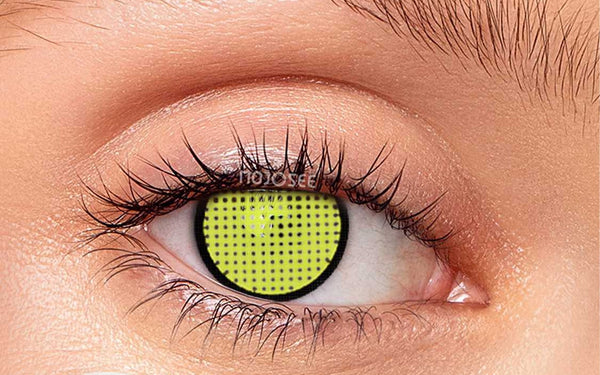
Across the catalogue, roughly one design in six carries corrective powers at the time of writing — mostly from 0.00 to -8.00 in quarter or half steps, with no plus powers and no toric lenses. The rest are plano only. Coverage is not even: the men's prescription collection is nearly all powered designs, natural browns have the most corrective options of any colour, and the costume families thin out fast — mesh and 22mm sclera are plano only because the print covers the pupil zone or the whole eye.
The power selector on each product page is generated from stock, so it is the authority for that design: if a selector is there, those powers exist; if it is not, they do not. Do not assume a design carries powers because a similar one does.
What a prescription contains, and what we check
| Line on the prescription | What it is | Why it matters for a colored lens |
|---|---|---|
| Power (SPH) | The corrective strength, 0.00 for plano | Must match the selector on the product page; a colored lens does not change your power |
| Base curve (BC) | The curve of the lens back surface | Fit. The wrong curve is tight or loose regardless of colour |
| Diameter (DIA) | Lens width | A 14.5mm costume lens on an eye fitted for 14.0mm sits differently; check the product size line |
| Brand / material | What was fitted | A different brand is legal to buy but the fit is your prescriber's call; ask if unsure |
| Expiry | Usually one to two years | An expired prescription cannot be filled; renewal is a short exam |
We do not print a base curve or material figure for you to match against on this page, because the values on product pages are being re-verified against supplier documentation. Fit to your prescriber's measurements and the size stated on the product page, and ask your prescriber if a specific parameter matters to your eye.
How verification actually works when you order
The Contact Lens Rule sets out a specific process, and it is worth knowing what it looks like from the buyer's side so that a seller doing it properly does not read as an obstacle.
- You give the seller your prescription — a copy, a photo, or the prescriber's details so it can be requested.
- If you only supplied the prescriber's details, the seller contacts the prescriber to confirm. The prescriber has eight business hours to respond; if they do not, the rule treats the prescription as verified and the order can ship.
- The seller checks the parameters — power, size, expiry — against what you ordered. A mismatch is a query to you, not a substitution.
- Then it ships. The delay this adds is normally a day, and it is the day that keeps a lens fitted for someone else off your eye.
A seller that skips step one entirely is not "easier". It is declining to do the one check that makes the rest of the process protective.
Prescriptions for plano and for costume lenses: two common questions
"My prescription is for clear lenses — does it cover colored ones?" Yes, if the power, base curve and diameter match what you are ordering. A colored lens is a soft contact lens with a print; the print does not change the fitting parameters. The one thing to check is the diameter line, because costume lenses run 14.5mm and a prescription written for 14.0mm lenses is a different fit.
"I only want them for one night — do I really need a fitting?" Legally yes, and practically the one-night wearer is the person the fitting protects most, because they have no experience to fall back on when something feels wrong. A contact lens exam is short, the prescription lasts a year or two, and it covers every costume between now and then.
Buying from outside the US
The FDA and FTC rules govern sales into the United States. Other countries have their own frameworks — the UK and Australia also treat contact lenses as regulated devices, Canada regulates them provincially — and in every case the same practical advice holds: get fitted, keep a copy of your prescription, and buy from a seller that asks for it. A seller that ships lenses to any address with no questions asked is not doing you a favour; it is telling you how it treats fit.
FAQ
Do I need a prescription for colored contacts with no power?
Yes. In the U.S., plano (0.00) cosmetic lenses are regulated as medical devices exactly like corrective ones, and require a valid prescription from a licensed eye care professional.
Is it illegal to sell colored contacts without a prescription in the US?
Yes — dispensing contact lenses without verifying a valid prescription violates federal rules. If a seller advertises "no prescription required," that's a compliance red flag about the whole operation.
Can I use my glasses prescription for contacts?
No. A contact lens prescription includes base curve and diameter from a fitting, and the power itself can differ because contacts sit on the eye rather than in front of it.
How long is a contact lens prescription valid?
Typically one to two years depending on your state and your eye care professional's judgment. An expired prescription can't be used to order, so check the date before a time-sensitive purchase.
What about ordering colored contacts from outside the US?
The rule follows the sale into the U.S. — a compliant seller shipping to a U.S. address still verifies your prescription. Sellers who skip it because they're overseas are not offering you a loophole, just an unverified lens.
Explore more: Hazel contacts · Gray contacts · First-timer insertion guide
Do I need a prescription for plano 0.00 colored contacts in the US?
Yes. Every contact lens is a regulated medical device regardless of power, and a plano lens still has to fit your cornea. A plano prescription is a normal prescription with the power set to zero.
How many colored contacts come with prescription powers?
Roughly one design in six on this site at the time of writing, mostly from 0.00 to -8.00. The men's prescription collection is nearly all powered designs; mesh and 22mm sclera are plano only. The power selector on each product page is the authority.
Can a seller legally ship colored contacts without asking for a prescription?
Not into the US. The FDA states that lenses sold without a prescription are being sold illegally, and the FTC Contact Lens Rule requires sellers to verify. A site that never asks is operating outside both.
You might also like
Picked to match this guide — every pair in stock now.
 Vika Tricolor Blue Colored Contact Lenses$21.98per pair (2 lenses)
 Polar Lights Blue Gray Prescription Colored $19.98per pair (2 lenses)
 Starry sky Gray Prescription Colored Contact$22.98per pair (2 lenses)
 Polar Lights Brown Prescription Colored Cont$21.98per pair (2 lenses)
Explore more: Colored Contacts for Dark Eyes →