








14.0mm vs 14.2mm vs 14.5mm Colored Contacts: Which Diameter Should You Buy?
Half a millimeter changes everything. How 14.0, 14.2 and 14.5mm actually look on real eyes, which size fits your face, and the one rule when you're stuck between two.

Diameter is the spec most people ignore when buying colored contacts — and the single biggest reason a lens looks "off" on the face. The difference between 14.0mm and 14.5mm is half a millimeter on paper and an entirely different vibe in the mirror. Here's how to choose.
What DIA actually means
DIA (diameter) is the width of the whole lens in millimeters. For reference, the average adult iris is about 11.5–12mm across — every colored contact is larger than your iris, because the lens needs to cover it plus stay stable under your eyelids. What changes between sizes is how much bigger than your iris the printed area looks.
The three sizes, honestly compared
- 14.0mm — the natural zone. Enlarges the iris just enough to brighten the eye without anyone being able to say why. The safe pick for office wear, for men, and for anyone whose goal is "born with it." Browse 14.0mm grays to see the effect.
- 14.2mm — the sweet spot. Noticeably bigger, still believable. This is the default size for most of our best-sellers: enough enlargement to read on camera, not enough to tip into doll territory.
- 14.5mm — the statement zone. Visibly enlarged, anime-adjacent, made for looks where the eyes are the point: cosplay, stage, editorial shoots. Pairs with lashes and liner; fights with a no-makeup face. See 14.5mm costume styles.
How to choose for your face
- Smaller or deep-set eyes: stay at 14.0–14.2mm. Oversized prints on small eyes create the "floating disc" effect — the #3 reason lenses read fake (full list in why colored contacts look fake).
- Larger or prominent eyes: you can wear the whole range; 14.5mm will still look intentional rather than cartoonish.
- Natural color change only: prioritize 14.0mm — the color does the work, not the size.
- Cosplay: match the character. Big-eyed anime designs want 14.5mm; realistic characters sit better at 14.2mm — the cosplay lens guide breaks this down by design type.
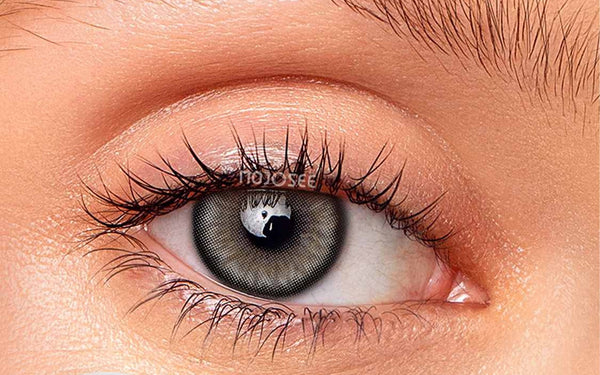
DNA Taylor Blue Gray sits at the realistic end of that split — a 14.2 mm design meant to read as an eye rather than as an anime frame.

One honest caveat about sizing
Printed diameter isn't the whole story: how a lens wears also depends on its base curve and how much of the print is opaque. Two 14.2mm lenses can look different sizes if one has a dense dark rim and the other fades at the edge. That's why every product page lists the diameter in the specifications — and why our collection pages let you filter by diameter directly.
Practical notes before you order
Diameter doesn't change the prescription rules: plano (0.00) and corrective powers both need proper care, replacement on schedule, and a fitting from an eye care professional if you're new to lenses. If you're between two sizes, buy the smaller one — an under-sized effect is subtle; an over-sized one is unmissable. Free US shipping over $49.
How to find a lens's real diameter before buying
Marketing diameters lie, so here's how to read the number that matters. Every legitimate product lists a DIA in its specifications — that's the physical lens size, and it's what your eye actually feels and what determines the enlargement look. Watch for the gap between DIA and "effect": many lenses advertised as a big dramatic size are physically 14.2–14.5mm with the color pattern printed to the very edge, so the effect is larger than the lens — good news, because you get the look with standard comfort. Your natural starting reference: most human corneas are about 11–12mm, and a natural-looking lens sits around 14.0–14.2mm, leaving visible white on both sides. Above 14.5mm you're into deliberate enlargement; 15mm+ is full costume territory. The single most useful habit: ignore the headline size in the product name and scroll to the DIA in the specs, then compare it to 14.2mm as your "natural" anchor. If a listing doesn't state DIA at all, that's a sourcing red flag, not just a missing detail — see the quality guide.
14.2 vs 14.5: the next size up
The same logic extends one step: 14.2mm is the "enhanced natural" ceiling, 14.5mm is where deliberate enlargement begins. On an average iris (11.5–12mm), a 14.2 lens brightens and defines without changing your proportions; a 14.5 adds a visible ring of extra iris that reads doll-like on camera — the standard choice for Douyin-style and cosplay looks, and the point where people start noticing the lens itself. If your eyes run small or hooded, 14.5 can overwhelm them; if you want the enlarging effect on camera, it is exactly the tool. Between the two, choose by intent: 14.2 to look naturally striking in person, 14.5 to look wide-eyed in photos.
What is actually in each size, right now
Diameter is the one spec you can filter the whole catalogue by, so here is the catalogue by diameter — live at the time of writing. "Share with powers" is the proportion of designs at that size that carry corrective powers; prices are per pair, one order is two lenses.
| Size | What it is | In stock | Price per pair | Share with powers | Reads as |
|---|---|---|---|---|---|
| 14.0mm | Natural iris size | 99% | $8.88 – $34.98 | 18% | your eyes, better lit |
| 14.2mm | Fractional lift | 97% | $18.98 – $34.98 | 12% | rested, brighter |
| 14.5mm | Visible enlargement | 95% | $9.90 – $34.98 | 22% | anime, costume, photos |
| 22.0mm | Full sclera | 70% | $72.98 – $120.00 | 0% | the whole eye changes |
Two things the table says that the marketing photos do not. First, the catalogue is weighted toward 14.5mm by a wide margin — that is where cosplay demand is — so if you want a natural size you have to filter for it rather than browse. Second, corrective powers are concentrated at 14.5mm in absolute terms but spread across all three standard sizes as a share; the natural sizes are not a plano-only ghetto. The 22mm range is plano only, because a sclera print covers the whole eye.
Diameter and your prescription
The DIA line on a contact lens prescription is not a suggestion. It is the size your prescriber measured your eye for, and it interacts with the base curve to set how the lens sits. A 14.5mm lens on an eye fitted for 14.0mm has more material than the lids can hold in place, so it rides up on each blink and settles off-centre — which on a printed lens means the clear window drifts off the pupil and vision goes soft. A 14.0mm lens on an eye fitted for 14.5mm sits tighter and can restrict oxygen. Neither is dangerous for an evening; both are wrong for every day.
The practical rule: buy the size on your prescription for everyday wear, and treat a step up to 14.5mm as an occasion size with a shorter wear session. If you have never been fitted, the size question is one of the reasons to be — a plano costume lens still has to fit.
Reading a size line before you buy
Every product page here states the diameter, and the same design often exists at two sizes with the same name and the same photograph — which is where most size mistakes come from. Check the size line before the colour, and if the listing shows a flat lens shot only, remember that a flat photo cannot show enlargement at all; only the on-eye photograph on a dark iris tells you how the size reads. Where a page shows both, the on-eye image is the one to judge from.
One line we do not ask you to match against: material and moisture figures on product pages are being re-verified against supplier documentation, and until that is done your prescriber's measurements are the fitting authority, not a spec line on a web page.
Why 0.5mm looks like a lot more than 0.5mm
A half-millimetre sounds like nothing until you remember what it is applied to. The visible iris is about 11 to 12mm across; a lens that sits 14.0mm covers it to the edge, and a lens at 14.5mm extends a quarter-millimetre past the edge all the way round — which, on an iris that size, is a visible increase in the area of colour that your brain reads instantly as "bigger eye". The effect scales with the eye opening: on a smaller palpebral aperture the same 14.5mm lens shows less white and reads more dramatic; on a larger opening it reads as a mild lift. That is why two people wearing the identical lens can report opposite experiences, and why the number on the box is a starting point rather than a verdict.
Diameter across the rest of the market
Most standard colored lenses from the big clear-lens brands sit at 14.0 to 14.2mm and never go larger, because their customers are light-eyed and want blending. The circle-lens and cosplay market runs 14.5mm and up, with "enlarging" as the selling point, and sclera lenses at 22mm are a category of their own. A catalogue built for dark eyes has to carry all three, which is why this one does — and why you should filter by size before colour, because browsing a 14.5mm-heavy catalogue for a natural lens is how people end up with an enlargement they did not want.
Size by occasion, in one table
| Occasion | Size | Why |
|---|---|---|
| Work, daylight, no makeup | 14.0mm | No enlargement; the only thing that changes is colour |
| Photos, weddings, a made-up face | 14.2mm | A lift the camera sees and a colleague does not |
| Anime cosplay, doll looks | 14.5mm | The enlargement is the point |
| Men, first pair | 14.0mm | Enlargement reads as a doll's eye on a bare male face fastest of all |
| Full-creature costume, close-up camera | 22.0mm | Whole-eye coverage; a different insertion technique and a short wear window |
FAQ
Is 14.5mm too big for daily wear?
For most faces, yes — it reads as styled rather than natural, which is exactly what it's designed for. Daily-wear looks usually sit best at 14.0–14.2mm.
Does a bigger diameter feel different in the eye?
Comfort depends more on material, moisture specification and base curve than on printed diameter. Any new size needs a short adaptation period; follow your eye care professional's fitting guidance.
What diameter makes eyes look bigger but still natural?
14.2mm with a defined but soft limbal ring is the classic "bigger but believable" formula — enlargement plus a natural edge.
How do I know which sizes a lens comes in?
Check the DIA line in the specifications on each product page, or use the Diameter filter on any collection page to shop by size directly.
What is the most natural contact lens diameter?
14.0–14.2mm — enough coverage to change your color completely while leaving visible white on both sides, which is what keeps eyes looking real. Above 14.5mm you're into deliberate enlargement; 15mm+ is costume territory.
What does DIA mean on colored contacts?
DIA is the physical lens diameter in millimeters, listed in the specs — the number your eye actually feels and the one that determines the enlargement look. Ignore the dramatic size in a product's name and check the DIA against 14.2mm as your natural anchor.
Which contact lens diameter has the most designs?
14.5mm by a wide margin — roughly two-thirds of the catalogue at the time of writing, because that is where cosplay demand sits. The natural sizes, 14.0 and 14.2mm, have to be filtered for rather than browsed.
Can I get 14.0mm colored contacts with a prescription?
Yes — a meaningful share of designs at every standard size carry corrective powers, from 0.00 to -8.00. Only the 22mm sclera range is plano only. The power selector on each product page is the authority for that design.
What happens if I wear a bigger diameter than my prescription?
The lens has more material than your lids can hold in place, so it drifts on each blink and the clear window moves off the pupil — soft vision that comes and goes. Fine for an evening; wrong for every day. Buy the size on your prescription for daily wear.
You might also like
Picked to match this guide — every pair in stock now.
 Vika Tricolor Blue Colored Contact Lenses$21.98per pair (2 lenses)
  Polar Lights Blue Gray Prescription Colored $19.98per pair (2 lenses)
  Starry sky Gray Prescription Colored Contact$22.98per pair (2 lenses)
  Polar Lights Brown Prescription Colored Cont$21.98per pair (2 lenses)
Explore more: Colored Contacts for Dark Eyes →