








Natural Colored Contacts That Don't Look Like Contacts: The 2026 Edit
What actually gives colored contacts away is the edge, not the color — the four tells, a two-minute mirror test, and the 2026 natural shortlist for dark brown eyes.
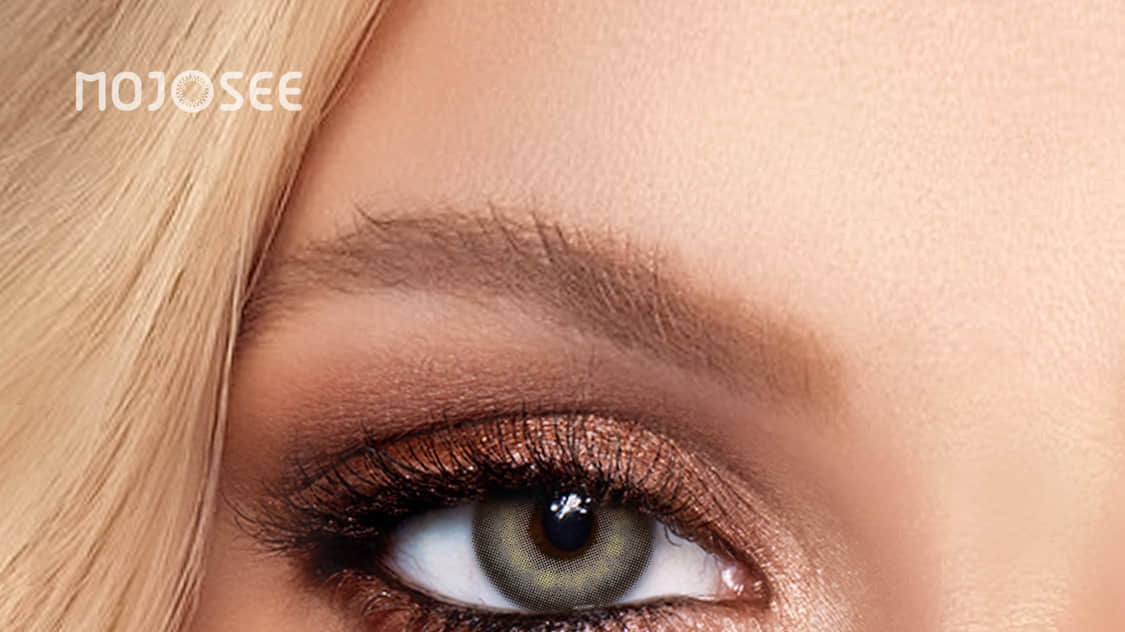
The most natural colored contacts are built to one specific recipe: 14.0–14.2 mm across, at least three tones instead of one flat color, and a soft feathered outer edge instead of a hard black ring. The shade matters far less than people think. In almost every "wait, are you wearing contacts?" moment, what actually registered was the edge — a too-perfect dark circle sitting a millimeter proud of the iris. Get the construction right and a dark brown eye can move to hazel, gray or olive without anyone being able to name what changed.
What actually gives a lens away
Four things, roughly in the order people notice them.

The hard limbal ring. A thick black outer band is the single loudest tell. Real irises do have a limbal ring, but it is diffuse, uneven, and often broken — it fades where the light hits. A printed ring is uniform all the way around, and the eye clocks that symmetry as artificial long before it works out why. Feathered edges solve this; solid rings never do, no matter how nice the color inside them is.
Flat, single-tone pigment. Look closely at any real iris and you will find at least three things happening: a darker rim, a mid-tone body, and warmer fibers radiating out from the pupil. A one-color lens flattens all of that into a sticker. Three-tone printing is not a marketing flourish — it is what survives being looked at from a foot away.
A diameter your iris cannot carry. Anything past about 14.5 mm starts reading as doll-eye, because the colored area no longer lines up with where an iris is supposed to end. If a listing does not publish its diameter, that silence is information. Our diameter guide has the full sizing breakdown.
A color at war with your undertone. An icy blue over a deep warm brown does not look like blue eyes; it looks like blue lenses, because nothing else on the face agrees with it. This is the tell people struggle to articulate — they can see the mismatch without locating it.

The soft-focus category is where this is easiest to see done well — a dense dot matrix that blurs iris texture the way a diffusion filter blurs skin, with no ring to give the game away. Rich Girl Brown is the clearest example on our shelf: on brown eyes it lands as a lightened version of your own color with the contrast gently raised.

The two-minute mirror test
Before you decide a pair passes, check it the way a stranger would — not at four inches from your bathroom mirror, which is closer than anyone will ever stand.
Arm's length, by a window. Daylight is unforgiving in a way bathroom bulbs are not. If the edge reads as a distinct line at arm's length in daylight, it will read that way across a table.
Look hard left, then hard right. This is the test most people skip. A lens sits on the tear film, not glued to the iris, so at the extremes of your gaze it lags very slightly behind — and a misaligned colored ring is instantly visible. Smaller diameters and softer edges lose far less here.
Take a photo with flash. Flash flattens the iris and exaggerates the print pattern. If a lens survives a flash photo, it survives a night out.
Ask one honest person. Not "do you like these" — ask "does anything look different about me?" If the answer is "you look well-rested", you have found your pair. If it is "you're wearing contacts", you have your answer too.
Match the lens to your undertone, not to a color you like
The color that looks best in the product photo is rarely the color that looks best on you, and the deciding factor is undertone rather than preference. Warm-toned eyes and skin — golden, olive, deep brown — accept warm lenses almost invisibly, because the lens is only doing what better lighting would do. That is why honey and hazel shades are the lowest-risk first pair for dark brown eyes.

Cool shades are the harder brief, and most gray lenses fail it by drifting blue or going flat silver against warm skin. An olive-leaning gray behaves differently: it stays cool without fighting the warmth underneath it, which is why it tends to flatter deep skin tones that pure grays clash with. If you want people to notice your eyes before they notice your lenses, this is the family to look at.


One caveat worth stating plainly: on very dark irises, a lens that is too sheer will not fail subtly — it will disappear into mud. Natural does not mean thin. It means an opaque base layer under a translucent finish, which is a different piece of engineering entirely, and we broke it down in why colored contacts disappear on dark eyes.
The 2026 shortlist, by what you want it to solve
If you want ten percent rather than fifty — a tint over your own color rather than a replacement — the sheer-veil route is the one. The pigment is laid down like a wash, so your iris stays visible underneath; in daylight it is close to a secret, and indoors it reads as an unusually clear eye. This is the pick for anyone who wants to wear lenses to work without a conversation about it.
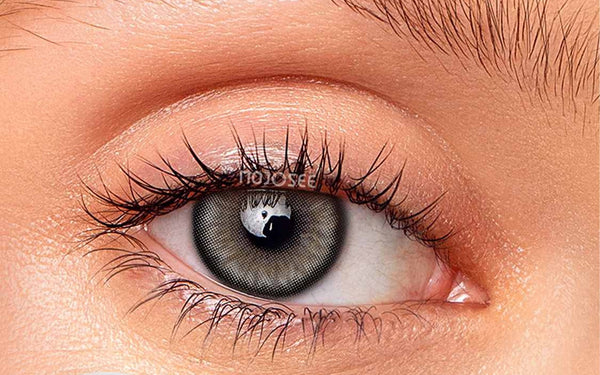
Polar Lights Gray is the sheer-veil pick in our range — the pigment is laid on like a wash rather than a replacement, which is why it survives fluorescent office light.


If you would rather test a color than commit to it, a daily-disposable pair costs less to be wrong about — there is a daily green that works well for exactly that. And if you want visible color that still passes, a denim-toned blue behaves far better on brown eyes than an ice blue does, because it keeps some warmth in the mix rather than sitting on top of your iris.

Whichever end you pick, all of these use FDA-cleared materials, come as a pair (2 lenses) in plano and prescription powers, and new 2026 shades keep landing on the new-arrivals rack. If this is your first pair full stop, the first-time playbook covers insertion, wear time and the care kit.
FAQ
What makes colored contacts look fake?
A hard, uniform black outer ring, a single flat color with no gradient, and a diameter over roughly 14.5 mm. Any one of the three is enough to be noticed; together they are unmistakable.
What are the most natural colored contacts for dark brown eyes?
Three-tone lenses around 14.0–14.2 mm with a feathered edge and an opaque base. Warm browns and hazels are the lowest-risk starting point; an olive-toned gray is the most flattering cool option.
Can people tell you are wearing colored contacts up close?
At conversation distance, usually not, if the edge is feathered and the diameter is close to your own iris. At four inches, most lenses are detectable — but nobody stands there.
Do natural colored contacts show up on very dark eyes?
Yes, provided the base layer is opaque. Sheer tints designed for light eyes vanish on deep brown irises; the low-opacity finish has to sit on top of a pigmented base to lift a dark eye at all.
What diameter looks most natural?
14.0–14.2 mm for most adult eyes. It is close enough to a real iris that the colored area ends where an iris should, which is the whole reason the effect holds up.
You might also like
Picked to match this guide — every pair in stock now.
 Vika Tricolor Blue Colored Contact Lenses$21.98per pair (2 lenses)
 Polar Lights Blue Gray Prescription Colored $19.98per pair (2 lenses)
 Starry sky Gray Prescription Colored Contact$22.98per pair (2 lenses)
 Polar Lights Brown Prescription Colored Cont$21.98per pair (2 lenses)
Explore more: Natural Colors → · Natural Contacts →