








Why Blue Contacts Look Fake on Brown Eyes — and What to Wear Instead
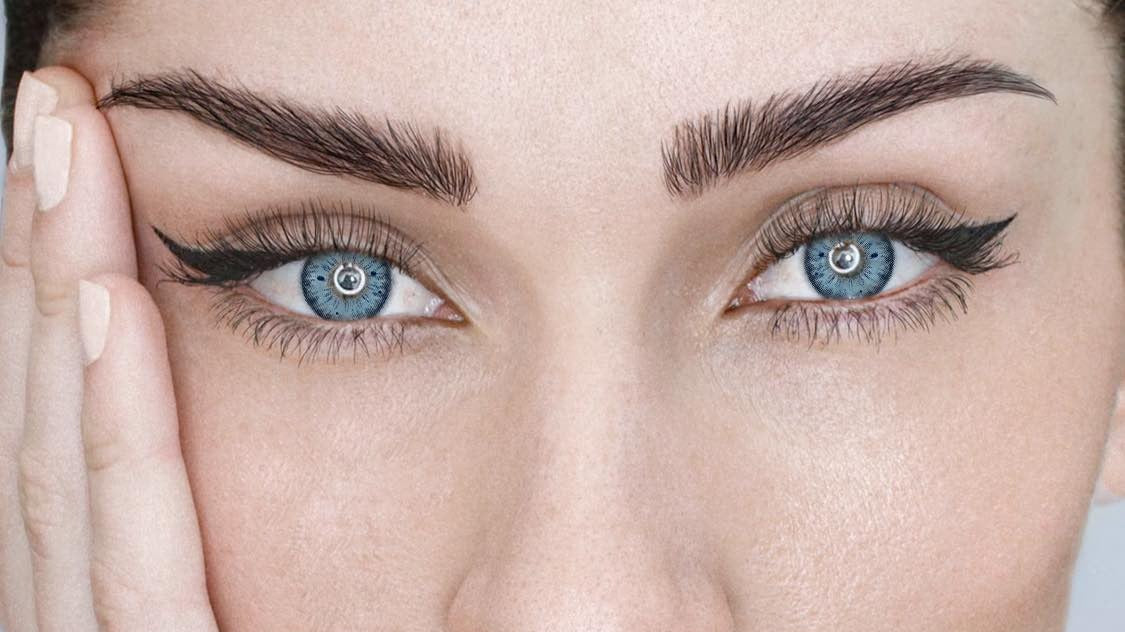
Honest answer: blue contacts can look fake on brown eyes — and when they do, it's for one of three fixable reasons, none of which is "blue doesn't suit me." Blue is simply the least forgiving color to wear over a dark iris, because there's no blue pigment in a brown eye for the lens to borrow. Here's where it goes wrong and how to buy around it.
Reason 1: sheer blue over a dark base
Most cheap blue lenses are enhancement tints made for already-light eyes. Over dark brown, the translucent print mixes with your melanin and lands on a murky gray-teal that matches nothing on your face — the classic "off" look people can't quite name. The fix is non-negotiable: only opaque blues display true blue on brown eyes (the mechanics are in our dark brown eyes explainer).

Reason 2: single-tone printing
A real light iris is never one flat color — it has radial fibers, a darker rim, a brighter core. A lens printed in one uniform blue has none of that, so under daylight it reads as a sticker. This is the #1 failure across all colors, but blue exposes it hardest because the contrast against dark skin tones is maximal. What to look for instead: two or three visible tones and a defined limbal ring.

Reason 3: wrong blue for the goal
There are two legitimate ways to wear blue on brown eyes, and mixing up their rules is what creates the uncanny middle zone:
- The natural route — blue-gray, not blue. Nobody's born with cornflower eyes and deep-brown lashes; everyone accepts stormy gray-blue. A muted blue-gray three-tone in 14.0–14.2mm passes conversation distance easily.
- The statement route — own it. Vivid sapphire with graphic edges is beautiful as a look — for shoots, events, cosplay. It photographs incredibly; it just doesn't pretend to be genetic. The mistake is wearing a statement blue and expecting natural reactions.
The uncanny zone is in between: a semi-vivid blue that's too loud to be real and too timid to be a look. Pick a side.

If you want the natural side
Muted, stormy, believable — the blue that reads as "light-eyed" rather than "wearing blue":

Or go a step cooler and grayer. This is the direction longtime FreshLook Sterling wearers usually take: blue in name and undertone, gray in behavior. It reads as stormy rather than tropical, keeps its depth under fluorescent office light where brighter blues wash out, and — because the blue lives in the undertone instead of the surface — it never produces that floating-disc contrast against dark lashes and brows. If the polar pick above is "light-eyed neighbor," this one is "gray eyes that turn blue by a window":

If you want the statement side
Then stop hedging and go saturated. A graphic, high-contrast blue with a bold dark rim photographs like nothing else against brown eyes and deep skin tones — the exact contrast that ruins "natural" attempts is what makes statement blue spectacular. Wear it to the things that get photographed: shoots, parties, cons. It will never pass as genetic, and that was never the assignment:

Quick self-check before you buy any blue
Whichever side you chose above, run the listing through this thirty-second audit — it filters out the lenses that created blue's bad reputation in the first place:
- Macro shot shows radial texture? (flat = sticker)
- Before/after photographed on a dark-eyed model?
- 14.0–14.2mm if you're going natural (see the diameter guide for why size is half the realism)
- Your undertone: golden/warm skin pairs better with blue-gray; cool skin can carry brighter blues
The photo test that settles it
Still unsure which side you're on? Take two selfies on day one — no filter, one by a window, one indoors at night. If you catch yourself enjoying how unmistakable the blue is, you're a statement wearer; buy the vivid one and stop trying to pass it as natural. If you keep zooming in to check whether it's detectable, you're a natural wearer; return to the blue-grays and never look back. Both are correct answers — the only wrong lens is the one bought for the other goal.
The blue range for dark eyes, by the numbers
Live figures at the time of writing for the blue-for-dark-eyes collection, which is curated for print density rather than shade. Prices per pair; one order is two lenses.
| In stock | 96% of the range |
| Price per pair | $12.88 – $88.98 (the top of the band is 22mm sclera) |
| Sizes | 14.0mm, 14.2mm, 14.5mm, 22.0mm |
| Share with corrective powers | about 16% |
| Against gray | a similar number of designs, but gray reads cleaner on dark brown because it has no warmth to fight |
Blue versus gray-blue versus gray: the honest ladder
If the goal is "my eyes look lighter and nobody can say why", the answer on a dark iris is usually not blue at all. A true blue has to be dense to read, and a dense true blue on a bare face is a statement. A gray-blue keeps the coolness and drops the saturation, so it reads as a light eye rather than a coloured one — the most natural blue result available on dark brown. A gray goes one step further: no warmth in the print to fight your own, so even a moderately opaque gray reads as a clean colour change. Most people who ask why their blue looks fake wanted a gray-blue; most people who wanted "blue eyes" and got them looked at the on-eye photo first.
Two blues that do not look fake, and one gray


All three are in-stock 14.0–14.2mm designs at the time of writing. The gray is there because it is the honest alternative for anyone whose real brief was "lighter", not "blue".
Reading a blue lens off the product photo
Three checks. The pupil edge: a translucent blue over a dark iris shows your own brown as a muddy halo around the pupil; a dense print holds its colour to the clear window. The outer ring: a defined limbal ring separates the blue from your iris so they do not blend into grey. The base the photo was shot on: a blue photographed on a hazel eye is not evidence — judge from an on-eye photo on a dark iris where the page shows one, and treat a flat lens shot as an upper bound.
Blue on dark skin, and why the advice runs backwards
The usual warning — "blue looks fake on brown eyes" — is aimed at people trying to blend, and it is wrong for a lot of dark-skinned wearers who are not trying to blend at all. On deep skin, a dense true blue at 14.0mm is a striking, deliberate look that reads as styled rather than as a mistake, precisely because there is no pretence of naturalness. The rule that still holds is print density: a translucent blue on a dark iris turns to grey mud on any skin tone. The rule that changes is colour distance — on deep skin a bold blue can be the point. Decide which brief you are buying for, and let the on-eye photo on a dark iris settle whether the print is dense enough.
Why blue goes grey indoors
Blue prints are cool-toned and most indoor lighting is warm-ish and dim, so a blue that read clearly in daylight loses saturation under a lamp and reads as a cool gray. That is not the lens failing; it is what blue does. If you want the colour to survive a restaurant, choose a more saturated blue than looks right in the daylight photo — or accept that it will read gray-blue in the evening, which for most faces is the more flattering result anyway.
Size makes blue look fake faster than colour does
A 14.5mm blue on a bare face is enlarged and blue, and the two signals compound. At 14.0mm the same print stops at the natural iris edge and the only thing that changed is colour — which is the version that gets "your eyes look nice" rather than "are those contacts". Buy the size on your prescription for everyday blue, and treat 14.5mm as the photo and cosplay size.
Which blue for which brief, in one table
| You want | Buy | Size | Why |
|---|---|---|---|
| Lighter eyes, nobody asks | A gray, not a blue | 14.0mm | No warmth to fight; the cleanest cool change on dark brown |
| A blue that reads as a real eye | Gray-blue with a defined ring | 14.0–14.2mm | Coolness without saturation; survives office light |
| Unmistakably blue eyes | A dense true blue | 14.0mm for a face, 14.5mm for a photo | Only a dense print holds blue over brown |
| Costume or anime blue | Character or ice-blue print | 14.5mm | The enlargement is the point |
The quick test at home
Put one lens in, leave the other eye bare, and look in a mirror in daylight. If the printed eye looks like a lighter version of the bare one, the blue is doing its job. If it looks like a different object — flatter, greyer, with a muddy ring around the pupil — the print is too translucent for your iris, and no amount of makeup fixes it. Do this before the event, not at it.
Blue with a prescription
About one blue design in six for dark eyes carries corrective powers, from 0.00 to -8.00 in quarter or half steps, with no plus powers and no toric lenses. That is enough to choose by shade and size first and filter for power second; the selector on each product page is generated from stock and is the authority. If your prescription has a meaningful cylinder, no spherical colored lens gives sharp vision, and a blue becomes an occasion lens over glasses rather than a replacement for them.
FAQ
Can brown eyes wear blue contacts naturally?
Yes — if the lens is an opaque, multi-tone blue-gray in natural sizing. Pure bright blues display fine but read as styled rather than genetic.
Why do my blue contacts look gray indoors?
All blues cool down under warm indoor light, and blue-grays lean fully gray. Check product photos in both lighting types before deciding a lens "isn't blue enough."
What blue contacts work best on dark skin?
High-contrast vivid blues photograph beautifully against deep skin tones as statement looks; for daily wear, smoky blue-gray harmonizes instead of shouting. Same lens rules, different goals.
Are blue contacts safe for dark eyes?
The color has no bearing on safety — the same rules apply as any soft lens: valid prescription (including plano in the U.S.), proper cleaning, replacement on schedule, and a fitting if you're new to contacts.
Explore more: Blue contacts · Blue for dark eyes · Gray contacts
Which blue contacts look most natural on brown eyes?
A gray-blue at 14.0mm with a defined outer ring. It keeps the coolness and drops the saturation, so it reads as a light eye rather than a coloured one. A true blue needs a dense print and reads as a statement; a plain gray is the cleaner choice if the real goal is "lighter".
How much do blue contacts for dark eyes cost?
$12.88 to $88.98 a pair in the blue-for-dark-eyes collection at the time of writing; the top of that band is 22mm sclera, not a dearer shade. Standard 14.0–14.5mm blues sit in the $12.88 to $34.98 range.
You might also like
Picked to match this guide — every pair in stock now.
 Dawn Colored Contacts – 4 Natural Shades for$24.98per pair (2 lenses)
 Stunna Girl Colored Contact Lenses$24.98per pair (2 lenses)
 Rich Girl Colored Contact Lenses$24.98per pair (2 lenses)
 Vika Tricolor Blue Colored Contact Lenses$21.98per pair (2 lenses)
Explore more: cos-Blue → · Blue Contacts → · Brown Contacts →


