








Do Colored Contacts Actually Show Up on Dark Brown (Almost Black) Eyes?
Short answer: yes — printed coloured contacts can create a visible change on dark brown eyes, but the result depends on the individual design. If your eyes are deep brown or "practically black," a sheer enhancement tint will vanish the moment it touches your iris, and that single mistake is behind most "colored contacts don't work on me" stories. Here's what actually happens on a dark iris, and how to buy accordingly.
Choose by the Change You Want
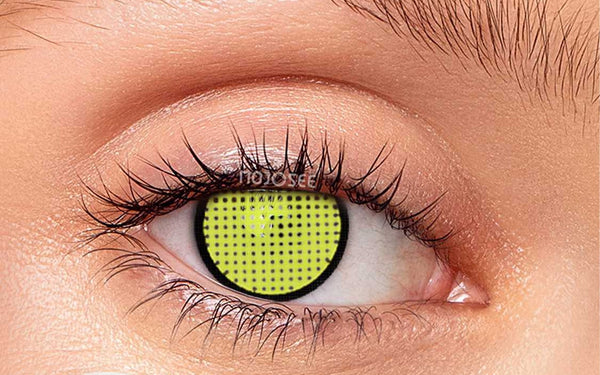
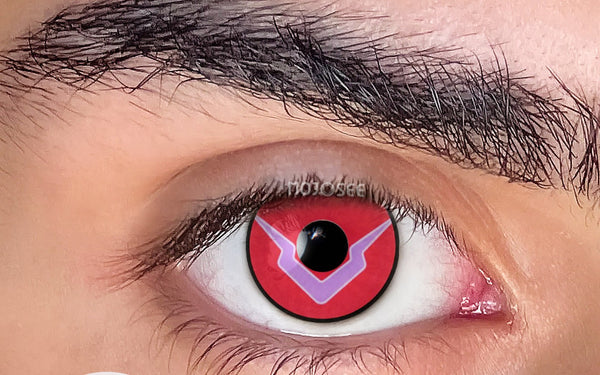
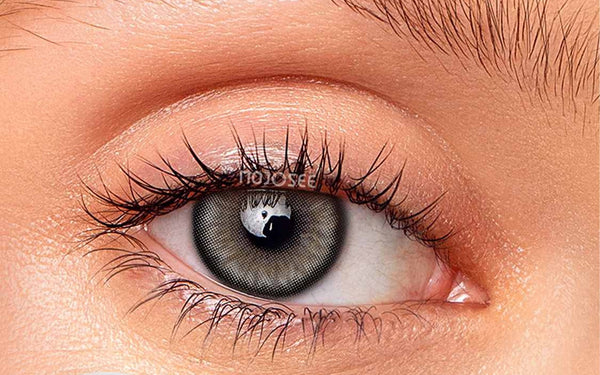
Subtle and close to brown: compare Brown Contacts and Hazel Contacts. Visible but wearable: compare Gray Contacts for Dark Eyes and Green Contacts for Dark Eyes. Bold or character-led: use Blue Contacts for Dark Eyes or Cosplay Contacts.
Use on-eye photos for the exact design. Print density, natural iris colour, fit, lighting and camera settings all affect the visible result, so no colour name guarantees one outcome.
Why dark eyes eat sheer lenses
A colored contact is a print sandwiched inside a clear lens. With sheer tints, that print is translucent — designed to blend with a light iris underneath. Put the same lens over dark brown, and the melanin behind it wins: sky blue turns muddy gray-green, emerald turns swamp, and light gray simply disappears. Nothing is wrong with your eyes; the lens was printed for someone else's.

Denser printed designs can create a stronger visible change on a dark iris. The result is not identical for every wearer: print density, natural iris colour, fit, lighting and camera settings all matter, so compare product-specific on-eye photos.
The realistic effect, shade by shade
Working from most subtle to most visible on a dark base:
- Brown → brighter brown: not a color change, an upgrade. A light-brown three-tone evens the iris and lifts it two steps — the "great genetics" look.
- Hazel: warm gold around the pupil, believable at any distance, the safest first lens on dark eyes.
- Gray / gray-green: the biggest visible change that still passes as natural — the compliment-magnet zone (we ranked those in the compliments test).
- Blue / vivid green: displays fully thanks to opaque printing, but reads as an intentional look rather than natural. Great for photos and events; know that's the trade.

Three picks that prove the point
A cool gray-blue that shows exactly why "opaque multi-tone" matters — dimensional over the darkest irises, silvery in daylight, slate indoors:

The warm route works differently: instead of covering your brown, it recruits it. A honey-gold core sits around the pupil and blends outward into your natural color, so there's no visible boundary anywhere — which is why hazel survives close-up scrutiny that would expose almost any other shade. On very dark irises the effect is a two-step brightening plus that warm flicker people read as "expressive eyes" rather than "different eyes":


And for the subtlest possible entry — brown-on-brown. It sounds pointless until you see it: the print is a cleaner, lighter, more even version of a natural brown iris, so the eye looks brighter and slightly larger while the color stays recognizably yours. This is the lens for "I want better, not different," and the one most often reordered after people cycle through louder shades:

Buying rules for dark eyes
Once you've seen the construction difference, shopping gets fast. Three practical checks reduce common purchase mistakes on a dark base:
- Look for "opaque" or visible multi-tone printing in the macro shot. Radial texture = real-eye depth.
- Check the before/after on a dark-eyed model, not a light-eyed one — that's the only preview that predicts your result.
- Compare 14.0–14.2 mm when you want less visual enlargement (sizing logic in the diameter guide); a defined limbal ring does more for realism than any color choice.
The one-week adjustment curve
One more thing nobody warns you about. First-timers on dark eyes almost always over-judge day one: the change looks bigger to you than to anyone else, because you're comparing against decades of your own mirror. Give a new shade a full week of normal life — work lighting, evening plans, a few photos — before deciding. Most "too much" verdicts soften by day three; most genuine mismatches (usually undertone clashes) are obvious by day two and won't improve.
Shade by shade, with what is actually in stock
| Shade | On dark brown, reads as | In stock | From | Powers |
|---|---|---|---|---|
| Brown | your eyes, lit | 97% | $16.98 | 17% |
| Gray | the cleanest cool change | 98% | $18.98 | 10% |
| Blue | a real change only when dense; gray-blue is the natural version | 96% | $12.88 | 16% |
| Green | contrast without costume, if muted | 97% | $12.88 | 18% |
| Hazel | the visible warm upgrade | 100% | $18.98 | 11% |
Black eyes: the darkest case
An iris that reads as black is a very dark brown, and the same rules apply with less margin: only a dense print shows, a translucent one disappears completely rather than muddying, and the ring matters more because there is no natural iris edge to borrow. Gray and light brown are the two colours that change a near-black iris reliably; blue needs the densest print in the range; hazel reads as a lighter brown rather than as hazel. Judge only from on-eye photographs on a dark base — a black iris is the case the light-eye photography misleads worst.
Two pairs to start with


Both in-stock 14.0mm designs with a defined ring at the time of writing — the one-step and two-step options for a dark base. Their 14.5mm versions exist for photographs and are the wrong first pair.
Buying rules for dark eyes, expanded
- Density before shade. On a dark iris a translucent lens muddies; only a dense print shows. Judge from the ring around the pupil on an on-eye photo taken on a dark base.
- Ring before shade. A defined outer ring separates the print from your iris so they do not blend, and gives the iris a real edge. On near-black eyes it is not optional.
- Size before shade. 14.0mm for everyday; 14.2mm for a lift; 14.5mm for photographs and cosplay only.
- Warmth to skin, not to eye. Your iris is brown either way; the shade has to agree with your undertone. Warm skin takes brown, honey and warm gray; cool skin takes greige and true gray.
- Then the shade, one to two steps from your own for invisible, three for a decision.
Most disappointing pairs on dark eyes fail rule one or three, and both are visible on the product page before you buy.
The one-week curve, with what to expect each day
Day one: the lens is more noticeable to you than to anyone. Day two: insertion drops to a couple of minutes once you stop aiming at the iris. Day three or four: the profile check and centring check are automatic. By the end of the week the pair is part of getting dressed, and the comments — if any — are "you look well". If it is still uncomfortable after a week, the size is wrong, not the technique.
Powers
About 43% of the dark-eyes master collection carries corrective powers from 0.00 to -8.00, no plus powers, no toric lenses. Choose shade and size first, then filter for power; the selector on each product page is generated from stock. We ship standard only — 14 to 20 days door to door, with tracking issued about five days after you order. Standard shipping is free on US orders over $49 and on UK, Canada and Australia orders over US$49.
What to expect from each shade after a month
A brown becomes invisible — you forget it is in and so does everyone else. A gray becomes "your eyes", with the occasional comment from someone who has not seen you in a while. A dense blue or green stays a decision every morning, which is either the point or a sign to drop one shade closer to your own. Whatever the shade, the lens that still feels like a lens after a month is the wrong size, not the wrong colour; check the diameter against your prescription before buying the next pair.
Ordering
For an everyday first pair, buy one and test it in daylight before the season's worth. For a date, count backwards three weeks for standard shipping and add a practice week.
FAQ
Do colored contacts work on black eyes?
"Black" eyes are very dark brown, and yes — opaque lenses display true color over them. Only sheer enhancement tints fail on a dark base.
Which color looks most natural on dark brown eyes?
Hazel and brightening browns win up close; multi-tone grays win for visible change. The full ranking with photos is in the complete dark eyes guide.
Why did my blue contacts look gray on my eyes?
They were sheer-printed for light irises. Over dark brown the tint mixes with your base color instead of covering it — swap to an opaque blue and the problem disappears.
Do I still need a prescription if I have perfect vision?
In the U.S., yes — all contact lenses require a valid prescription, including plano (0.00) cosmetic ones. It's a fit-and-safety check, not just a vision test.
Explore more: Gray for dark eyes · Brown for dark eyes · Hazel contacts
Do colored contacts show on black eyes?
Yes, if the print is dense. A near-black iris is a very dark brown; a translucent lens disappears on it entirely, a dense print with a defined ring shows exactly as printed. Gray and light brown are the most reliable changes; blue needs the densest print available.
Why did my blue contacts look gray on my dark eyes?
The print was translucent enough for your brown to show through and cancel the blue, and indoor light is warm and dim, which drains blue further. A dense blue holds; a gray-blue is the version most people actually wanted.
You might also like
Picked to match this guide — every pair in stock now.
 Polar Lights Brown Prescription Colored Cont$21.98per pair (2 lenses)
 Smoky Marble Prescription Colored Contact Le$21.98per pair (2 lenses)
 Black Small Pupil Prescription Colored Conta$34.98per pair (2 lenses)
 Starry sky Brown Prescription Colored Contac$22.98per pair (2 lenses)
Explore more: cos-Black → · Brown Contacts → · Black Contacts →