









Vampire Eye Contacts: From First Bite to Final Form

You can fake fangs with a trip to the party store. You cannot fake the eyes. Every vampire story agrees on one detail — the moment the hunger shows, it shows in the iris — which is why red contacts are the load-bearing piece of the entire costume. But 'red eyes' covers a whole bloodline, from a whisper of crimson to a fully drowned sclera. This guide sorts the family tree so you can pick the exact degree of monster you want to be.
Choose the Vampire Effect First
Fast tricolor-red route: start with Vika Tricolor Red and compare its product photos with your eye colour and makeup lighting.
Character-pattern route: compare Red Vampire / Yor Forger. For more options, browse Vampire Contacts or Red Halloween Contacts.
Open the product page to confirm the live variant, package details, availability and destination-specific delivery estimate before checkout.

The crimson iris: newly turned
The entry point is a true, saturated red iris with a natural round pupil — human architecture, wrong color. It reads as recently bitten: still passing at the dinner party, betrayed only when the candlelight catches. Because the print is opaque, the red lands with full force on dark brown eyes, and in warm light it smolders rather than glows. This is the vampire most people should play: elegant, conversational, quietly wrong.

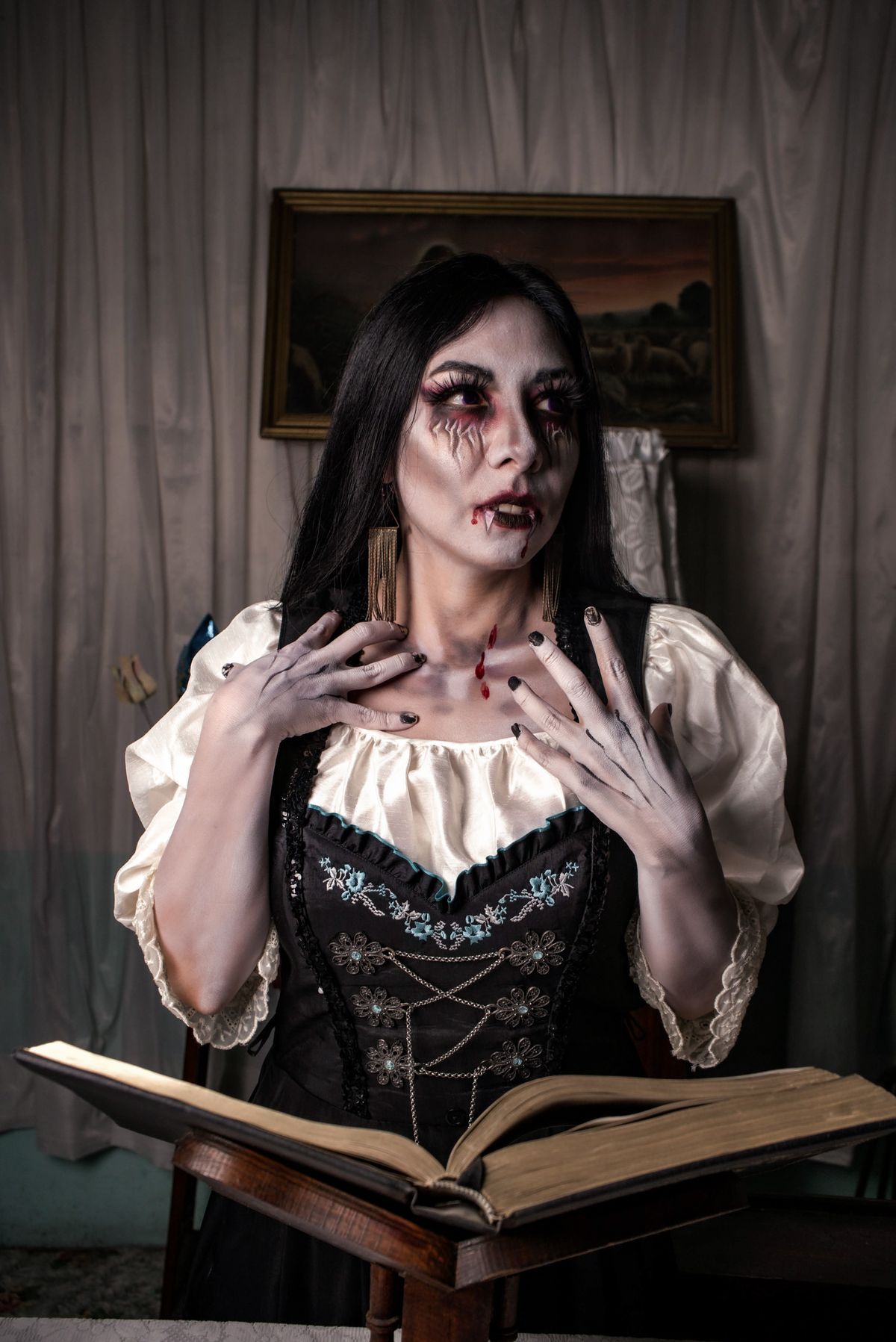

Black-rimmed red: the elder
Add a heavy black limbal ring around the red and the character ages three centuries. The dark rim tightens the iris into something colder and more deliberate — an elder who has done this many times and is no longer curious about you. The black edge also sharpens the eye in photos, giving portrait shots a graphic, illustrated quality that plain red cannot match. Pair with pale foundation and let the ring do the intimidating.

Block red: no humanity left
A solid red disc across the whole iris — no pattern, no pupil definition, just color — removes the last human signal from the face. Block designs are for the feral end of the myth: the starved, the turned-wrong, the thing in the crypt. At conversation distance the flat red is genuinely unsettling because the eye offers nothing to read. It is maximum effect for minimum makeup, and it owns every phone flash it meets.

Bloodstained sclera: final form
Then there is the look that ends conversations: red veining that spreads beyond the iris into the white of the eye. Bloodstained sclera designs turn the entire visible eye into the aftermath of the feed, and they are the single most photographed lens style at any horror event. They are also the most committed — coverage this bold dims more peripheral vision than a standard lens, so practice at home, plan shorter wear sessions, and give your eyes the night off afterward.

The daylight vampire
Some costumes need a red that survives brunch. A tricolor red blends crimson through warmer tones with a soft edge, reading as intense and stylish rather than undead — the vampire who has learned moderation. It is the pick for anime-leaning looks, subtle demon builds, and anyone who wants the color without the full monster commitment.

Fangs, light and photographs
Red lenses reward planning. Candlelight and warm bulbs make every red above smolder; cold white LED flattens them, so pick your corner of the party. For photos, a single light slightly above eye level puts a catchlight in the red and reads as hunger — our photography guide has the full setup. If your villain leans more sci-fi than gothic, the red villain eye guide covers that branch of the family, and the color-to-costume matcher handles everything else on the guest list.
Timing the night
Lenses go in first, before fangs, face paint or anything airborne — a fleck of setting spray under a lens ends the evening early. Count backward from the party: most wearers get 8–10 comfortable hours, so a 7 p.m. start covers you well past midnight, though a smoky venue can shave an hour off that window. Pack a flat case and a travel bottle of solution, and when the night ends the lenses come out before sleep does — no exceptions. Red designs also read darkest in dim light, so schedule photos early in the evening while the color is still doing its loudest work.
Every red in the catalogue, side by side
Six designs cover the vampire range, and the difference between them is not shade — it is how much humanity the eye keeps. All are in stock at the price shown for one pair (two lenses), all 14.5 mm except the sclera.
| Design | What it reads as | Pupil | Price | Rx | Wear window |
|---|---|---|---|---|---|
| Circle Block Red Vampire | Newly turned, still passing | Clear, normal | $24.98 | — | Full evening |
| Vika Tricolor Red | Warm crimson, human architecture | Clear, normal | $22.98 | — | Full evening |
| Enchanted Black | Elder — red inside a jagged black rim | Clear, normal | $26.98 | — | Full evening |
| Red | Flat saturated red, no humanity left | Clear, normal | $34.98 | — | Full evening |
| Vampire Block | Stage-strength crimson block | Clear, normal | $24.98 | — | Full evening |
| Bloodstained Sclera | Final form — whole eye taken | Covered edges | $88.98 | — | Photo hours only |
The jump in price at the bottom of that table is a jump in product class, not in quality: a 22 mm sclera lens covers the white of the eye as well as the iris, takes practice to insert, and is built for photographs rather than for a night of walking around. Everything above it is an ordinary 14.5 mm cosmetic lens that happens to be red.
Picking the red for your own face
Dark brown eyes. Every design above is an opaque print, which is the only thing that matters here — a sheer red tint over a dark iris turns muddy brown, not crimson. On dark eyes the warm reds (Vika Tricolor, Circle Block) read richest, because the warmth has something to sit against; flat block red can look slightly flat by comparison, which is exactly right for the inhuman end of the range.
Light eyes. The opposite: block red lands hardest on pale irises, and the warm crimsons can drift pink under strong light. If you have blue or green eyes and want the elder look, the black-rimmed design keeps the shape crisp where a plain red would blur.
Pale-foundation builds. The classic vampire makeup — pale base, dark socket, dark lip — pushes every red one step brighter in photos. Pick one step deeper than you think you want, or the face reads as Halloween-store rather than centuries old.
Glasses wearers. None of the costume reds in this range come in prescription powers. If you need correction on the night, the practical route is to wear the lenses for photos and your glasses for the rest of the evening — or look at the prescription cosplay line, where the reds that do exist are character designs rather than plain vampire crimsons.
What goes wrong with red lenses
Red is the least forgiving color in the catalogue. These are the ways it fails, and every one of them is decided before the night starts.
Buying sclera for a party. A 22 mm sclera lens is the most photographed vampire look and the worst one to wear for six hours. It sits over the whole eye, it takes a mirror and a steady hand to insert, and it dries faster than a standard lens. People buy it for Halloween night, put it in at seven, and take it out by nine. Plan it for the shoot and carry a standard pair for the party.
Underestimating how red photographs. Camera sensors amplify saturated red more than any other color, and phone night mode amplifies it further. A lens that looks deep burgundy in the mirror can blow out to neon in a flash photo. If the night will be photographed with flash, the black-rimmed design holds its edge where a plain red loses definition.
Red with warm party lighting. Orange uplighting and red lenses cancel each other out — the eye reads as the same color as the room and the effect disappears. This is the single most common "my lenses did not show up in the photos" complaint, and it is a lighting problem rather than a lens problem. Cool or neutral light makes red eyes read; warm light hides them.
Expecting fangs and lenses to compete. Both are close-up details. In a full-length costume photo neither reads, and in a portrait both fight for the same attention. Pick which one carries the shot — for eyes, that means a tighter crop than most people shoot.
Leaving the order to October. Red is the first Halloween color to sell through every year, and the crimsons go before the blocks do. The deadline below is not a marketing device; it is the actual arithmetic of how long a parcel takes.
The numbers
One unit is one pair, which is two lenses. A standard vampire build is one pair at $22.98–$34.98 — the whole cost of the eyes. Two pairs, which is the usual couple order or a standard-plus-sclera combination, clears the $49 free US shipping threshold (elsewhere it is $69; under it, shipping is $10.99).
Diameter is 14.5 mm across the standard reds — normal cosmetic-lens territory, no special handling. The sclera design is 22 mm and belongs to a different class entirely; if that is the look you are after, the sclera guide covers insertion and wear limits properly.
For October 31, standard delivery runs 14–20 days door to door, which puts the order-by date at October 1. That date is the standard-shipping line: order after it and arrival before October 31 stops being something you can count on, and past mid-October it is not realistic at all. The country-by-country cutoffs are in the order deadline guide. If you have never worn lenses, add a week for a test wear at home — the night itself is the wrong time to learn.
Vampire red versus the other red looks
Not every red eye is a vampire. The distinction matters because the three families photograph differently and suit different costumes.
Vampire reds keep human iris architecture: a round pupil, a visible limbal edge, a color that could almost be a trick of the light. That is what makes them unsettling at a dinner table. Demon and villain reds abandon that — slit pupils, triple pupils, rank marks, patterns that no eye has ever had — and they read as monster rather than as predator; those live with the villain eye looks. Anime-inspired reds are a third thing again: high-saturation, high-contrast prints designed to match a specific character's reference art, which is why they look overdone on a generic vampire costume and perfect on the character they were made for.
If your build is "vampire" without a named character attached, stay in the first family. The moment a pattern enters the iris, most viewers stop reading vampire and start reading demon.
FAQ
Do red vampire contacts show on dark brown eyes?
Yes — all the designs here are printed opaque, so the red covers a dark iris completely. Deep brown eyes actually flatter red lenses: the natural darkness underneath makes the color look richer.
Which red should a first-timer pick?
Start with a crimson iris design like Vika Tricolor Red. It delivers the full vampire signal with normal comfort and vision, and you can escalate to block or sclera styles once you know how bold lenses feel.
Can you see through block and sclera designs?
Straight-ahead vision stays clear through the unprinted center, but bold coverage dims the edges of your vision more than a standard lens. Practice before the event, and never drive in them.
How long can I wear them on Halloween night?
Plan for six to eight hours of comfortable wear, less for sclera styles. Carry a case and solution, take them out before sleep, and never share lenses — not even within the coven.
Do I need a prescription for costume reds in the US?
Yes. All contact lenses are regulated in the US and require a prescription, including 0.00 plano costume lenses.
Explore more: Red Halloween → · Halloween & Goth → · All Red →
Which red vampire contacts look most realistic?
The warm crimsons with a normal round pupil — Vika Tricolor Red and the Circle Block red — because they keep human iris architecture and only change the color. Flat block reds and patterned designs read as demon rather than vampire, which is a different costume even when the shade is similar.
Do red contacts show up in photos?
They show strongly in cool or neutral light and disappear under warm orange party lighting, which is the most common reason people think their lenses failed. Camera sensors also amplify saturated red, so a deep burgundy in the mirror can read neon under flash — the black-rimmed design holds its shape best in that situation.
How long can I wear sclera vampire lenses?
Treat 22 mm sclera designs as a photo-hours lens, not an all-night one. They cover the white of the eye, take practice to insert, and dry faster than a standard 14.5 mm lens. The practical plan is sclera for the shoot, a standard red pair for the rest of the night.
Are red contacts available in prescription?
Not in this costume-red range — these are plano only. Where prescription reds exist they are character cosplay designs rather than plain vampire crimsons, and they are spherical powers only, so they do not correct astigmatism.
When do I need to order red contacts for Halloween?
October 1 on standard shipping, which runs 14–20 days door to door. Later than that and arrival before the 31st stops being something you can count on. What the date really protects is stock: red sells through earlier than any other Halloween color.
You might also like
Picked to match this guide — every pair in stock now.
 Date with the Demon Triple Pupil Colored Con$29.98per pair (2 lenses)
 Red Cross Colored Contact Lenses$28.98per pair (2 lenses)
 Trauma Breaking Dawn Colored Contact Lenses$19.98per pair (2 lenses)
 Power Prescription Cosplay Contact Lenses – Chainsaw Man$34.98per pair (2 lenses)
Explore more: Red Halloween Contacts → · vampire → · halloween →


