




High Prescription Colored Contacts: What You Can Get at −6, −8 and Beyond
If your prescription is −6.00 or stronger, you have probably had this experience: you find a colored lens you love, open the power dropdown, and it stops at −6.00 or −8.00. It is not that manufacturers forgot about you. It is a manufacturing constraint that gets worse the higher your correction goes — and there are three legitimate ways around it, one of which most people never hear about.
Why colored lens ranges stop where they do
A colored contact is a sandwich: pigment layer between two layers of lens material. Corrective power comes from lens thickness varying across the surface, and the stronger the minus power, the thicker the edge and the thinner the center becomes. Now add a pigment layer that has to stay perfectly aligned over that changing thickness, and the tolerances get brutal past about −8.00 — the print starts to distort, the lens gets heavier on the eye, and comfort drops.

Clear lenses go much higher because they have no print to keep flat. This is also why high-power colored lenses tend to be sold in fewer designs: each design has to be re-engineered, not just re-poured.

What you can actually do at −6 and beyond
Three routes, in the order most people should try them:
- Buy in your power where it exists. Ranges vary by design, not by brand — one lens family might stop at −6.00 while another reaches −8.00. Always check the individual power selector rather than assuming a store-wide ceiling.
- Wear plano colored lenses over glasses-free days only. Unglamorous but common: people with strong prescriptions keep a pair of 0.00 colored lenses for short photo occasions where they don't need sharp distance vision, and wear their clear correction the rest of the time.
- Ask your eye care professional about a custom or piggyback option. This is the route most people never hear about — specialty labs make cosmetic lenses to prescription, and some practitioners fit a clear corrective lens with a separate cosmetic overlay. It costs more and requires a proper fitting, but it is the only path to full correction plus full color.
What you should not do is buy a power lower than your actual prescription "because it's close enough." Under-correction causes eye strain and headaches, and it is genuinely unsafe when driving.
Vertex distance: your glasses number is not your lens number
Here's the part that surprises people at high powers: a contact lens sits directly on your eye, while glasses sit about 12mm in front of it. That distance changes the effective power, and the effect grows with the prescription. Around −4.00 it is negligible — a quarter of a diopter. At −8.00 it is three quarter-steps: −8.00 glasses converts to roughly −7.25 in contacts. Practically, that means the contact lens power your optometrist writes will often be slightly weaker than your glasses power — and that's correct, not a mistake. The full conversion table, from −4.00 to −10.00, is in glasses vs contact lens prescription.
Never do this conversion yourself from a glasses prescription. A contact lens prescription is a separate document with base curve and diameter, issued after a fitting; that's what you order from. Our U.S. prescription guide covers what has to be on it.

Making a strong prescription look good, not just work
High-minus lenses have thicker edges, which interacts with lens design in a way nobody warns you about:
- Prefer softer limbal rings. A hard, dark outer ring plus a thick lens edge can create a visible double line at the iris boundary. Multi-tone prints with a gradient edge hide this completely.
- Stay at 14.0–14.2mm. Larger diameters mean more lens mass; at high powers that's more weight sitting on the eye all day. Sizing logic is in the diameter guide.
- Expect a slightly smaller visual field than glasses give you, in exchange for no frames and no rain on your lenses.
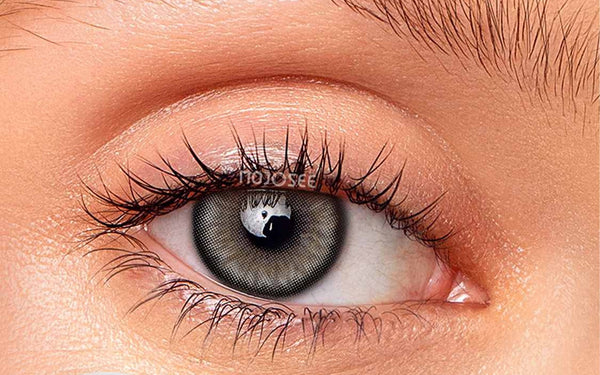
Two designs that behave well at higher powers — both use soft-edged three-tone prints rather than a hard ring, so the thicker lens edge stays invisible:

The warm-toned equivalent is the more forgiving of the two if your prescription sits at the top of the available range. Warm prints diffuse light rather than reflecting it in a hard ring, so the extra edge thickness of a strong minus lens has nothing to catch on visually — the boundary between lens and sclera stays soft even under direct flash. It is also the shade people compliment without asking what changed, which matters more than usual here: when you have spent years in glasses, the last thing you want from your first contact-lens summer is a lens that announces itself before you do.
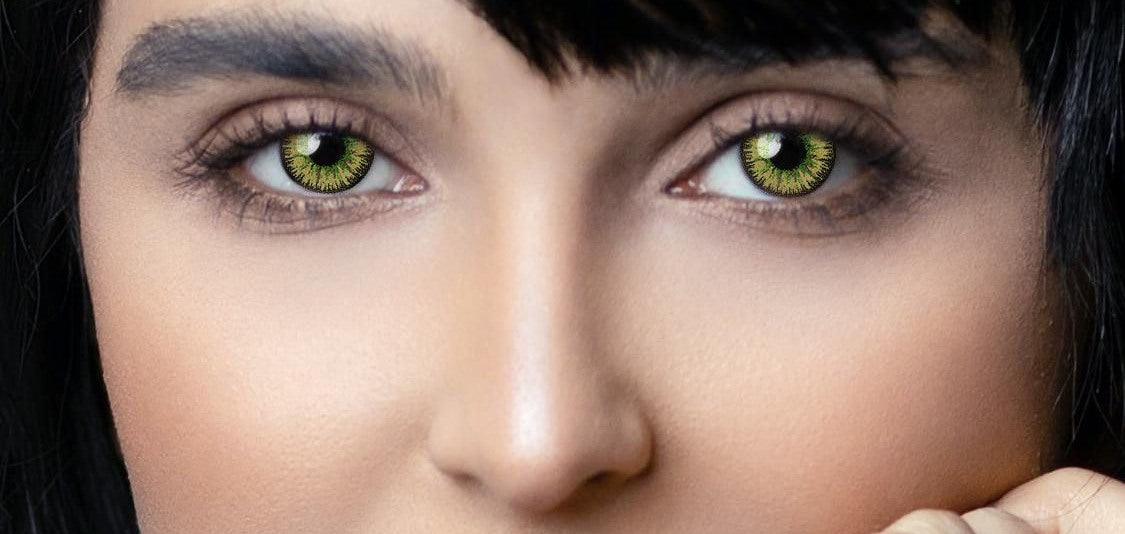
Pure Hazel is the quiet end of that spectrum: a tonal blend of brown, green and gold that reads as your own eye in better light, which is exactly what you want when the lens is already doing heavy optical work.

If neither cool gray nor warm hazel is your register, the third direction is a brightening brown — same soft-edge construction, but it works with your natural iris instead of replacing it. For strong prescriptions this is the lowest-risk entry point of all three, because even if the fit takes a week to feel normal, nobody is looking at your eyes wondering what is different:

FAQ
Can you get colored contacts for −8.00?
Sometimes, depending on the design — ranges differ per lens family, so check the power selector on the specific product. Beyond the listed maximum, ask your eye care professional about custom cosmetic lenses.
Why don't colored contacts come in high prescriptions?
The pigment layer has to stay flat and aligned while lens thickness varies across the surface. Past roughly −8.00 that becomes hard to manufacture consistently, and comfort drops as the lens gets heavier.
Is my glasses prescription the same as my contact lens prescription?
No. Contacts sit on the eye rather than 12mm in front of it, so the effective power differs — noticeably at strong prescriptions. You need a contact lens prescription with base curve and diameter, issued after a fitting.
Can I wear plano colored contacts with glasses?
Some people do wear 0.00 colored lenses briefly for photos while going without correction, but wearing contacts under glasses is a decision for your eye care professional — ask before trying it.
Do high-power colored lenses feel different?
They can feel slightly heavier because the edges are thicker. Choosing a natural diameter and a soft-edged print minimizes both the sensation and the visible lens edge.
Explore more: Gray contacts · Hazel contacts · Safety guide
You might also like
Picked to match this guide — every pair in stock now.
 Vika Tricolor Blue Colored Contact Lenses$21.98per pair (2 lenses)
 Polar Lights Blue Gray Prescription Colored $19.98per pair (2 lenses)
 Starry sky Gray Prescription Colored Contact$22.98per pair (2 lenses)
 Polar Lights Brown Prescription Colored Cont$21.98per pair (2 lenses)
Explore more: Colored Contacts for Dark Eyes →