









Lizard Eye Contacts Guide: Slit Pupils, Scales & Reptile Looks
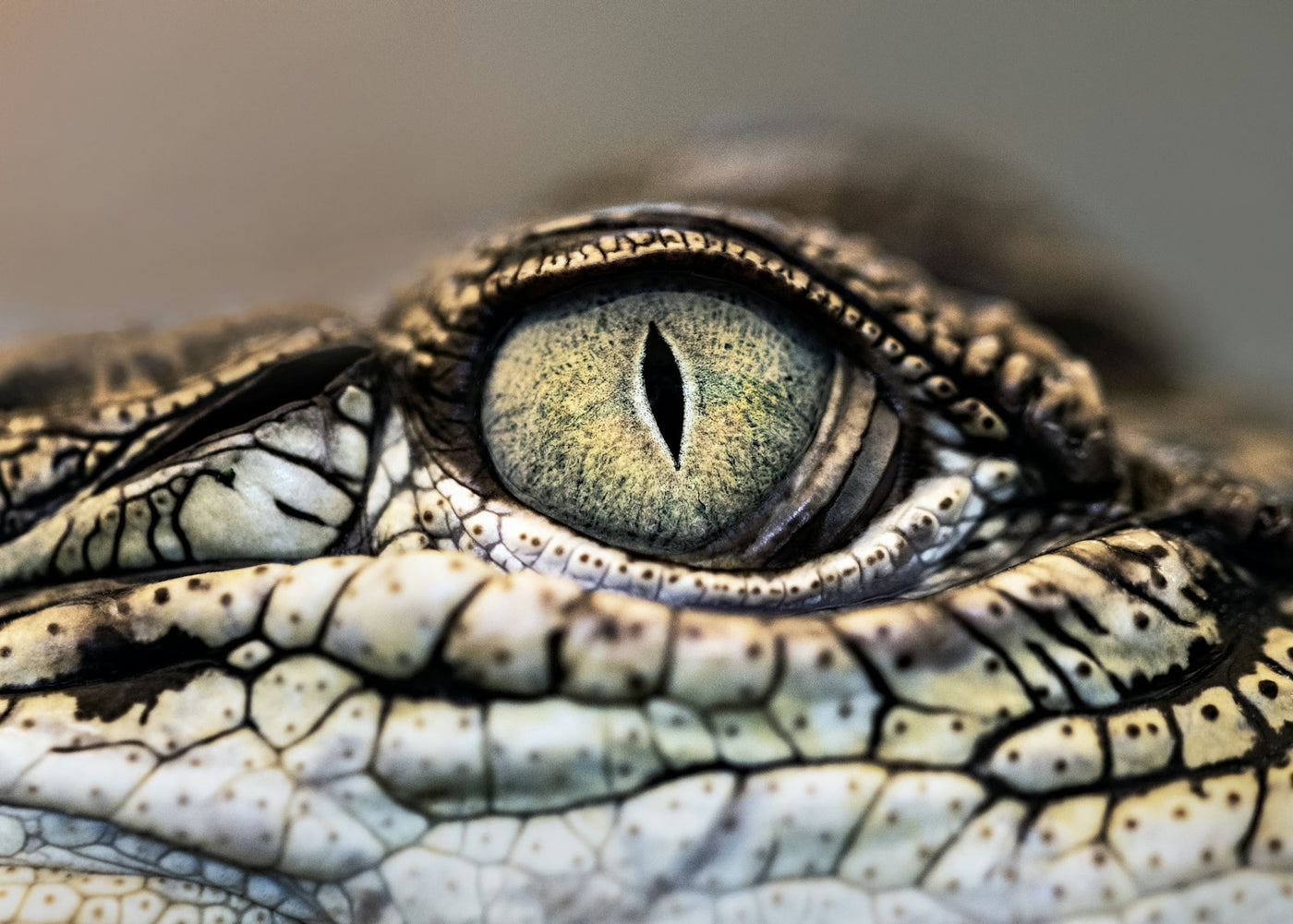
A slit pupil is the single fastest way to stop looking human. Round pupils read as mammal — as person — no matter what color you paint the iris. Swap that circle for a vertical slit and the whole face reorganizes itself around it: reptile, demon, cat, thing-that-hunts-at-night. That's why slit-pupil lenses are the backbone of every serious creature build, and why they behave differently from every other lens you've worn.
Why a slit reads as reptile (and what that costs you)
Real vertical-slit pupils belong to ambush predators — geckos, vipers, crocodiles, house cats. Our brains learned that shape as a threat signal long before anyone made a contact lens, so a slit triggers an instinctive "not one of us" reaction from across a room. It is the only lens design that works at conversation distance and in a photo taken from three meters away.

The cost is printing area. To make a slit visible, the lens has to print an opaque dark shape across the middle of the iris zone — including part of what would normally be your clear pupil opening. That's the fundamental trade of this category, and it's what the next section is really about.

Can you actually see through them?
Yes — but honestly, less well than through a standard colored lens, and you should plan for that rather than be surprised by it.
How it works: the slit itself is the clear channel, so your straight-ahead vision stays serviceable. What suffers is peripheral clarity, because the printed area sits over the edges of your pupil. In dim light, when your pupil dilates past the printed zone, the effect is like looking through a keyhole — you'll notice haze at the sides and less light overall. Concretely, that means:
- Bright venues, con floors, daylight shoots: fine. Your pupil is small, the slit lines up, vision is close to normal.
- Dark clubs, night walks, dim haunted-house corridors: expect reduced peripheral awareness. Move slower, turn your head instead of relying on side vision.
- Never: driving, cycling, or anything where you need reliable peripheral vision at speed.
Everyone adapts differently, so wear a new pair for a short session at home before you wear them somewhere you can't easily take them out (the same first-wear discipline covered in our insertion guide).
Which color for which creature
The slit does the species work; the color decides which creature, and it changes the read completely.
Green is the default reptile — lizard, dragon, serpent, forest creature. It's also the most photogenic of the three under warm event lighting, where green reads as scaled rather than simply colored:

Amber-brown pulls the look toward predator rather than monster — big cat, hawk, werewolf mid-transformation. On dark brown eyes this is quietly the most effective of the three: the surrounding amber sits close enough to your natural iris that the eye still looks like your eye, which leaves the slit as the single impossible detail. That's a stronger horror mechanic than changing everything at once — the uncanny lands hardest when only one thing is wrong. It also survives warm indoor lighting better than green, which can go slightly murky under tungsten:

Silver-gray is the coldest option, and the one that reads least like an animal and most like something simply wrong — undead, possessed, alien, doll-that-moved. Because there is no warmth anywhere in the print, it drains life out of the whole eye rather than recoloring it, which is why it pairs so well with pale base makeup and hollow contouring. Under flash it goes almost white at the edges, the effect horror photographers chase. Skip it if you want anything that reads as living creature:

If you want the slit shape but a cooler, icier palette, the cat-eye family covers similar ground in blues:

Making them survive a full costume day
Slit lenses fail in public for boring reasons, not dramatic ones:
- Rotation. A vertical slit only reads correctly when it's vertical. Every soft lens rotates slightly as you blink; check your reflection every hour or so and blink hard a few times to let it re-settle. This is the difference between "reptile" and "smudged eye."
- Dryness. Densely printed lenses feel drier faster, and con halls are dehydrating. Bring rewetting drops approved for soft lenses, and take a lens-free break if your eyes start protesting.
- Face paint. Insert lenses before paint and latex, remove them after washing your hands clean of both — the sequence that keeps pigment out of your eye.
- Photos. Slit pupils eat light. Ask for a light source slightly above eye level; flat frontal flash flattens the slit into a black blob.
Safety, prescription and expectations
Slit-pupil lenses are soft cosmetic contact lenses and carry the same rules as any other: in the U.S. you need a valid prescription even for plano (0.00), you clean and store them properly, you never share them, and you never sleep in them. Because the printed area is larger than a standard colored lens, be extra attentive to comfort — if a pair feels scratchy or your vision stays hazy in bright light, take them out and check with your eye care professional. Our safety guide covers what "FDA-cleared materials" does and doesn't mean, and the U.S. prescription rules are spelled out separately.
Order at least two weeks before an event so you have time for a practice wear. Free U.S. shipping over $49.
If this is for a Halloween build rather than a shoot, order by September 30 for standard delivery — the order deadline guide has the cutoffs.
The reptile range, at a glance
"Lizard eye" is the search term, but the slit-pupil family here splits into four distinct prints, and the differences matter more than the colour. Everything below is 14.5mm, in stock as of this writing, and priced per pair — one order is two lenses.
| Design | Reads as | Powers | Price | |
|---|---|---|---|---|
| Lizard Eye Green | Slit on a mottled, earthy iris | Lizard, chameleon, swamp creature | Plano | $23.98 |
| Lizard Eye Brown | Slit on a warm scaled iris | Gecko, desert reptile, werewolf hybrid | Plano | $23.98 |
| Cat Eyes Snake Green | Narrow slit, flat green | Serpent, Medusa, naga | Plano | $17.99 |
| Wildness Snake Green | Heavier slit, textured green | Serpent, close-up work | Plano | $26.98 |
| Crimson Dragon | Heavy slit, radial red iris | Dragon, demon, fire creature | Plano | $29.98 |
| Frost Dragon | Heavy slit, radial ice-blue iris | Ice dragon, wyvern, winter creature | Plano | $29.98 |
| Blood Dragon Frenzy | Triple pupil, blue | Mutant, eldritch, corrupted | 0.00 to -8.00 | $29.98 |
The pattern to notice: the lizard prints put texture around the slit, the snake prints keep the iris flat so the slit is the whole read, and the dragon prints add a radial burst built to survive being seen from further away. Pick by the distance the costume will be seen from, not by the animal name. The full slit-pupil collection has the current stock line on each.
Lizard, snake or dragon: which slit for which creature
Lizard — the mottled iris is the tell. It reads as a living, textured eye rather than a graphic one, which is what you want when the rest of the costume is also textured: scale prosthetics, painted skin, a chameleon or gecko build. Up close it is the most convincing of the three; at a distance the texture blurs and it reads as a plain slit, which is fine.
Snake — a flat colour field with a narrower slit. Colder and more alien than lizard because there is nothing organic in the iris to soften it. This is the pick for Medusa, naga, serpent-witch and any villain whose eyes should look like they have no warmth in them. It also reads cleanly across a room, because a flat field with a hard line survives distance better than texture does.
Dragon — the heaviest slit and a radial iris that looks like it is lit from inside. Made for photographs and stage light: the radial print catches a key light and glows, and the slit is thick enough to register in a group shot. On a dark brown iris the crimson version is the strongest change of anything in this family.
Triple pupil — not a slit at all, but it lives here because it answers the same brief: stop looking human. It is also the only design in this family that carries corrective powers, which makes it the default for glasses-wearers who want a creature eye and a full day of usable vision.
Getting the slit vertical, and keeping it there
A slit-pupil lens only works when the line sits upright. Soft lenses rotate freely on the eye, so a slit that goes in at an angle stays at an angle until you fix it — and a diagonal pupil reads as a printing error, not as a creature.
Insert as normal, then before you blink hard, look in a mirror and check the line. If it is off, close your eye and nudge the lens with a clean fingertip on the lid, rolling it rather than pressing, until the slit is vertical. Blink slowly a few times; a well-fitting lens settles and stops rotating once your lids have worked over it. Check again after ten minutes and once more before photos. It becomes a five-second habit.
Two things make it worse. A lens that is inside out never sits still — check the profile on your fingertip before insertion (a clean U is correct, a flared rim is not). And a dry eye grips the lens unevenly, so if the slit keeps drifting an hour in, the fix is rewetting drops rather than more nudging.
What they cost, and what the price buys
The slit-pupil family runs $17.99 to $29.98 a pair. The bottom of that range is a single slit on a flat colour; the middle adds iris texture; the top is the heavy dragon slits and the one prescription-capable design. Quality is the same across the tiers — you are paying for print complexity, not for a better lens.
For a first creature costume the $17.99 snake or a $23.98 lizard is the right buy. The fine iris work on a $29.98 dragon lens is mostly invisible beyond a metre; save it for costumes where someone will be taking close-ups or where the eye is the whole character read.
Ordering in time for Halloween
We ship standard only — 14 to 20 days door to door, with tracking issued about five days after you order. Standard is the only service we offer, so count backwards from the event rather than hoping to speed it up later.
Order by September 30 for Halloween. Slit-pupil lenses in particular reward a practice wear at home the week before, because the first time you centre and straighten a slit is never the fastest. The order deadline guide covers the UK, Canada and Australia on the same basis.
The in-stock designs, with colour and diameter listed for each: lizard eye contacts.
FAQ
Can you see out of lizard eye contacts?
Yes, through the slit — straight-ahead vision is serviceable. Peripheral vision and low-light clarity are reduced because the printed area covers part of your pupil, so avoid driving and go slower in dark venues.
Do slit-pupil contacts work on dark brown eyes?
Yes. The print is opaque, so both the slit and the surrounding color display fully on any natural eye color — dark irises need no special version.
How do I keep the slit vertical?
Soft lenses rotate a little as you blink. Check your reflection periodically and blink firmly a few times to let the lens re-center. Avoid rubbing your eyes, which spins them off-axis fastest.
Are lizard eye contacts safe for a full-day convention?
They can be, with rewetting drops, a case for breaks, and attention to how your eyes feel. Densely printed lenses dry out faster than plain ones, so plan a lens-free window if your day runs long.
Which color is best for a dragon or serpent build?
Green for classic reptile, amber-brown for predator warmth, silver-gray for undead or alien coldness. All three carry the same slit; only the temperature of the read changes.
How much do lizard eye contacts cost?
$17.99 to $29.98 a pair across the slit-pupil family — the two Lizard Eye designs are $23.98, snake prints start at $17.99 and the dragon prints are $29.98. One order is one pair, meaning two lenses.
Do lizard eye contacts come with prescription powers?
The slit designs are plano 0.00 only, because the printed slit sits over the pupil zone. The exception in this family is the triple-pupil Blood Dragon Frenzy, which runs 0.00 to -8.00 in 24 steps at $29.98.
What is the difference between lizard, snake and dragon eye contacts?
Lizard puts organic texture around the slit and is the most convincing up close. Snake keeps the iris flat so the slit is the whole read, and carries best across a room. Dragon uses a heavier slit with a radial iris built for photographs and stage light.
What size are lizard eye contacts?
14.5mm across this family — slightly larger than your natural iris, so the print extends a little past the iris edge. That is what makes the slit read as inhuman rather than merely dark.
Explore more: Halloween & Goth contacts · Cosplay contacts · Character matching table
You might also like
Picked to match this guide — every pair in stock now.
 Cat Eyes Colored Contact Lenses$17.99per pair (2 lenses)
 Cat Eyes Blue Colored Contact Lenses$17.99per pair (2 lenses)
 Cat Eyes Red Colored Contact Lenses$17.99per pair (2 lenses)
 Sexy Cat Eye Green Colored Contact Lenses$17.99per pair (2 lenses)
Explore more: Cat Eye Contacts → · halloween → · Cosplay Contacts →


