









Flake Lens & Snowflake Contacts: The Winter Effect Guide
Two very different lenses share the snowflake idea: a wearable gray crystalline daily and a blue cosplay starburst. Which one your winter look actually needs.
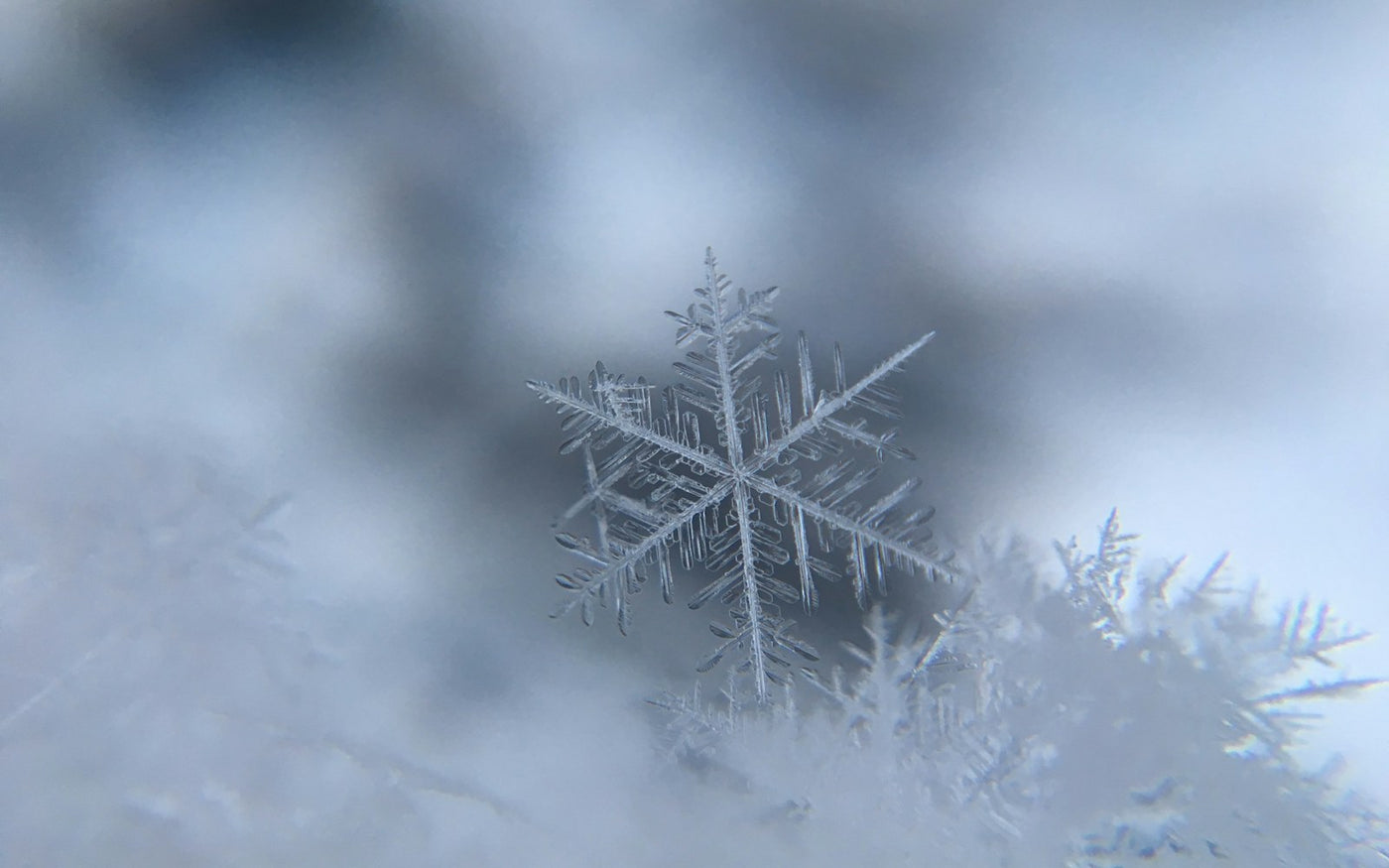
Search "flake lens" or "snowflake contacts" and you will find two designs that share a name but belong to different wardrobes: a subtle gray crystalline lens you can wear to brunch, and a vivid blue starburst built for frost-fairy and ice-queen costume looks. Here is how to tell which one you want.

The two designs, side by side
| Flake Lens (gray) — sold out | Snowflake (blue) | |
|---|---|---|
| Base color | Soft crystalline gray | Vivid ice blue |
| Diameter | 14.0 mm — natural sizing | 14.5 mm — subtle enlargement |
| Effect strength | Everyday wearable | Costume / photo statement |
| Best for | Winter daily looks, cool-toned makeup | Ice queen, frost fairy, winter cosplay |
On dark brown eyes
Both are opaque prints, so both show up fully on dark irises — the difference is temperature. The gray Flake Lens reads like a natural cool eye with unusual sparkle; light catches the crystalline pattern the way it catches fresh frost. The blue Snowflake makes no attempt at realism: it is a costume centerpiece, and on dark eyes the contrast makes the starburst edges even crisper than on light irises.
If the costume centerpiece is what you came for, Snowflake is the one still in stock — the blue crystal print that makes no attempt at realism.

Styling the winter look
- Everyday frost: gray Flake Lens + silver inner-corner highlight + neutral cool lip. Reads "striking eyes", not "costume".
- Ice queen / frost fairy: blue Snowflake + white-blue cut crease + face gems or faux frost lashes. This is the look for winter parties, LARP and January photo shoots.
- Winter cosplay: the blue Snowflake covers ice-element characters across anime and games — pair with the cosplay lens guide to match diameter and pattern to your character.
Want the winter-gray effect without the ice pattern? Starry Sky Gray carries the same printed-fiber texture in a plain cool gray, and it comes in prescription powers.

Wear notes
Both designs wear like standard colored contacts — the pattern surrounds a clear central zone, so vision is unaffected and full-day wear is fine with normal care. They are not session-limited effect lenses like mesh or sclera. Standard rules apply: prescription required in the US even at 0.00, fresh solution, and the replacement cycle starts at opening (cycle guide).
Winter timing tip: these sell hardest November–January. Shipping runs 14–20 days, so order by mid-October for reliable December delivery — the same logistics window as the Halloween ordering deadline.
Styling the winter/snowflake look for photos
Snowflake and frost-effect lenses are built for a specific aesthetic, and a few styling choices make them read as "ice queen" rather than "novelty lens." Cool everything. The lens is cool-toned, so pull your whole palette cool — silver and icy-blue makeup, cool-toned highlight, frosty lip. A warm bronze face fights the frost and muddies the effect. Light from the front for the sparkle. Like all flake lenses, the crystalline particles need point-source light to catch — shoot near a window, with flash, or under directional light, following the catchlight geometry in the photography guide. Lean into the winter context. These lenses land best in themed settings — a snow shoot, a winter formal, an ice/Elsa/Winter Court cosplay — where the frost reads as intentional world-building rather than a random sparkle. Keep skin luminous and cool. Dewy, cool-highlighted skin completes the ethereal read. The vision note applies as with any patterned lens: the crystalline print sits over part of the iris, so expect a little edge awareness in dim light. For a genuinely magical winter portrait, the lens plus cool styling plus directional light is the whole recipe.
And if you want the cold tone to read as your own eye colour rather than as a costume, Polar Lights Blue Grey sits exactly between the two — winter temperature, everyday believability.

Where snowflake lenses sit in the effect range
A snowflake print is a textured white or ice-blue effect on a standard 14.5mm lens — dense at the edge, lighter toward the pupil, with a clear optical window — which places it between a plain white-out lens and a mesh. It reads more like a real, if impossible, iris than a mesh does, and it keeps more vision than a full white. On a dark brown base that texture is the whole point: a flat white lens over brown shows an edge; a snowflake print has no edge to show. The catalogue's 14.5mm range is about 95% in stock at the time of writing, priced $9.90 to $34.98 a pair, and these designs sit in the middle of that band.
Winter looks, by setting
| Setting | What reads | Pair it with |
|---|---|---|
| Daylight, snow or white backdrop | The texture; the lens looks like frost, not paint | Pale, matte skin; white or silver on the lid; nothing warm |
| Indoor party, warm light | Mostly the white; texture flattens | Cool highlighter at the inner corner to keep the eye reading cold |
| Flash photography | A bright, almost lit-from-inside iris | Keep the rest of the face matte so the eye is the only highlight |
| Stage or cosplay hall | White at distance; texture only up close | A darker liner than you think, to keep the eye's shape |
Snowflake versus the other winter effects
| Effect | Reads as | Vision | Best for |
|---|---|---|---|
| Snowflake / flake print | A frosted iris with texture | Usable; dim periphery | Ice queen, frost spirit, winter shoots |
| Plain white-out | A blank white iris | Usable; larger clear zone | Ghost, undead, possessed |
| Ice-blue enlarging | A very light blue eye | Normal | Elsa-style looks that still read human |
| White mesh | A screen over the whole iris | Screen-door dimming | Horror, hive-mind |
| White sclera | The whole eye white | Dim, tunnel-ish | Full creature, close-up camera |
The snowflake sits second from the top on effect and second from the top on vision, which is why it is the usual answer for a winter look that still has to get through a party.
Making frost read on dark brown eyes
A frosted print over a dark iris has an advantage a colour lens does not: there is no colour to fight. The white and ice-blue simply cover, and the texture that reads as frost on a light eye reads as frost on a dark one. The two things that still go wrong are the same as for any effect lens — a lens that is not centred shows a crescent of brown at one edge, and a print that has faded from being stored too long goes patchy rather than frosted. Centre it in a mirror after insertion, and buy fresh for the season rather than saving last winter's pair.
Vision, honestly
The clear window over the pupil keeps straight-ahead vision usable; the textured print around it dims the periphery and adds a slight glow around lights, more than a plain colour lens and less than a mesh. Practice at home before an event, keep sessions to a few hours, and do not drive in them. If the dimming is more than you want, a plain white 14.5mm lens keeps a larger clear zone; if you want more effect, the mesh range goes further at the cost of more vision.
Pairing snowflake lenses with a costume
The lens is bright, so the costume around it should be either brighter or much darker — mid-tones fight it. All-white or icy pastels make the eye the coldest point on the face, which is the frost-spirit read; deep navy, black or charcoal make the eye the only light point, which is the more theatrical winter-witch read. Silver on the face works with both; gold works with neither. Keep the lip cool and matte, and put any shimmer on the inner corner rather than the lid so it reads as ice rather than as party glitter.
Care between winter events
A white-based print shows deposits sooner than a dark one and hazes at the edge if it is not rubbed clean, and a hazy snowflake reads as a cataract rather than as frost. Fresh multipurpose solution every time with a rub, a case replaced every three months, never water, and the replacement clock from the day the seal breaks. Buy fresh for the season rather than storing a pair through the summer; a print that has sat in solution for months usually comes out faded, and faded is the one thing this look cannot carry.
Ordering for the season
We ship standard only — 14 to 20 days door to door, with tracking issued about five days after you order. Standard shipping is free on US orders over $49 and on UK, Canada and Australia orders over US$69. There is no faster service, so for a winter event count backwards three weeks and add a practice wear. White-based effects are the ones that run lowest on stock through autumn; if the costume depends on this look, order it first.
FAQ
Can you see through snowflake contacts?
Yes — both the gray and blue designs keep a clear pupil zone. Vision is normal, unlike whiteout or mesh styles.
Which snowflake lens looks natural?
The 14.0 mm gray Flake Lens. At conversation distance it reads as a cool gray eye; the crystalline pattern only shows up close and in direct light.
Do snowflake contacts work on dark brown eyes?
Yes — both are opaque prints photographed on dark irises in our listings, so what you see is what you get.
How long can I wear them?
Like regular colored contacts: build up to 8–10 hours with proper hygiene. Remove before sleep, always.
Do snowflake contacts sparkle in normal light?
Not much — the crystalline flakes need point-source light (flash, sun, stage lights) to catch and sparkle. In soft even indoor light they mostly show the base color. Buy them for photo shoots and themed events with dramatic lighting, not everyday wear.
What look are snowflake contacts best for?
Cool-toned, ethereal aesthetics — ice queen, winter formal, snow shoots, Elsa or Winter Court cosplay. Pair with cool silver-and-blue makeup and luminous skin; a warm bronze face fights the frost effect and muddies it.
Can you see clearly through snowflake lenses?
Yes through the clear center, though the crystalline print sits over part of the iris, so expect slight edge awareness in dim light when your pupil widens. Fine for photos and events; not for driving at night.
How long do snowflake flake lenses last?
Like any lens, it depends on the replacement cycle printed on the pack — yearly, monthly or daily — which starts when you open the seal, not when you first wear them. Since flake lenses tend to be occasion wear, a shorter cycle or dailies often makes more sense than a yearly pair that mostly sits in solution between rare uses.
Are snowflake contacts the same as white-out contacts?
No. A white-out is a flat opaque white; a snowflake print is textured — dense at the edge, lighter toward the pupil — with a clear optical window. It reads as a frosted iris rather than a blank one and keeps more vision than a full white or a mesh.
What size are snowflake contacts?
14.5mm, the standard effect size, which extends slightly past the natural iris edge. They insert like an ordinary soft lens; only 22mm sclera designs need a different technique.
You might also like
Picked to match this guide — every pair in stock now.
 Vika Tricolor Blue Colored Contact Lenses$21.98per pair (2 lenses)
 Polar Lights Blue Gray Prescription Colored $19.98per pair (2 lenses)
 Starry sky Gray Prescription Colored Contact$22.98per pair (2 lenses)
 Polar Lights Brown Prescription Colored Cont$21.98per pair (2 lenses)
Explore more: Colored Contacts for Dark Eyes →


