




How Much Do Colored Contacts Cost? The Real 2026 Price Breakdown
Straight answer: a quality pair of colored contacts costs $19–$35 in 2026. Yearly natural shades sit at the low end of that range, daily disposables come in multi-lens packs around $27–$35, and full sclera specialty lenses run up to about $89. Anything dramatically below that band is not a bargain — it usually means the corners that got cut are the ones you cannot see: pigment isolation, sterile packaging and batch testing.
The three price bands, and what lives in each
$19–24: yearly lenses. This is where most first pairs land, and where the best cost-per-wear lives. The lens is built to survive up to twelve months of cleaning and storage, so the material has to hold its shape wear after wear. Tricolor naturals, everyday grays and cosplay prints all cluster here.

$27–35: daily disposables. The higher sticker buys you a pack of sealed single-use lenses — no case, no solution, no cleaning routine. Per lens it is cheaper than a yearly; per wear it is more expensive if you wear color often. The full math is in our daily vs yearly cost breakdown, but the short version: twice a week or more, buy yearly; occasional wear, buy dailies.
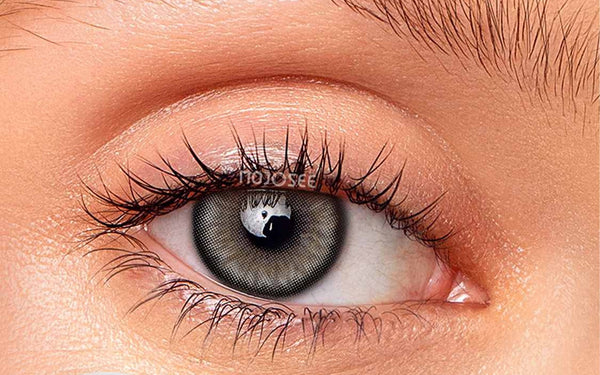
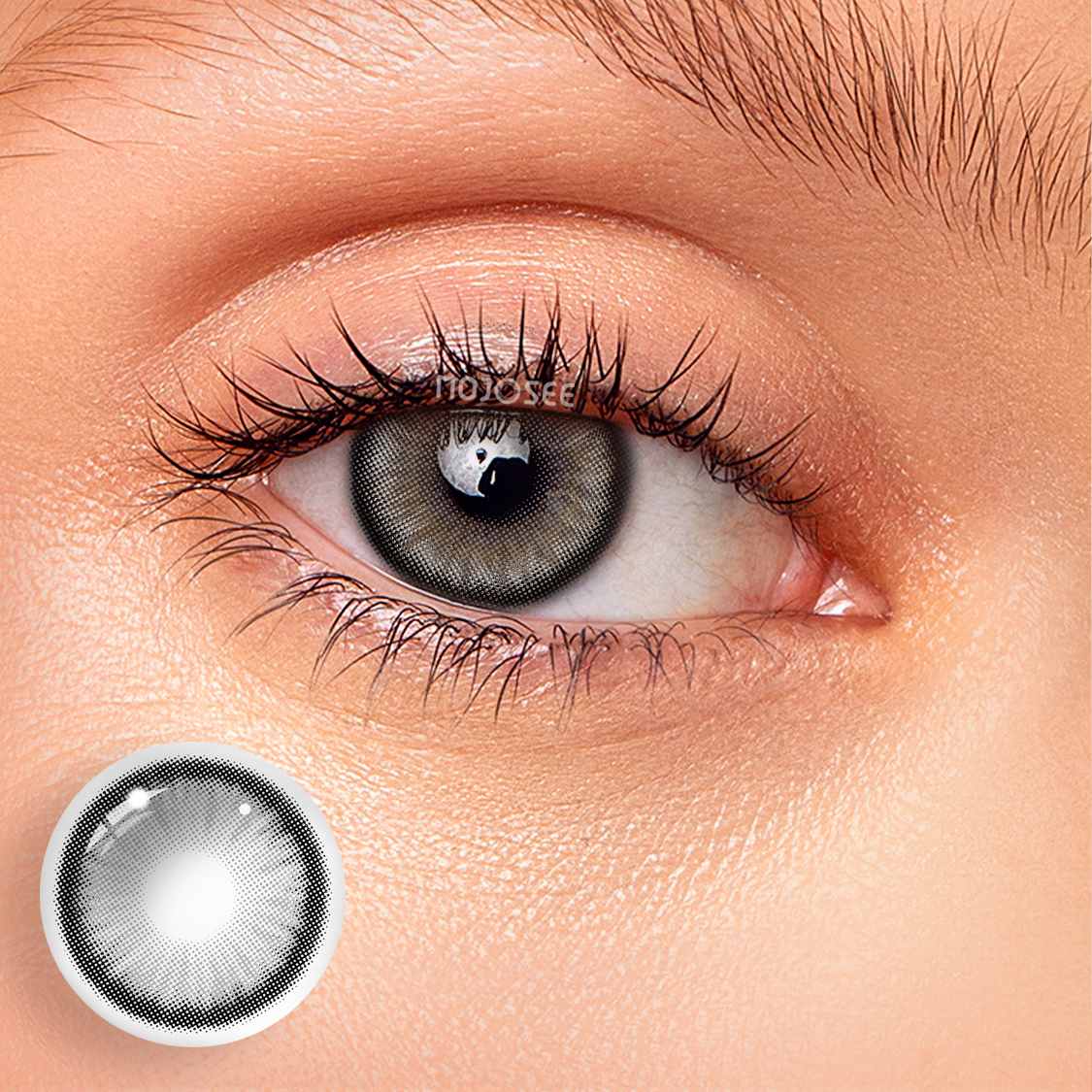
STARSHINE-Kiwi A.Claro is the daily-wear side of that math: a cool, believable gray you buy by the box rather than by the year.

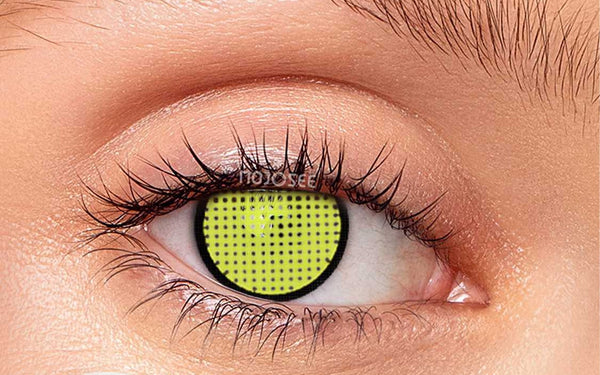
$50–89: specialty effects. Full sclera lenses that cover the whole visible eye are hand-checked, larger, and made in far smaller runs — which is why a 22mm blood-effect lens costs four times a regular pair. If your costume needs one, it is the single most transformative piece you will buy.

What the money actually buys
Two lenses can look identical in a product photo and be completely different objects. The price of a properly made colored contact pays for pigment sealed between layers of lens material so color never touches your cornea, sealed, dated packaging and a seller that can stand behind its materials — and, most of all, the fitting that makes any of it apply to your eye. A $6 no-name lens from a costume stall skips some or all of that list — our guide to whether cheap colored contacts are safe covers exactly where the line sits between a good deal and a bad idea.
The costs nobody puts on the price tag
Budget a little past the lens itself. Yearly lenses need multipurpose solution and a fresh case every few months — a few dollars a month that dailies skip entirely. If you have never worn contacts, a fitting from an eye care professional comes first; in the US every contact lens order, including 0.00 plano, requires a valid prescription, so the exam is not optional paperwork, it is the thing that makes the lens fit your eye. And shipping: US orders ship free over $49, which is why most people order two pairs at once — two yearly pairs land almost exactly on the threshold.
How to spend less without buying worse
Pair up to clear the free-shipping line instead of paying for one pair plus postage. Pick shades you will actually rotate — a natural for daily wear and a bolder pair for events beats three impulse colors you wear once. Care for yearly lenses properly (the care guide takes three minutes) so a twelve-month lens actually lasts twelve months. And if your eyes are dark brown, start from lenses printed to show on dark eyes — the dark-eyes collection — rather than paying twice after a sheer tint disappears on your iris.
Quick reference: what each budget gets you
| Budget | What it buys | Best for |
|---|---|---|
| $19–24 | One yearly pair, case included | Regular wear, best cost per wear |
| $27–35 | A pack of sealed daily lenses | Occasional wear, zero maintenance |
| $49+ | Two pairs + free US shipping | A natural + a bold in rotation |
| $50–89 | Specialty sclera / full-eye effects | Costume builds, stage, film |
One honest note on timing: prices in this guide are regular prices. Seasonal bundles change the math in your favor, but the bands above are what to sanity-check any deal against — a discount from a real price is savings; a permanent "90% off" from an imaginary price is marketing.
What colored contacts actually cost here, right now
Rather than "cheap" and "premium", here is the live price distribution across every in-stock design at the time of writing — priced per pair, one order is two lenses.
| Cheapest design | $8.88 |
| A quarter of the catalogue costs no more than | $21.98 |
| Median price | $22.98 |
| Three quarters cost no more than | $26.98 |
| Most expensive design (22mm sclera) | $120.00 |
| Median, designs with corrective powers | $34.98 |
| Median, plano designs | $22.98 |
Two things fall out of that. The middle of the market is a tight band — half of everything sits between about $21.98 and $26.98 — and the price of a lens is set mostly by two features, not by quality: diameter (22mm sclera costs three to four times a standard lens because it is a larger moulding in small runs) and corrective powers (a powered design carries a stock of every step from 0.00 to -8.00, which is why the powered median sits well above the plano one).
Price by size
| Size | Price range | What moves the price inside the band |
|---|---|---|
| 14.0mm natural | $8.88 – $34.98 | Powers; texture in the print |
| 14.2mm everyday | $18.98 – $34.98 | Powers; multi-tone prints |
| 14.5mm cosplay / enlarging | $9.90 – $34.98 | Character prints; powers |
| 22.0mm sclera | $72.98 – $120.00 | Moulding and small runs; plano only |
Notice that the three standard sizes share almost the same band. Enlargement does not cost extra; only full-eye coverage does.
The cost that is not on the price tag
A lens's real cost is the pair plus what it takes to keep it safe. A yearly lens needs multipurpose solution and a fresh case every three months; a daily disposable needs neither. Worn a few times a month, a daily at about $21.98 a pair is cheaper per wear than a yearly at about $22.98 that is retired after twelve months however rarely it was opened. Worn most days with a real routine, the yearly wins by a wide margin. The crossover is roughly two wears a week. And the one cost that dwarfs both: a contact lens fitting is the purchase that makes every lens after it safe, and skipping it to save on the exam is the most expensive economy in this category.
Two pairs or one: the maths most people get wrong
Because standard shipping is free over the threshold and flat below it, a single pair ordered on its own carries the shipping as a real share of its cost, and a second pair is close to free at the margin. The honest advice for a first order is therefore not "buy one to try it" — it is "buy the natural pair you will wear and the occasion pair you were going to want anyway", which puts the order over the threshold and halves the effective cost of each. The exception is a genuine first-time wearer who does not yet know if they can insert a lens at all; for that person one cheap plano pair, shipping and all, is the right purchase, and the second order can wait.
Shipping, and the threshold worth knowing
We ship standard only — 14 to 20 days door to door, with tracking issued about five days after you order. Standard shipping is free on US orders over $49 and on UK, Canada and Australia orders over US$49. Below the threshold, shipping is a flat charge shown at checkout. For a first pair on its own, the shipping is a real share of the cost; for two or three pairs it disappears — which is the honest reason most people order a natural pair and a costume pair together.
Budget by goal: what each amount actually buys you
| If you want | Expect to pay per pair | What you are buying |
|---|---|---|
| A first natural pair, plano, to see if you like lenses | $8.88 – $21.98 | A flat-colour 14.0mm print with a ring; everything you need to find out |
| An everyday natural pair you will wear for a year | around $22.98 | Texture in the print, a better ring, the shade you actually want |
| The same, in your prescription | around $34.98 | The inventory behind a full power run |
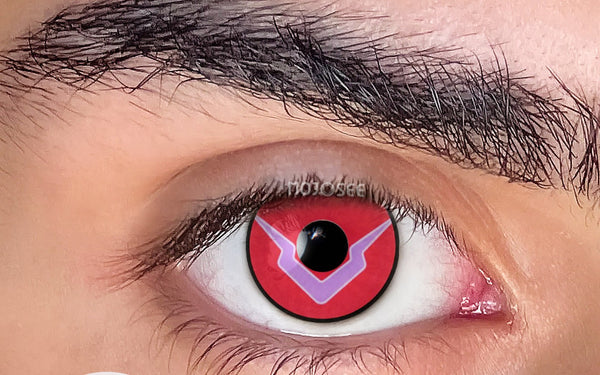
| A cosplay or Halloween character pair | $21.98 – $26.98 | A licensed-look print at 14.5mm; price tracks print complexity |
| Full-eye sclera for a creature costume | $72.98 and up | A 22mm moulding in a small run; plano only |
The pattern to notice: the cheapest tier and the median tier are the same size and the same safety — the money buys print and shade, not a better lens. Spend up for the exact colour you want, not for reassurance.
Why a lens can be $5 somewhere else
Most colored lenses at every price are moulded by a small number of factories, and the same factory can supply a $5 marketplace listing and a $25 specialist listing. The lens may be physically similar. What the $20 difference buys is the chain between the factory and your eye — a prescription check, sealed and dated packaging, storage that was controlled, and a business you can reach — and the reason the $5 listing can be $5 is that it removed all of that. It is not the same product cheaper; it is a different product with the checks taken out, and it is the category the FDA warnings are written about.
What a price does not tell you
Two designs at $22.98 can be a subtle 14.0mm natural and a dense 14.5mm anime print — the same price, opposite purposes. Price tells you almost nothing about how a lens will look on your eye; the size line and the on-eye photograph do. Buy by size and print density first, and let the price be the tie-breaker between two designs that both pass.
FAQ
How much should I pay for good colored contacts?
Expect $19–24 for a quality yearly pair and $27–35 for a pack of daily disposables. Below roughly $10 a pair, ask what was cut — usually pigment isolation, sterile packaging or testing.
Why are some colored contacts only $5?
Ultra-cheap lenses typically skip sealed pigment layers and batch quality control, and many are sold illegally without prescription verification. The savings are real; so are the risks.
Do prescription colored contacts cost more than plano?
No — at Mojosee the price is the same whether you choose 0.00 or a corrective power. Note that in the US a valid prescription is required either way.
Which is cheaper long-term, daily or yearly lenses?
For anyone wearing color twice a week or more, yearly lenses win on cost per wear even after adding solution and cases. Occasional wearers come out ahead with dailies.
How do I avoid paying for shipping?
US orders over $49 ship free. Two yearly pairs typically clear the threshold — which is also the practical way to keep a natural shade and a bold shade in rotation.
Explore more: For Dark Eyes → · Gray → · Cosplay →
What is the average price of colored contacts?
The median in-stock design here is $22.98 a pair at the time of writing, and half of the catalogue sits between about $21.98 and $26.98. The outliers are 22mm sclera at $72.98 and up, and the cheapest plano designs from $8.88.
Do bigger colored contacts cost more?
Not until 22mm. The three standard sizes — 14.0, 14.2 and 14.5mm — share almost the same price band. Full-eye sclera lenses cost three to four times as much because they are a larger moulding made in small runs.
Why do prescription colored contacts cost more than plano?
A powered design carries stock of every step from 0.00 to -8.00 rather than one plano version, and the median powered design here is $34.98 against $22.98 for plano. Same lens, more inventory behind it.
You might also like
Picked to match this guide — every pair in stock now.
 Vika Tricolor Blue Colored Contact Lenses$21.98per pair (2 lenses)
 Polar Lights Blue Gray Prescription Colored $19.98per pair (2 lenses)
 Starry sky Gray Prescription Colored Contact$22.98per pair (2 lenses)
 Polar Lights Brown Prescription Colored Cont$21.98per pair (2 lenses)
Explore more: Colored Contacts for Dark Eyes →