








Why Are My Colored Contacts Blurry? 7 Causes and How to Fix Each
Does blinking clear it? That one question splits the 7 causes of contact lens blur — inside-out lenses, pigment drift, deposits, dryness, power, astigmatism, damage — and each has a fix.
New lenses in, world slightly smeared — or lenses you've worn for weeks suddenly hazy by afternoon. Blur with colored contacts has seven common causes, and you can identify yours in about two minutes with one question: does blinking temporarily clear it? If yes, it's a surface problem (causes 3 and 4). If no, it's fit, orientation or optics (the rest). Work down the list.

1. The lens is inside out
The classic. An inside-out lens sits loose, moves with every blink and blurs on and off. Before inserting, do the side check: on your fingertip, a correct lens is a clean bowl with edges curving straight up; inside out, the edges flare outward like a soup plate. Full technique in the insertion guide. If blur started the moment you put them in, fix this first — it's the cause in half of all cases.
2. The pigment zone is drifting over your pupil
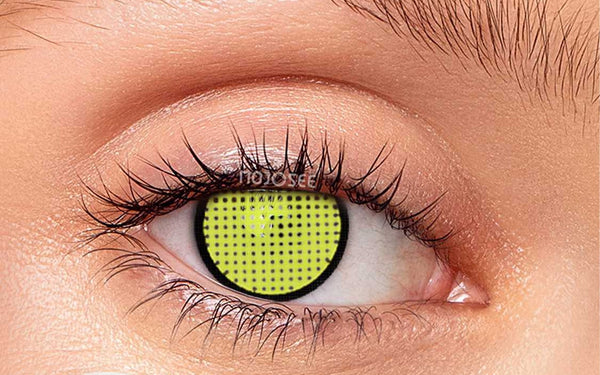
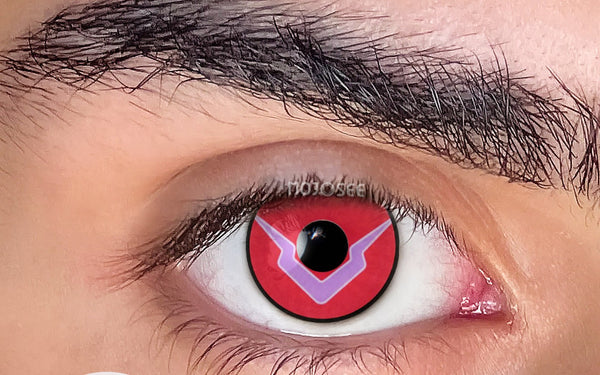
Colored lenses have a clear optical center surrounded by printed pigment. Large-diameter costume styles have proportionally smaller clear zones, so when the lens rotates or slides, pigment edges cross your line of sight — momentary shadowing or haze, worst in dim light when your pupil dilates wider than the clear zone. Fixes: size down (see the diameter guide), and accept that heavy patterns like red patterned eye or mesh trade some visual crispness for the look — that part is by design.
3. Deposits: the week-three haze
Protein and lipid film builds on any soft lens. If vision is clear in the morning and fogs by evening, or a months-old pair is permanently smeary, deposits are your answer. Nightly rub-and-rinse slows it; the replacement cycle ends it — a monthly lens on month three will never be clear again, no matter how you clean it. See replacement cycles.
4. Dryness blur
A dehydrating lens loses its smooth optical surface. Signature: blur that sharpens for a second after a hard blink, worse with screens, AC and hour ten of wear. That's a comfort problem wearing a vision costume — the full fix list is in the dryness guide.
5. Wrong power (or plano when you need power)
Fashion lenses default to 0.00 — if you normally wear glasses and ordered plano, the blur is just your prescription. Most of our natural styles come in minus powers; check the power selector on the product page. One nuance: your contact lens power can differ slightly from your glasses power (vertex distance) — for higher prescriptions, use your contact lens Rx, not your glasses Rx, and see the VERTEX note on product pages.
If wrong power is your suspect, the fix is a lens sold in real minus steps per eye — Ocean Brown runs from plano down the minus range with each eye ordered separately, which deletes this failure mode entirely.

6. Astigmatism
Standard colored contacts are spherical — they correct near- and far-sightedness but not astigmatism. With mild astigmatism most people wear spherical lenses happily with a touch of softness at night; with moderate-plus cylinder, no spherical lens will ever be crisp, and that's a conversation with your eye doctor, not a different color choice.
7. The lens itself is done
Torn edge, warped from a dried-out night, past its cycle, or past its printed expiry — a damaged lens blurs and usually announces itself with irritation too. When in doubt, compare against a fresh pair; if the fresh one is crisp, the mystery is solved. Expiry rules live in shelf life and storage.
The decision tree
Blurry from first insertion: inside-out, wrong power, or astigmatism. Blurry by evening: dryness or deposits. Blurry in dim light: pigment-zone overlap. Blurry one eye only: flipped, damaged or dirty lens — swap that one first. Blurry without lenses in: not the lenses — see your eye doctor.
The two-minute clean-and-recheck test
Before assuming a lens is defective, run this: take the suspect lens out, rinse it thoroughly in fresh multipurpose solution (never water), rub it gently between clean fingertips to lift any film, inspect it against the light for a tear or a rough edge, confirm it's not inside out, and reinsert. Roughly half of "this lens is blurry" cases are solved right here — the blur was a deposit smear or a flipped lens, not a real optical problem. If a freshly cleaned, correctly-oriented lens is still blurry, compare it directly against a brand-new pair: crisp new lens means the old one is spent (deposits or past its cycle); still blurry with a new lens means the issue is your power, astigmatism, or your eyes rather than the lens. This one test cleanly splits "lens problem" from "not a lens problem" and saves you troubleshooting the wrong thing.
Why colored lenses blur more than clear ones
A clear soft lens is optically simple: a thin, uniform disc. A colored lens adds a printed layer, and the print has to leave a clear window over the pupil. Two consequences follow. First, the lens is slightly thicker and less oxygen-permeable, so it dries faster and dryness blur arrives sooner. Second, if the clear window is not centred over your pupil — because the lens has rotated, drifted, or is simply the wrong diameter for your eye — the edge of the print sits in your line of sight and everything goes soft. Neither is a fault in the lens; both are fit and handling, and both are fixable.
The one thing that is not fixable is a lens whose print has started to break down. A cloudy or patchy print scatters light, and no amount of cleaning restores it. If the haze is in the lens rather than on it, the lens is finished.
Diameter and the drifting window
This is the cause people miss because it does not feel like a fit problem. A 14.5mm costume lens on an eye that was fitted for 14.0mm has more lens than the lids can hold in place, so it rides up under the upper lid on each blink and settles slightly off-centre. The clear window moves with it, and the pupil ends up looking through the printed edge. The symptom is blur that comes and goes with blinking and is worse when you look up.
The fix is the size, not the lens. For everyday wear on an eye fitted at 14.0mm, buy 14.0mm; keep 14.5mm for costume nights when a bit of drift is tolerable. If you are not sure what you were fitted for, the diameter is a line on your prescription.
Blur that is actually the eye, not the lens
Three situations look like a lens problem and are not.
Dryness from the environment. Air conditioning, screens, wind and long wear all thin the tear film, and a printed lens shows it first. Rewetting drops formulated for contact lenses — not redness-relief drops — clear this in seconds. If it comes back within minutes, the wear session is over.
Uncorrected astigmatism. A spherical colored lens cannot correct an astigmatic eye, so someone with a meaningful cylinder in their prescription will see softly through any spherical lens, colored or not. The tell is that the blur is directional — vertical lines sharper than horizontal, or the reverse — and constant. We do not stock toric colored lenses; if your cylinder is significant, the honest answer is a clear toric lens.
A prescription that has changed. Vision drifts. A lens bought against a two-year-old prescription can be the wrong power now, and the blur will be there with the lens in and gone with glasses on. That is a renewal, not a lens problem.
Reading the blur: a quick diagnostic
| What the blur does | Most likely cause | First thing to try |
|---|---|---|
| Comes and goes with blinking, worse looking up | Lens drifting — often the wrong diameter | Re-centre; if it recurs, check the size against your prescription |
| Clears for a few seconds after a blink, then returns | Dryness | Rewetting drops; shorten the wear session |
| Constant, same in both eyes, started week two or three | Deposits | Rub-and-rinse clean; if no better, the lens is done |
| Constant, directional (lines one way sharper) | Astigmatism | Check your cylinder; a spherical colored lens will not fix it |
| Only one eye, from the moment it went in | Inside out, or the lenses are swapped | Take it out, check the profile, swap eyes |
| With pain, redness, or light sensitivity | Not a lens problem | Lens out, stays out, eye care professional today |
Most colored-lens blur is in the first three rows, and all three are handling. The last row is the only one where waiting costs you something.
Why new wearers see blur that experienced wearers do not
Two habits separate them. Experienced wearers check the profile on the fingertip every time — a clean U is correct, a flared rim is inside out — so they never wear an inverted lens for an hour wondering why it is soft. And they centre deliberately: after insertion, look straight ahead in a mirror, blink slowly three or four times, and confirm the print is concentric before doing anything else. On a clear lens neither habit matters much; on a printed lens with a clear window, both are the difference between sharp and hazy.
The third habit is less obvious: they take the lens out at the first sign of dryness rather than pushing to the end of the day. A printed lens that has dried on the eye is harder to remove, and forcing it is how a blur problem becomes a scratch.
When to stop troubleshooting and take it out
Every cause above produces blur without pain. Blur with pain, redness that gets worse after the lens is out, new light sensitivity, or cloudiness that stays after the lens is removed are different: those are the early signs of infection or a corneal scratch, and the response is lens out, not back in, and an eye care professional the same day. The line between "annoying" and "urgent" is whether the eye still feels wrong once the lens is gone.
If the lens is the problem, the cheap fix
A colored lens that blurs from deposits or a breaking print is at the end of its life, whatever the box says about replacement. If that keeps happening — because the cleaning routine is not really happening — the fix is a daily disposable: one wear, no case, no deposits, no week-three haze. The extra cost per wear is small next to the frustration of a lens that will not clear.
FAQ
Are new colored contacts blurry at first?
The first few minutes, yes — the lens is settling and your tear film is adjusting. Persistent blur past the first day is not adaptation; run the checklist above, starting with the inside-out test.
Why are my contacts blurry at night?
Two usual suspects: a day's worth of dryness and deposits (blink test — if blinking helps, that's it), or your pupil dilating wider than the lens's clear optical zone in dim light, which shows pattern edges.
Can I wear colored contacts if I have astigmatism?
With mild astigmatism, many people wear spherical colored lenses comfortably, accepting slight softness. Moderate or higher astigmatism needs toric correction that standard colored lenses don't provide — ask your eye doctor before ordering.
Why is only one eye blurry?
Almost always mechanical: that lens is inside out, damaged, dirtier than the other, or the two lenses got swapped between eyes (relevant if your prescription differs per eye). Fix or replace that single lens before troubleshooting anything else.
Why do colored contacts blur faster than clear ones?
The printed layer makes the lens slightly thicker and less oxygen-permeable, so dryness blur arrives sooner, and the clear window over the pupil has to stay centred — a rotated or oversized lens puts the print edge in your line of sight.
Is blur from a colored contact dangerous?
Blur on its own, without pain, is a fit or handling issue. Blur with pain, redness that worsens after the lens is out, light sensitivity, or cloudiness that stays after removal is different — lens out, not back in, and an eye care professional the same day.
Which colored contacts are least likely to go blurry?
A daily disposable at the diameter you were fitted for. No deposits build up because the lens is never worn twice, and the right size keeps the clear window over the pupil.
You might also like
Picked to match this guide — every pair in stock now.
 Vika Tricolor Blue Colored Contact Lenses$21.98per pair (2 lenses)
 Polar Lights Blue Gray Prescription Colored $19.98per pair (2 lenses)
 Starry sky Gray Prescription Colored Contact$22.98per pair (2 lenses)
 Polar Lights Brown Prescription Colored Cont$21.98per pair (2 lenses)
Explore more: Colored Contacts for Dark Eyes →