








Sith Eye Contacts: Getting the Red-Yellow Villain Look Right
The corrupted villain eye — molten yellow iris ringed in red — is one of the most-searched effect looks. What makes it read correctly, and how to wear it.
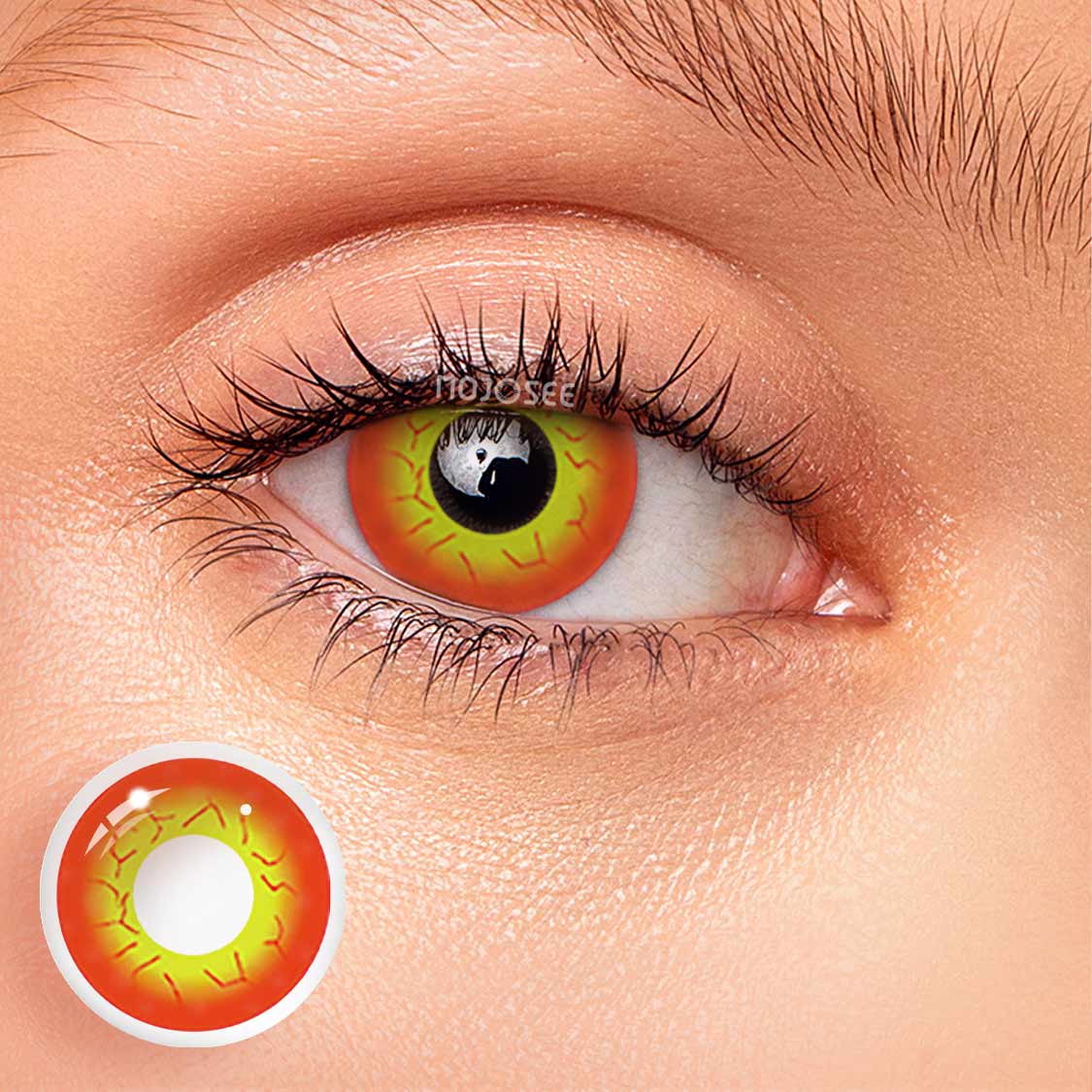
The "sith eye" that fans search for is a specific piece of visual language: a molten yellow-gold iris wrapped in a burning red rim, the universal shorthand for a character consumed by the dark side. Get the two-color structure right and the look lands instantly; get a flat yellow or plain red lens and it reads as generic Halloween. (Design note: our lenses are fan-inspired interpretations — Mojosee is not affiliated with any film franchise.)
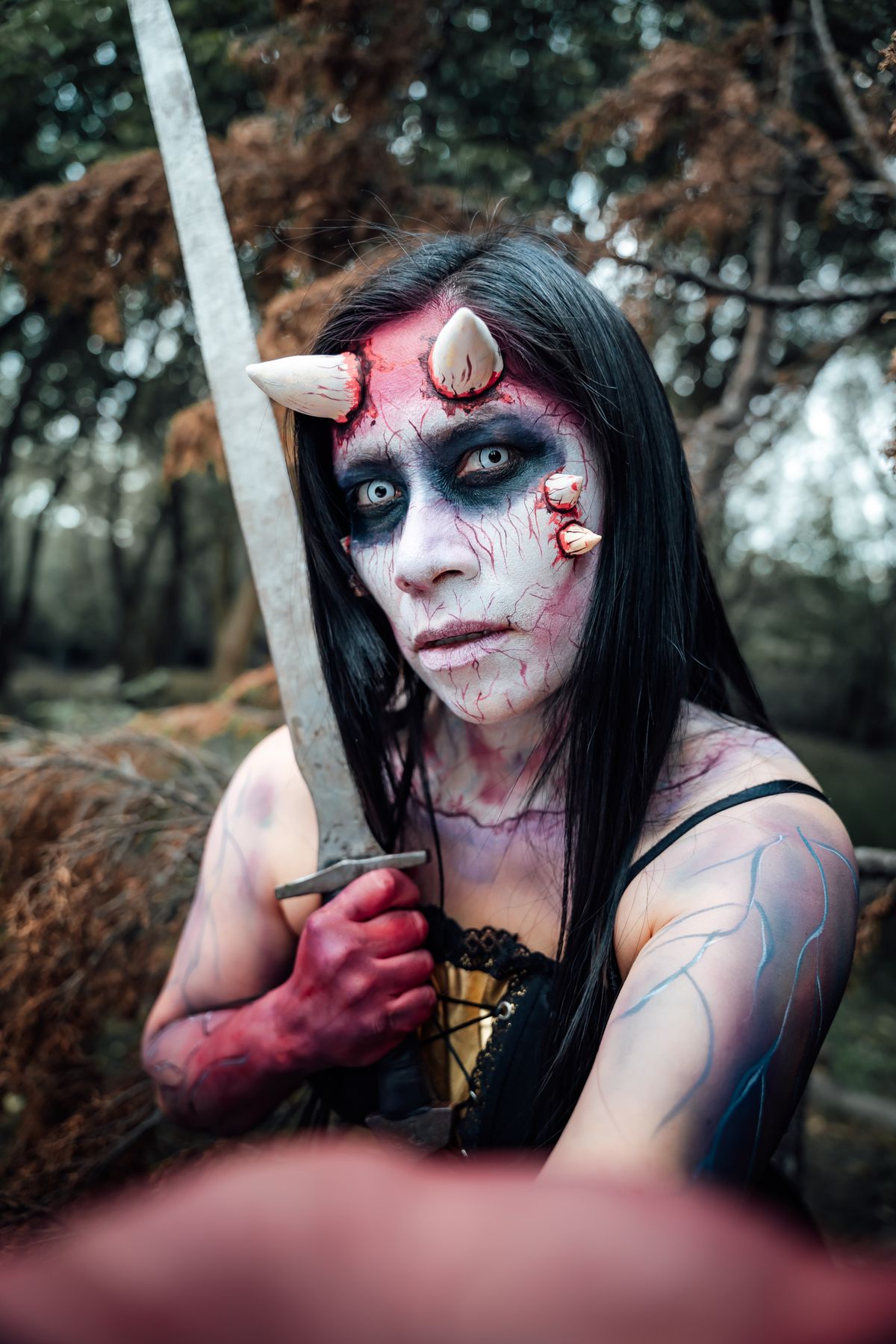
What makes the villain eye read correctly
Three elements, in order of importance:
- The two-tone structure. Yellow core + red outer ring is non-negotiable — it is what separates "corrupted" from "cat" or "demon". Our Red & Yellow Villain Eye lens prints exactly this gradient at 14.5 mm.
- Dark surroundings. The look was designed for hooded, shadowed faces. Deep-set eye shadow, dark brows and low-key lighting do half the work.
- Intensity without motion. Villain eyes are still. In photos, a fixed gaze slightly below the camera line reads far more menacing than wide eyes.
On dark brown eyes
This is one of the few effect looks that is genuinely easier on dark irises: the opaque yellow print gets full saturation over brown pigment, and your natural dark limbal area blends into the printed red rim, deepening the burn effect. Light-eyed wearers often get a brighter, more cartoonish yellow — dark-eyed wearers get the smolder.
Both eyes, or one?
Both. Unlike mesh or single-feature character eyes, the corrupted look is symmetrical by definition — one yellow eye reads as an accident. The lens has a clear central zone, so vision stays normal and a full party night is realistic (8+ hours with drops, standard care).

Building the rest of the look
- Minimal version: the lenses + charcoal smoked lids + neutral face. The eyes carry it.
- Full villain: add a dark hood or high collar, sallow contour (gray-taupe, not bronze), and matte skin. Avoid red face paint — the red belongs in the eyes only.
- Photography: single top-light or ring light at low power; slight underexposure keeps the yellow molten. Flash at full power flattens the gradient.
Adjacent looks from the same shelf
If the brief is "evil, but not that franchise": Vika Tricolor Red gives a wearable demon glow, Hell Raiser goes full chaos, and red sclera is the maximum-budget possession look. Browse the whole shelf in Halloween contacts and compare vision trade-offs in the effects guide.

Standard delivery: 12–20 days.
Getting the full Sith transformation, not just the eyes
The red-and-yellow Sith eye is iconic, but the lens alone reads as "red contacts" without the surrounding details that sell the dark-side corruption. The lens: a red-iris-on-yellow-sclera-adjacent design is the canon look — the fiery ring with the sickly ring around it. The skin: Sith corruption comes with pale, veined, cracked skin — cool grey-toned pallor with dark veining radiating from the eyes turns "red contacts" into "fallen Jedi." The socket: darkened, hollowed, slightly bruised — the corruption should look like it's spreading from the eyes outward. The context: hood, dark robes, and lighting that lets the eyes glow (the same front-catchlight geometry from the photo guide makes the red actually read on camera rather than going dark). The eyes are the anchor, but it's the veined pallor and hollow socket that make people recognize the specific character rather than just "someone in red lenses." Match the exact design to your character — a fully-turned Sith versus mid-corruption differs in intensity — and build the makeup outward from the eyes as the source of the corruption.
Standard delivery: 12–20 days.
The villain-eye options, side by side
Four designs cover this shelf, and they differ in how the yellow and red are arranged — which is exactly what decides whether the eye reads as Sith, as demon, or as a generic red contact. Prices are for one pair (two lenses); every design is 14.5 mm.
| Design | The effect | Pupil | Price | Rx | Best for |
|---|---|---|---|---|---|
| Sith Eye | Yellow iris, red outer burn | Normal | $22.99 | — | The canonical fallen-Jedi eye |
| Yellow Small Pupil | Flat yellow, pinpoint pupil | Shrunken | $34.98 | 24 powers | Inhuman stare, prescription needed |
| Red Small Pupil | Flat red, pinpoint pupil | Shrunken | $34.98 | 24 powers | Full corruption, prescription needed |
| Hell Raiser | Black and white ring | Normal | $19.98 | — | Dark-side without the yellow |
The two small-pupil designs are the only ones on this shelf made in prescription powers — 24 spherical steps each, which is unusual for special-effect lenses and worth knowing if you wear glasses. Spherical powers do not correct astigmatism; a cylinder value means ordering a spherical equivalent, and the calculator converts your numbers.

Getting the colour relationship right
The single thing that makes a villain eye read correctly is that yellow sits inside red, not beside it. The canonical fallen-Jedi eye is a sulphur-yellow iris with the red bleeding inward from the rim, as though the sclera itself is inflamed. Reverse that — red iris, yellow rim — and the eye reads as a demon or a dragon instead.
On dark brown eyes the yellow is the part at risk, because yellow is the lowest-contrast colour against a dark iris. Only fully opaque prints hold it; any design described as a tint will drift olive or muddy green. Everything in the table above is opaque.
On light eyes the opposite risk applies: yellow over blue can go slightly green, and the red rim reads hotter than intended. Going one step deeper — or choosing the small-pupil design, where the flat colour dominates — solves it.
One eye or both. Both, for a Sith. This is not a one-eye look: the corruption is systemic in the source material, and a single yellow eye reads as an injury rather than a fall.
What goes wrong with villain eyes
These are the failure modes we see most, and each is decided at order time.
Buying plain red for a Sith. Plain red is a vampire or a demon. The Sith eye is yellow with red intrusion, and the distinction is the whole costume — this is the most common miss in the category by a wide margin.
Expecting a small pupil to read across a room. The shrunken pupil is a close-up and camera effect. At conversational distance a viewer reads iris colour first; the pinpoint pupil only becomes unsettling within a metre or two. Build the poses accordingly.
Warm venue lighting. Orange and amber uplighting flattens yellow into the colour of the room, and this is the single most common "my lenses did not show in photos" complaint on this shelf. Cool or neutral light is what makes yellow read; if the venue is warm, the black-and-white ring design holds its shape better than either yellow or red.
Letting the makeup compete. Cracked dark-side veining around the eye socket and a yellow iris are both close-up details fighting for the same attention. Either keep the veining subtle and let the eye carry the face, or accept that in a wide shot neither will read.
Ordering after the deadline and paying for it twice. Villain eyes are peak-season stock, and yellow sells through before red does — it has fewer substitutes. Order while the shade you want is still there — by the time the popular yellows go, the substitutes are a different costume.
One detail that separates a convincing fall from a costume-shop one: the red should look like it is coming from the sclera inward, not printed as a neat ring. On the worn photo above, the veining is irregular and thickest at the outer edge, which is why it reads as inflammation rather than as a border. When you are checking product photos before buying, look for that irregularity — an evenly drawn red circle around a yellow disc is the tell of a cheaper print, and it is visible in close-ups even when it looks fine in the listing thumbnail.
The numbers
One unit is one pair, which is two lenses. A full villain build is one pair: $19.98–$34.98 for the entire eye effect. Two pairs — a Sith and an apprentice, or a standard pair plus a prescription pair — clears the $49 free US shipping threshold (outside the US it is $49; under it, shipping is $10.99).
Diameter is 14.5 mm across the shelf, which is ordinary cosmetic-lens territory: no special insertion technique, no sclera handling, and comfortable for an evening provided you keep solution with you and take them out before sleeping. None of these designs cover the pupil, so vision is normal.
Standard delivery: 12–20 days. See order deadline guide. For a convention, count back the same way and add a week to test-wear at home.
Two-person and group builds
The master-and-apprentice pairing is the most common two-person build on this shelf, and it has a lens logic worth planning. Give the fully fallen character the flat small-pupil design — the pinpoint pupil reads as someone who has been at this a long time — and give the apprentice the yellow-with-red-burn design, where the red is still arriving from the edges. Photographed side by side, the two lenses tell the progression without a line of dialogue, and it costs the same as buying two identical pairs.
For a larger group, the practical constraint is insertion time rather than money. Special-effect lenses take a first-timer several minutes per eye, and a group of five with two beginners can lose half an hour at exactly the moment everyone wants to leave for the venue. Hand the lenses out days in advance with instructions to practise once at home; the pair you bought includes a spare of each eye, which is what makes a failed first attempt survivable. The first convention guide has the full kit list, and the short version is: solution, case, mirror, clean hands, and more time than you think.
Sith eyes versus the other red-and-yellow looks
Three neighbouring effects get bought by mistake for this costume, and knowing the difference saves an order.
Vampire reds keep human iris architecture — round pupil, clean limbal edge, no yellow anywhere. They read as predator rather than as corruption; those live in the vampire red guide. Wolf and animal ambers are warm gold with a jagged rim, which reads as feral rather than fallen — the wolf eye guide covers that shelf. And demon prints add pattern to the iris: slits, triple pupils, rank marks. The moment geometry enters the iris, most viewers stop reading Sith and start reading monster.
If your costume is a fallen Jedi, stay with yellow-inside-red and a normal round pupil. Everything else on this page is a different story being told.
FAQ
Can you see through sith eye contacts?
Yes — the red-yellow print surrounds a clear central zone, so vision is functionally normal. This is an all-night lens, not a short-session effect.
Do they work on dark brown eyes?
Better than on light eyes — full saturation on the yellow, and your natural dark rim deepens the red burn.
Do I need a prescription for 0.00 costume lenses?
In the US, yes — all contact lenses are prescription medical devices regardless of power. See the safety guide.
What diameter are villain eye lenses?
14.5 mm — slight enlargement that suits dramatic looks. For daily-wearable red-adjacent colors, stay 14.0–14.2 and see red contacts for dark eyes.
What contacts do you need for a Sith costume?
A red-iris design (ideally with the sickly yellow ring that marks dark-side corruption). But the lens alone reads as "red contacts" — pair it with cool veined pallor and a hollowed, darkened socket to turn it into a recognizable fallen-Jedi look.
What colour are Sith eyes exactly?
Sulphur yellow in the iris with red bleeding inward from the rim — yellow inside, red outside. Plain red with no yellow reads as a vampire or demon, and reversing the order (red iris, yellow rim) reads as a dragon. The arrangement is what identifies the costume.
Do villain eye contacts come in prescription?
Two designs on this shelf do: the yellow and red small-pupil lenses, each in 24 spherical powers. The rest are plano. Spherical powers do not correct astigmatism, so a cylinder value means ordering a spherical equivalent rather than a toric lens.
Will yellow contacts show on dark brown eyes?
Only if the print is fully opaque, which every design here is. Yellow is the lowest-contrast colour against a dark iris, so a sheer or tint-style yellow will drift muddy olive. This is the one colour where opacity is not optional.
Should I wear one Sith lens or two?
Two. Unlike a red patterned eye or a scarred-eye build, dark-side corruption is systemic in the source material — a single yellow eye reads as an injury, not a fall.
Why do my yellow lenses disappear in party photos?
Warm venue lighting. Orange and amber uplighting flattens yellow toward the colour of the room. Shoot under cool or neutral light, or pick the black-and-white ring design, which keeps its contrast under any colour temperature.
You might also like
Picked to match this guide — every pair in stock now.
 Circle Block Colored Contact Lenses$18.98per pair (2 lenses)
 Cat Eyes Colored Contact Lenses$17.99per pair (2 lenses)
 Mesh Colored Contact Lenses$18.98per pair (2 lenses)
 Wolf Eyes Colored Contact Lenses$24.98per pair (2 lenses)
Explore more: Red Halloween Contacts → · Yellow Halloween Contacts → · halloween →