








Why Do Colored Contacts Feel Dry? What to Check First
Dry-feeling colored contacts can have several causes. Learn which symptoms need prompt care, what to record for your fitter and how to use only compatible drops.

If your colored contacts feel dry, take the discomfort seriously before looking for a different color or a longer-wear claim. Remove the lenses if your eyes are irritated, switch to glasses, and note when the sensation began. An eye care professional can check your tear film, lens fit, replacement schedule and care products. If there is pain, marked redness, light sensitivity, discharge or a sudden vision change, call promptly; those signs cannot be diagnosed from a blog post. Rewetting drops may help some wearers, but only if the product is appropriate for the exact lens and your professional has recommended it.
“Dry” can describe several experiences: a lens that feels gritty after hours at a screen, one that stings immediately after insertion, or one that moves poorly at removal. They do not have one guaranteed fix. The CDC lists dry eyes, allergy, abrasions and infection among different contact-related problems. Guessing which one you have from a mirror is unreliable. A useful first step is to separate ordinary environmental discomfort from symptoms that need an exam, and to record the details a fitter can actually use.
Start with a short symptom check
| Pattern | What it may tell your fitter | Action now |
|---|---|---|
| Discomfort builds during screen work or in dry air | Environment and blinking may contribute | Take a break, remove uncomfortable lenses, discuss prevention |
| Stinging starts after a new solution or fresh pair | Care product, damage or fit needs review | Stop that wear; bring the products and lens details to your appointment |
| Pain, strong redness, light sensitivity, discharge or new blur | Possible serious eye problem | Remove if safely possible and contact eye care promptly |
The National Eye Institute names pain, red eyes, light sensitivity, sudden blur and discharge as reasons to take out contacts and seek help if symptoms persist or worsen. Do not keep a lens in to finish a photo session when those signs appear. Nor should temporary relief from a drop become permission to ignore repeated symptoms. Keep backup glasses available so the safe choice is practical.
Why the same lens may feel different at a screen
The NEI notes that dry-eye symptoms can be associated with long periods looking at a computer, tablet or phone, and suggests screen breaks and avoiding drying environments as possible measures. That does not prove your lens is the cause, or that “more water content” on a product page would solve it. A print pattern, diameter or hydration number alone cannot tell whether a lens fits your eye or how it will feel at hour six. The lens should match the fitted model and the professional's wear plan.
Pay attention to where and when the feeling changes. Did it begin after three hours of editing photos under an air vent, after switching solutions, or immediately after opening a sealed pair? Did it occur in one eye only? Does it persist after removal? A brief note on your phone can make a later exam more useful than “all contacts are dry.” If a lens repeatedly becomes difficult to remove, the AAO says both lubrication and fit may need reassessment; the answer is not to pull harder.

Know the difference between drops and disinfecting solution
Ask which rewetting or lubricating drops can be used with your exact lenses. The AAO advises choosing a product clearly labeled for contact-lens wear when drops are used over lenses and following your doctor's guidance. A bottle that says “eye drops” is not automatically compatible. A saline rinse or rewetting drop is also not a substitute for disinfecting a reusable lens; the AAO's care guide separates those jobs.
Never top off old case solution or use water, saliva or homemade saline to store a pair. The CDC's care guidance calls for fresh recommended solution, handwashing and complete hand drying, and replacing the case on the advised schedule. If a bottle was left open, the case is dirty, or you cannot identify the solution, pause lens wear and obtain proper supplies. More liquid is not necessarily the same as correct care.

Replacement schedule and fit deserve a check
A reusable lens has a prescribed replacement schedule even if it spends many days in the case. Wearing it beyond that schedule, changing the disinfecting routine, or switching brands on the basis of a shared power can create problems. The replacement-cycle guide separates daily wear from daily disposable and from an annual label. Neither “annual” nor “soft” is a comfort guarantee. If a recently fitted pair becomes uncomfortable before its expected replacement date, tell the fitter instead of trying to solve it by choosing a different diameter yourself.
Colored lenses sold without vision correction still require proper fitting and care. The FDA explains that decorative contacts require an exam and prescription in the United States. A plano option does not make the lens a cosmetic accessory you can swap freely. If your eyes are persistently dry, your professional may consider different lens materials, wear time or a broader dry-eye evaluation. A blogger cannot select those for you from a catalog photo.
Use a simple log before buying another pair
Write down the exact brand and model, prescription, opening date, stated replacement schedule, solution name, any drops used, hours worn, activity, room conditions and symptoms. Bring the package or a photograph of it. The goal is not to run a self-experiment through several painful wears; it is to give an eye care professional enough context to decide what changed. The removal guide helps if the lens has become hard to lift, while the sensitivity guide explains why itch and irritation are not always the same as dryness.
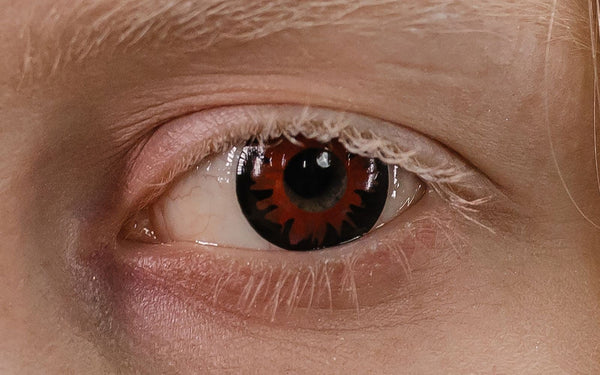
If you are comparing a violet look, the independent cover shows a person wearing a violet lens; it is not a test of any store lens or a promise of comfort. The violet designs below are visual examples to consider only after the exact lens is fitted and its care plan is clear. Price and available options can change, so verify the product page. Choosing a shade is a separate decision from working out why your eye felt dry.
FAQ
Why do my colored contacts feel dry after a few hours?
Screen time, dry air, the tear film, care products, fit and other conditions may contribute. Remove uncomfortable lenses and discuss the pattern with your eye care professional; a catalog specification cannot diagnose the cause.
Can I put any artificial tears over colored contacts?
No. Use only drops labeled for contact-lens wear and recommended for your lens by your eye care professional. Other drops may require removing the lenses first.
Does a higher water-content number mean the lens will be more comfortable?
Not by itself. Comfort depends on the fitted lens, your eye and the wear conditions. Do not choose a brand or size from one number as a substitute for fitting.
Should I keep wearing the lens if rewetting drops help briefly?
Temporary relief does not explain repeated discomfort. If symptoms recur, remove the lens and arrange a fit and eye-health check; seek prompt advice for pain, marked redness, light sensitivity or vision change.
Can I switch to another brand with the same power?
No. A matching power does not make two brands or models interchangeable. Ask your eye care professional to assess the proposed lens.
Is a plano colored contact exempt from fitting?
No. A lens without vision correction still touches the eye and needs fitting, wear instructions and care.
You might also like
Violet looks to compare only after the exact model has been professionally fitted; a new color is not a dryness treatment.
 Vivid Purple Circle Contact Lenses - Dark Rim, Vika Tricolor$26.98per pair (2 lenses)
 Circle Block Violet Block Colored Contact Lenses – Solid Purple Eye$26.98per pair (2 lenses)
 Purple Anime Contact Lenses for Dark Eyes - Violet$26.98per pair (2 lenses)
 Violet-Gray Circle Contact Lenses - Dark Rim, Mirage$26.98per pair (2 lenses)
Explore more: Purple contacts → · Goth contacts →