








Colored Contacts for Light Eyes: Enhancing Blue, Green and Hazel
Most lens guides assume dark eyes. Light-eyed wearers play a different game — easier color payoff, gray as the standout, and one edge problem dark eyes never face.

Nearly every colored-contact guide on the internet is written for dark brown eyes and their coverage problem. If your eyes are already blue, green or hazel, you are playing a different game — an easier one in most respects, with one failure mode dark-eyed wearers never have to think about. Light irises take color with very little effort, which means your decision is almost never "will this show up?" and almost always "how far do I want to go, and will the edge give me away?"
Choose by How Much Change You Want
Keep your natural eye colour recognisable: start with Natural Contacts and compare the inner blend and outer ring in the on-eye photos.
Shift to another colour family: compare individual examples such as Ocean Cyan Gray and Vika Tricolor Green. A lens that looks subtle on dark eyes can read more strongly on a light iris.
Build a character or fantasy look: browse Cosplay Contacts. Always use the live product specifications and photos rather than assuming “natural” means translucent.
What "enhancement tint" means — and what it does not
The term you will keep running into is enhancement tint: a translucent lens that layers over your natural color to deepen and define it rather than replace it. On a dark iris these vanish completely, which is why every dark-eye guide tells you to ignore them. On a light iris they are the whole point — your own color, turned up, with nothing to detect because nothing was covered.

Worth being straight about this: our range is opaque three-tone lenses, not sheer enhancement tints. That does not shut you out of the subtle end — it just means the subtlety comes from the print rather than from transparency. A three-tone lens with a graduated rim, worn on a light iris, lands much softer than the same lens does on dark brown, because your natural color still reads through the outer band instead of fighting it. If you want a whisper, the design of the lens matters more than its opacity number.
Enhance vs transform: pick your lane
Enhance. Stay inside your color family and go a shade deeper or clearer — blue to a richer blue, green to a more saturated green, hazel resolved into a cleaner gold or green instead of a muddle. This is the everyday lane, and on light eyes it is close to undetectable because the change agrees with everything else on your face.
Transform. Jump families entirely. This is the part that is genuinely effortless for you: blue to green, green to gray, hazel to blue all land cleanly, because there is no dark base underneath dragging the color toward mud. Dark-eyed wearers pay for this with opacity; you get it for free. Tricolor designs are the ones to look at, since the graduated rim is what keeps a full color change from reading as a costume.

That is a full family jump on a light base — saturated green, but the rim still grades out instead of stopping at a hard line. On a dark iris the same lens would need to work much harder to get there.

Gray is the light-eyed showstopper
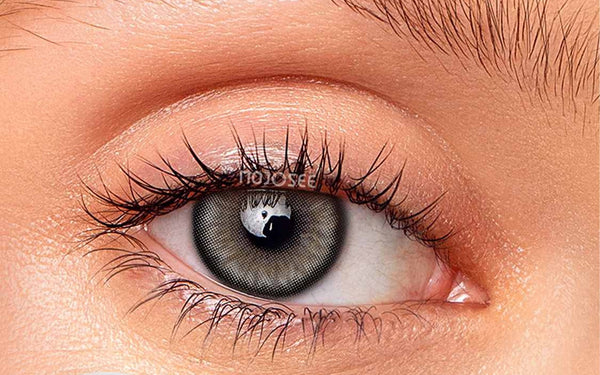
If the signature win for dark eyes is a good hazel, the signature win for light eyes is gray. Gray is the hardest color to pull off on a dark iris — it tends to flatten into silver or drift blue — and the easiest to make look extraordinary on a light one. On a light base a gray lens reads as that rare, cool, slightly steely eye that people cannot place and cannot stop looking at.

That is the effect on a light hazel base: the natural warmth is still there underneath, but the eye now resolves as cool gray-green rather than indeterminate brown-green. That layering is only available to light eyes — on a dark iris the same lens simply prints over the top.

Violet is the shade light eyes ask about most and the one that most often disappoints: see violet tried one eye in, one eye out on hazel eyes before you order it.
The one pitfall: the halo ring
Here is the failure mode that is yours alone. Because your natural iris stays visible right up to the lens edge, any mismatch at that border shows — a faint double ring, or a halo where printed color meets real color. Dark-eyed wearers never see this, because their own iris is darker than the lens edge and simply swallows it.
Two fixes, both about the lens rather than about you. Choose graduated, feathered rims over hard-ringed designs — our pattern guide breaks down rim types, and why contacts look fake covers the ring tell in detail. And stay in natural diameters, 14.0–14.2 mm, so the lens edge lands roughly where your own limbal ring already sits; the diameter guide has the sizing. The sheerest-looking lenses in our range are the wash-style grays, which is where to start if the halo is what you are worried about.

Styling still follows undertone
Light eyes do not exempt you from the undertone rule. Warm-toned light eyes come alive in warm enhancers and greens; cool-toned ones belong in grays and blues — the color guide walks through how to tell which you are. Hair frames all of it, and the pairings in the hair color guide apply to you too, with more room to experiment since almost any color takes.
One last note that cuts the other way: if you have light eyes and you have been reading our dark-eye material, ignore the opacity advice in it. That guide exists because dark irises need a pigmented base to show anything at all. You have the opposite problem — plenty of show, and an edge to keep honest.
FAQ
Do colored contacts work better on light eyes?
They work more easily. Any color will show on a light iris without needing a heavily pigmented base, so both subtle and dramatic results are available. The trade-off is that the lens edge is more visible against a light iris than a dark one.
What are enhancement tint contacts?
Translucent lenses that deepen your natural color instead of replacing it. They only do anything on light eyes — on a dark iris they do not register. Our own range is opaque three-tone rather than sheer tint, so for a soft result look for a graduated rim rather than for transparency.
What is the best colored contact color for light eyes?
Gray, if you want the biggest payoff for the least effort — light bases produce the cleanest grays there are. Otherwise enhance within your family for an everyday look, or jump families for an easy full change.
Why do my colored contacts show a ring on my light eyes?
Your natural iris is visible right to the lens edge, so a hard-ringed or oversized lens creates a visible halo. Graduated tricolor rims in 14.0–14.2 mm blend that border; wide, hard-edged designs never will.
Can light-eyed wearers use lenses made for dark eyes?
Yes, and they will look more saturated on you than on the model, since nothing underneath is muting the pigment. Expect a stronger result than the product photo if that photo was shot on brown eyes.
You might also like
Picked to match this guide — every pair in stock now.
 Dawn Colored Contacts – 4 Natural Shades for$24.98per pair (2 lenses)
 Stunna Girl Colored Contact Lenses$24.98per pair (2 lenses)
 Sexy Cat Colored Contact Lenses$19.98per pair (2 lenses)
 Emerald Spell Vision Blue Colored Contact Le$22.98per pair (2 lenses)
Explore more: Natural Colors → · Natural Contacts → · Greenery →