








Witch Eyes: Green and Purple Contacts That Finish the Spell
The two canon witch colors, decoded: green for the earthy craft, purple for coven royalty — plus the makeup formula and the candlelight lighting trick.
Witch is the most-worn costume archetype every single October, and the eyes are where the look either becomes bewitching or stays "girl in a hat." The two canon witch colors are green and purple — here's what each one actually does, which witch wears which, and the lenses that finish the spell.
The short answer, if you are deciding in a hurry: green for earthy, forest and familiar-bound witches; purple for sorceresses, dark royals and celestial ones. Both read clearly on dark brown eyes provided the lens is opaque, and a round pupil keeps her human where a vertical slit stops her being human at all. Everything below is the long version.
The elegant witch: deep emerald
Candlelight, velvet, a tarot deck fanned across a table — and eyes the color of bottle glass, watching you decide which card to turn. That's the elegant witch, and she runs on deep emerald. The shade sits just inside the range of possible human eyes, which is what makes it powerful: everyone who looks at her spends the evening quietly wondering. In warm light, emerald does something no other costume color does — it glows from inside, like the last hour of a forest before dark. The rest of the look can be one thrift-store cloak and confidence; the eyes carry the coven.


The feral witch: slit pupils
Then there's the witch nobody invites inside — hair full of leaves, familiar on her shoulder, curses muttered in something older than Latin. Her eyes gave up on looking human a few covens ago. A vertical slit pupil in acid green flips a face from "person in costume" to "creature borrowing a body," and it happens instantly, at first eye contact, before anyone has processed the rest of the outfit. It's the single fastest transformation any lens can perform: one design choice, and the whole costume changes species.

The transformed: caught mid-curse
Somewhere between the two lives the hexed one — the witch whose own magic is turning on her, the apprentice who read one page too far. Eyes like this keep the human shape but lose the human color: a wolfish, radioactive green that suggests the transformation is still in progress and nobody knows where it stops. It's the pick for looks built around "something went wrong" — torn sleeves, smudged sigils, a smile that reassures no one.

The dark royal: violet
Purple is the witch who runs the coven. She doesn't stir cauldrons — she has people for that. Violet irises read as power that has never needed to raise its voice: the fortune teller whose predictions keep landing, the queen whose portrait's eyes follow you down the hall. Purple is rarer than green in real life and rarer at parties too, which is exactly why it stops conversations. It deepens in low light instead of washing out, pairs with amethyst and velvet like they were commissioned together, and photographs like an oil painting.

The celestial witch: sparkle in the violet
For the star-chart witch — the one with constellations inked on her collarbone and moon phases in her jewelry — a violet with light caught inside it finishes the astrology. The shimmer reads as starlight at conversation distance and as pure magic on camera, especially under fairy lights or a phone flash. It's the softest entry in the witch canon: less "fear me," more "I already know how your year ends."


Green witch or purple witch: pick your energy
The quick test: is your witch of the earth or above it? Herbs, forests, familiars, moss-and-bone — green, always. Astrology, velvet, court intrigue, quiet menace — purple. Doing a coven group? Split the colors: green and purple witches photograph beautifully together, coordinated-but-different in a way that reads like an actual coven instead of a uniform (the group guide covers the choreography).
The witch-eye makeup formula
Both colors run the same structure. Socket smoked out in deep brown or plum — witchy is shadowed, not glittery. A dramatic wing, extended past comfortable. Under the eye, a wash of the lens color at one-third intensity ties everything together: green shadow under green lenses, plum under purple. Skin matte and half a shade paler than yours. The finishing details: a tiny moon at the outer corner, dark nails, hair loose or hooded. Lips stay muted — dark nude or deep plum, never red, which drags the whole look toward vampire. The lens is the magic; everything else is set dressing.
Candlelight: making witch eyes photograph
Witch shoots happen in dim, moody settings — exactly where lenses die on camera. One candle-warm light source slightly above and in front of the face, eyes angled up to catch it, and the color comes alive; the full geometry is in the photography guide. Green loves warm light (emerald ignites near flame); purple prefers neutral-to-cool light to stay violet instead of muddying brown. Shoot the hero portrait near the light, then go be mysterious in the dark.
The witch lineup, side by side
Six lenses cover the whole archetype. This is what separates them — colour behaviour, pupil shape, diameter and what each one actually does over a dark brown iris, which is the base colour most people are working from.
| Lens | Colour & pupil | Diameter | Price | Over dark brown | Her witch |
|---|---|---|---|---|---|
| Emerald Green | Jewel teal-green, round pupil, fine radial striations | 14.2mm | $22.98 | Opaque — reads as a rich believable emerald rather than washing out | Elegant, candlelit |
| Cat Eyes Snake Green | Earthy green, vertical slit pupil | 14.5mm | $17.99 | Opaque colour field; the slit reads at first eye contact | Feral, familiar-possessed |
| Green Werewolf | Jewel-toned green, jagged outer rim, round pupil | 14.5mm | $19.99 | Opaque print covers the iris fully; stays natural on lighter eyes | Mid-transformation |
| Shizuku Purple | Amethyst with dramatic depth, soft edge, round pupil | 14.5mm | $26.98 | Holds its depth; the softest edge of the purple three | Dark royal |
| Violet Mirage | Periwinkle-leaning violet, dark outer rim, round pupil | 14.5mm | $22.98 | Brown anchors the violet so it glows without going costume-bright | Dark royal, daytime version |
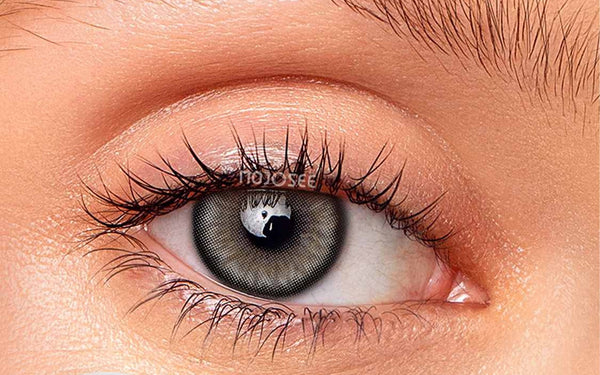
| Witch Nebula Gray | Smoky gray with stardust flecks, deep outer ring | 14.2mm | $22.98 | Speckling keeps its depth instead of flattening to one tone | Celestial |
One pattern worth noticing: the two cheapest lenses in the table are the two most dramatic. Costume geometry — a slit pupil, a jagged rim — is not what costs money. Depth of colour is.
Pick by your own eyes, not just by your witch
The archetype tells you green or purple. Four things about you decide which lens in that colour actually works.
Your base iris. If your eyes are dark brown or black, opacity is the only spec that matters — sheer tints disappear entirely on a dark iris, and no amount of makeup rescues them. Every lens in the table above is an opaque or full-coverage print, which is why they all survive a brown base. If your eyes are light, you have the opposite problem and the opposite freedom: almost anything shows, so pick for depth rather than coverage, and expect the colour to run one shade brighter on you than on the model.
Your skin. Deep and warm complexions carry emerald and amethyst extremely well — the saturation has something to push against. On very fair, cool-toned skin the same emerald can tip theatrical; the gray-based celestial option stays believable where a saturated green would not. Purple is the more forgiving of the two canon colours across skin tones, which is part of why it photographs so consistently.
Your eye shape. Diameter is the quiet variable. On a smaller palpebral opening — or on hooded and puffy lids, where the upper lid covers more iris — a 14.5mm lens can sit with its outer ring partly hidden, which reads as a dark smudge rather than a defined edge. If that is your eye, the 14.2mm options are the safer buy. If you have a large visible iris and want maximum drama, 14.5mm is doing exactly what you want.
Your night. A one-room house party under warm bulbs is a different job from a three-hour photoshoot or a full convention day. Slit pupils are spectacular for an evening and tiring for twelve hours, because they are the lens people ask you about constantly. For a long day in costume, a round-pupil colour asks less of you and still carries the look.
What goes wrong with witch eyes
Nobody writes this part down, so here it is. These are the failures that turn up every October, in rough order of how often.

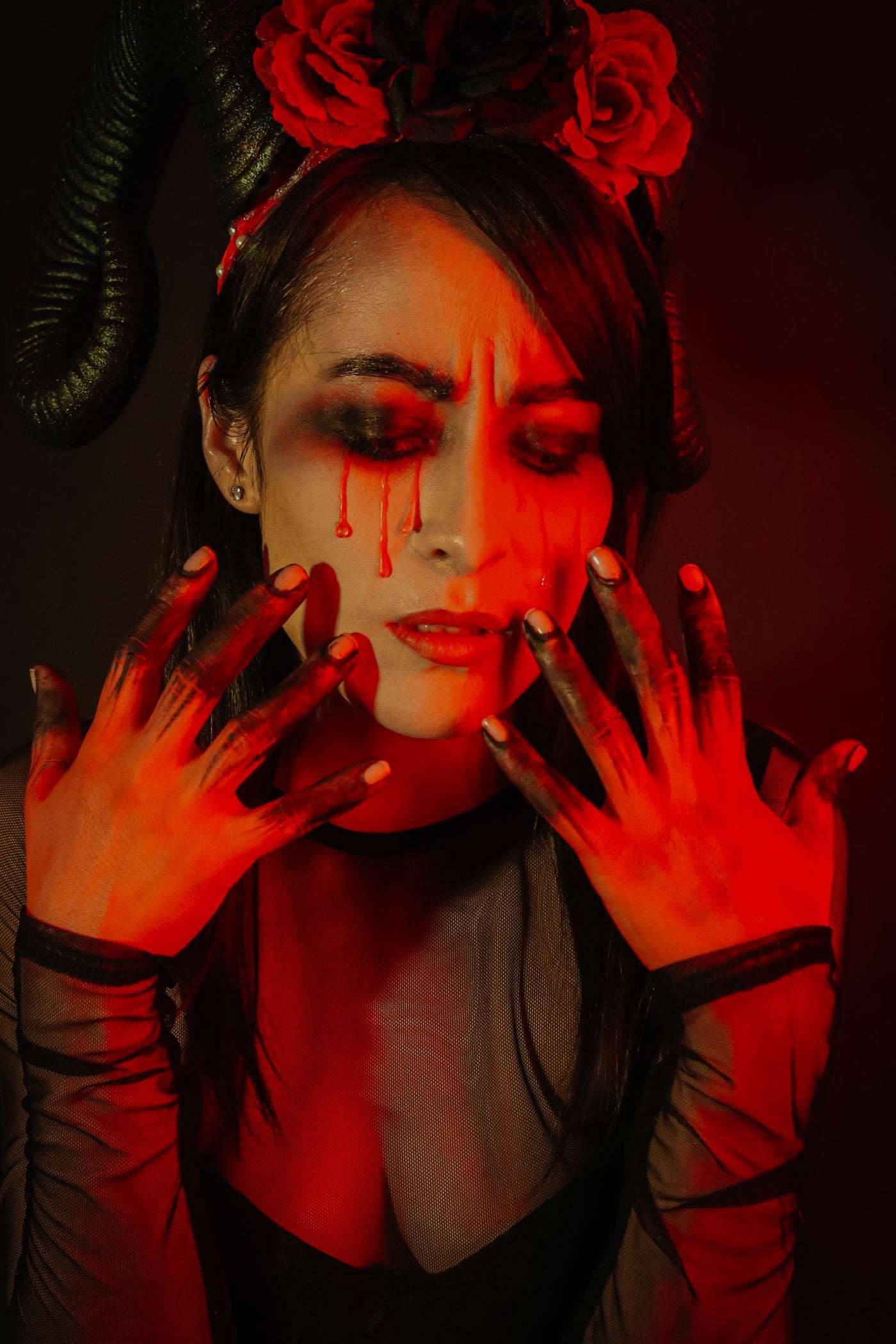
The photo above is the whole lighting problem in one frame: a face lit by a single coloured source. Whatever colour your lenses are, that light is deciding what the camera records. Plan for it.
The colour goes muddy. Almost always a sheer or tinted lens on a dark iris — the brown underneath mixes through and you get swamp rather than emerald. Check that the listing says opaque or full-coverage before you buy, not just that the lens looks green in the vial photo. A lens photographed only on a light-eyed model tells you nothing about your own eyes.
The slit pupil sits crooked. Soft lenses rotate; they settle where they settle, and a vertical slit makes any rotation obvious in a way a round pupil never does. This is normal lens behaviour, not a defect. Blink several times and give it a minute to centre before you judge it, and check a mirror before photos rather than after. If it has not settled straight after a couple of minutes, take it out, rinse it, and reseat it.
Purple turns brown on camera. Violet is the most light-dependent colour in the costume range. Warm candlelight and orange party bulbs drag purple toward brown; the same lens under neutral or slightly cool light reads as clean violet. If your shoot is candlelit and purple is non-negotiable, bring one neutral light source for the hero portraits. Green has the opposite bias — it thrives near flame.
The eyes give out before the night does. Dry indoor air, alcohol, a long evening and a lens you are not used to add up fast. Decide your removal time before you leave the house, carry fresh solution and a case, and accept that costume lenses are an evening commitment rather than an all-nighter. Never top up or rinse with water, and never sleep in them.
Glitter gets behind the lens. Witch makeup and loose pigment go together, and fallout under a lens is the single most common reason a costume gets abandoned at 10pm. Lenses go in first, before any eye makeup, and come out first at the end of the night. Tap excess off the brush, keep liner off the waterline, and if something does get in, remove the lens rather than rubbing your eye.
Someone expects a prescription. These are plano, cosmetic lenses — the power is 0.00 and they do not correct anything, astigmatism included. If you wear glasses, plan to wear the lenses over nothing and accept the blur, or keep the costume to an event where that is fine. Buying a costume lens hoping it doubles as vision correction is the one mistake that cannot be fixed on the night.
The group buys one pair between them. Obvious when written down, and it still happens. Lenses are personal — sharing them passes infection between people. A coven needs a pair per witch.
The numbers that decide the build
Diameter: 14.2mm or 14.5mm. Three tenths of a millimetre sounds like nothing and is visible in the mirror. A natural human iris is roughly 11.5–12mm of visible colour, so both sizes are already enlarging; 14.5mm gives the bigger, more supernatural circle, 14.2mm keeps the outer ring comfortably inside a smaller lid opening.
Base curve 8.6mm, water content 40%. Those are the figures on the HEMA hydrogel series in this guide. The base curve is the fit against your cornea and 8.6mm is the common middle of the range; the water content is why these behave like an evening lens rather than a wear-them-and-forget-them lens — moderate water content holds colour density, which is exactly what an opaque costume print needs.
Price: $17.99 to $26.98. That is the whole witch range, and one unit is one pair — two lenses. The slit-pupil option is the cheapest thing here, which is worth knowing if the budget is tight and the drama is not optional.
Shipping maths. US orders ship free over $49, elsewhere over $49. Two pairs clears the US threshold at almost any combination in the table, which is the practical argument for buying your November lens at the same time as your October one — or for a coven ordering together rather than separately.
Time. Standard delivery is the constraint that actually ruins Halloween builds, not stock. Order dates are printed on each product page; work backwards from the party, not forwards from today, and leave yourself a few days to try the lenses on before the night. A lens you have never worn is not a lens you want to meet for the first time an hour before a party.
Witch lenses versus the drugstore aisle
People ask why they cannot just pick these up alongside their everyday colour lenses. The honest answer is that they are different products solving different problems.
The mainstream colour ranges — FreshLook Colorblends, Air Optix Colors and their equivalents — are built to make eyes look like plausible human eyes. They are excellent at that, and several are available with a prescription, which costume lenses generally are not. What they do not make is costume geometry: no vertical slit pupils, no jagged beast rims, no stardust speckling. A feral witch cannot be sourced from that aisle at any price, because nothing in it is trying to stop looking human.
Pop-up Halloween shops sit at the other end. The look is right and the price is tempting; the variable is information. Before buying anywhere, including here, the check is the same: is the diameter printed, is the base curve printed, is the material named, is the lens sealed in its own blister, and does the seller avoid claiming vision correction it cannot deliver. A seller who publishes all five is telling you something about the lens. A seller who publishes none is telling you something too.
The natural-luxury brands — Solotica and similar — solve believability at a much higher price point and are simply the wrong tool here. A witch is not trying to pass.
After October: the witch colors that keep working
Both colors outlive the costume. A round-pupil textured emerald is a legitimate fashion lens the other eleven months — deep greens read striking-but-human at dinners and shoots, especially against brown and red hair (the hair pairing guide). Soft violets cross over too: in daylight a muted purple reads as "unusual light eyes" (the fashion-purple guide). The slit pupils stay in the costume drawer — those are October hardware. Given the choice between two witch lenses, the one you'd also wear in November wins the cost-per-wear math every time.
FAQ
What color contacts should a witch costume use?
Green for earthy, forest, herb-and-familiar witches; purple for sorceresses, dark royals and celestial witches. Both are canon — pick by your witch's energy, or split them across a group.
Do green contacts show up on dark eyes?
Yes, if opaque — costume greens are built with full-coverage pigment, so the color reads true over any base. Sheer green tints won't; check for opaque coverage before buying.
Can I wear witch contacts with heavy eye makeup?
Yes — lenses go in first, before any makeup, and come out first at night before remover. Keep powder fallout controlled and liner off the waterline; the full sequence is in the makeup order guide.
Slit-pupil or round-pupil lenses for a witch?
Round keeps her human and powerful; slit pushes into familiar-possessed or transformed territory. Elegant witch → round. Feral witch → slit.
What's the best witch lens if I can only buy one pair?
A round-pupil textured emerald — it covers elegant and forest witch looks, photographs richly in candle-warm light, and doubles as a fashion lens the rest of the year. Purple is the pick only if your witch is specifically the dark-royal type.
Will a slit-pupil lens stay vertical?
Mostly, but not perfectly — soft lenses rotate slightly as they settle, and a slit makes that visible where a round pupil hides it. Blink a few times, give it a minute, and check a mirror before photos. Persistent tilt usually means the lens needs reseating rather than replacing.
Do green or purple contacts show up better on very dark brown eyes?
Green, marginally — a saturated green sits further from brown on the colour wheel, so the contrast does more of the work. Purple gets closer to brown under warm light, which is where it can muddy. Both work on a dark iris provided the print is opaque; the difference is how much the lighting can hurt you.
Can I wear witch contacts if I need a prescription?
These are plano lenses — power 0.00, cosmetic only, and they correct nothing, astigmatism included. If you normally wear glasses, you will be wearing the costume without your correction, so plan the evening around that.
How long can I keep witch contacts in at a party?
Treat them as an evening, not a night. Dry air, alcohol and an unfamiliar lens shorten the comfortable window, so decide your removal time before you go out and carry solution and a case. Take them out if they sting, blur or feel gritty rather than pushing through.
You might also like
Picked to match this guide — every pair in stock now.
 Lizard Eye Green Colored Contact Lenses$23.98per pair (2 lenses)
 Lizard Eye Brown Colored Contact Lenses$23.98per pair (2 lenses)
 Blue Mesh Colored Contact Lenses$22.98per pair (2 lenses)
 Black Out Pure Black Blackout Colored Contac$28.00per pair (2 lenses)
Explore more: Green Halloween Contacts → · Purple Halloween Contacts → · Witch →