








Can You Swim or Shower in Colored Contacts? Water Rules Explained
Pools, oceans, hot tubs and yes, your shower — ranked from bad to worst for lens wearers, why the rule has no flexible version, and the goggles-plus-dailies workaround.

Beach day, pool party, or just a hot shower after a long night out — and your colored contacts are in. Can they stay? Short answer: water and contact lenses should never meet, and that includes the shower. Here's what each kind of water actually does, the workarounds that let you see at the pool anyway, and the one-eyed monster of a worst case this rule exists to prevent.
The rule and the reason
Soft lenses are sponges. Whatever the water carries — chlorine, salt, minerals, microorganisms — the lens soaks up and holds against your cornea for hours afterward. The organism that makes this non-negotiable is Acanthamoeba, found in tap water, lakes and hot tubs; the infection it causes is rare, brutal to treat, and overwhelmingly associated with exactly two habits: rinsing lenses in tap water (covered in the water storage guide) and wearing lenses in water. This isn't a comfort rule. It's the one safety rule with no flexible version.
Ranked: from bad to worst
Shower: the one everyone ignores. Brief, low-splash showers with eyes shut usually pass without incident — which teaches the wrong lesson. Spray, shampoo runoff and tap water all reach your eyes more than you think. Lenses out before, or eyes firmly closed and face out of the stream.
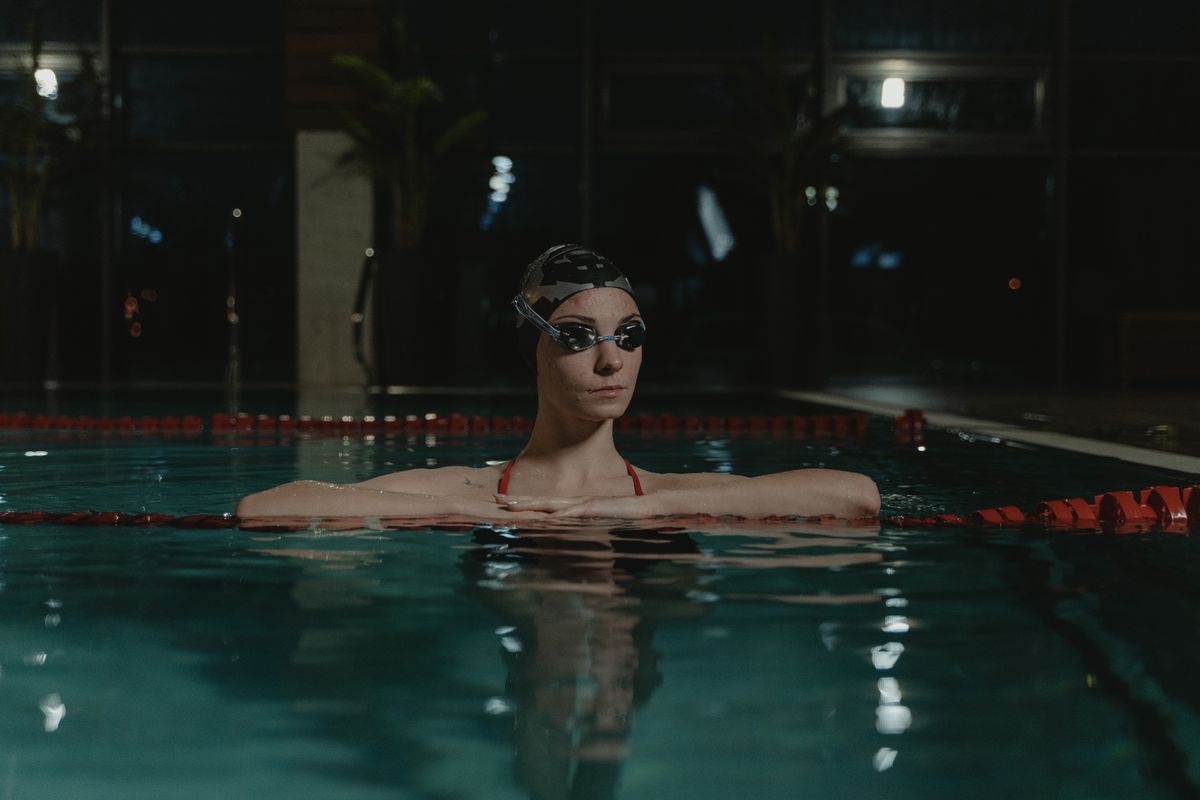
Swimming pool: chlorine doesn't sterilize the way people assume, and it also binds to the lens — post-pool lenses sting and haze. Chlorine-resistant organisms plus a soaked sponge on your cornea: skip it.
Ocean: salt water dehydrates lenses on contact (instant gritty-tight feeling) and carries its own microbial load.
Lakes and rivers: the highest Acanthamoeba territory. Hard no.
Hot tubs: the worst of all worlds — warm water is the organism's favorite temperature, and jets aerosolize it straight at your face. Lenses stay in the room.
"But I can't see without them" — the real workarounds
Daily disposables + sealed goggles is the accepted compromise for swimmers: fresh dailies like DNA Taylor dailies under well-sealed goggles, then bin the lenses the moment you're out and dry-handed. The lens costs a dollar-something; that's the disposal math working as intended. Prescription goggles exist and are cheaper than you'd guess — the better answer for regular swimmers. For the pool party (in the water twice, mostly socializing): put lenses in after you're done swimming instead — carry the case, insert with clean dry hands when you switch to dry-land mode.

If water already got them
Splash across the face: probably fine — but if the lens feels gritty or vision hazes, take it out and clean it properly. Dunked, or wore lenses for a swim: treat the pair as compromised — discard it — and give your eyes a lens-free day. Redness, pain or light sensitivity in the days after any water event: eye doctor, promptly, and mention the water. Fast action is what keeps the rare bad outcome rare.
The beach and pool-day playbook, hour by hour
Here's how lens wearers actually run a water day without breaking the rules. Before leaving: decide your mode. Swimming seriously → prescription goggles or dailies-under-sealed-goggles, spare pair packed. Mostly lounging → lenses stay in the case until after water time. At the water: if you're in dailies + goggles, keep your face out of splash fights and never open your eyes underwater even goggled. If you're lens-free, sunglasses handle the squint. The transition moment (the step everyone botches): out of the water, you must be dry-handed before touching lenses — towel, then hand sanitizer is not enough on its own, so pack a small bottle of solution and do a proper rinse-hands-somewhere-clean routine, or wait until a real bathroom. After: swam in dailies? Bin them immediately, rest your eyes ten minutes, then fresh pair. Any grit, haze or redness that evening → lenses out and stay out overnight. The whole playbook fits in a sandwich bag: case, travel solution, spare dailies, drops.
What is actually in the water
The reason every eye-care body gives the same flat "no" is not the chlorine and not the salt. It is a single-celled organism called Acanthamoeba, which lives in tap water, lakes, pools and hot tubs, and which a soft contact lens is unusually good at trapping against the cornea. The infection it causes — Acanthamoeba keratitis — is rare, painful, slow to treat, and in the worst cases ends in a corneal transplant. Almost every documented case involves a contact lens and water.
A colored lens changes nothing about that mechanism except one thing: the printed layer makes the lens slightly thicker and less oxygen-permeable than a clear lens of the same design, so a lens that has been soaked and then left in is doing two bad things to the cornea at once. The FDA's decorative lens guidance and the American Academy of Ophthalmology both treat costume lenses as ordinary soft lenses for this purpose — the same rules, with less margin.
Shower, pool, sea, hot tub: the honest ranking
| Water | Risk with lenses in | Why |
|---|---|---|
| Shower, eyes closed, face out of the stream | Low but real | Tap water is the source in a large share of cases. Splashes happen. Take them out first if you can. |
| Chlorinated pool | Moderate | Chlorine does not reliably kill the organism, and the lens absorbs pool water and holds it against the eye afterwards. |
| Sea | Moderate to high | Salt stings and makes you rub; sand under a lens abrades the cornea; bacteria load varies by beach. |
| Lake, river, pond | High | Untreated fresh water is where the organism lives. This is the category in the case reports. |
| Hot tub | Highest | Warm, aerated, shared, and often under-chlorinated — the ideal environment for the organism, and the lens sits in it for an hour. |
None of these rows says "fine". The difference between them is how many things have to go wrong, not whether anything can.
Daily disposables are the real answer
If you want colored eyes on a beach or pool day, the honest solution is not a sealed goggle or a careful head position. It is a lens you throw away the moment you get out of the water.
A daily disposable worn for the swim and discarded afterwards carries a fraction of the risk of a monthly lens that gets water in it and then goes back in the case, because the contaminated lens never gets a second wear and never touches your storage solution. The cost is a pair of lenses; the alternative cost is weeks of treatment.
Even with a daily, the rules on the day are the same: lenses in after you are dry, not before you get wet; if water gets in your eyes, the lens comes out and does not go back; and a fresh pair for the evening rather than the pair that survived the pool.
The moment water gets in: what to do, in order
Most people do the wrong thing here out of instinct — rub the eye, blink hard, leave the lens in "to see if it settles". The right sequence is short.
- Do not rub. Rubbing pushes whatever is in the water under the lens edge and against the cornea.
- Get out of the water, wash and dry your hands with clean water and a clean towel — not a pool-side towel, not your swimsuit.
- Take the lens out. If it feels stuck because it has dried or swollen, a drop of rewetting solution first, then remove. Never force a dry lens.
- Do not put it back in. A daily disposable goes in the bin. A monthly lens that has been in the water goes in the bin too, whatever the schedule says — the risk is in the organism, not in the wear-count.
- Rinse the eye with sterile saline or artificial tears if you have them. Not tap water: that is the same exposure again.
- Go lens-free for the rest of the day, and watch for the symptoms listed below over the next 48 hours.
The step people skip is the fourth one. Throwing away a $20 pair feels wasteful; the alternative is weeks of drops if you are lucky and a transplant if you are not.
Does plano versus prescription change any of this?
No. A plano 0.00 costume lens and a corrective lens are the same object as far as water is concerned — a soft hydrogel disc sitting on the cornea. The rules apply identically, and so do the injuries. If anything, plano wearers are at slightly higher risk because they are more likely to be occasional wearers who have never been through a proper fitting or been taught lens hygiene. If that is you, the rules in this article are not optional refinements; they are the whole safety system.
The same goes for teenagers borrowing a pair for a pool party: the age does not change the organism, and sharing a lens adds a second person's bacteria to the water's.
Colored lenses specifically: two extra things
The print holds water longer. A printed lens is denser than a clear one and dries more slowly, so a colored lens that has been in the sea keeps seawater against the cornea for longer after you get out. Take it out sooner than you would a clear lens, not later.
Chlorine and salt fade the print. This is the cosmetic cost rather than the medical one: a colored lens that has been through a pool a few times loses saturation unevenly and starts to look patchy, and the patches are where the print has thinned — which is also where the lens is weakest. A faded lens is a lens near the end of its life whatever the replacement schedule says.
Symptoms that mean stop guessing
If a lens has been in water and any of the following appear in the next day or two, the lens is out for good and you see an eye care professional the same day. Acanthamoeba infections are treatable when caught early and difficult when caught late, and the early signs are easy to wave away.
- Pain that feels out of proportion to how the eye looks.
- Redness that gets worse after the lens is out, not better.
- New sensitivity to light.
- A feeling that something is in the eye when nothing is.
- Blurred vision that does not clear with blinking.
Tell the clinician the lens was in water. It changes what they look for, and it changes the treatment.
FAQ
Can I shower with colored contacts in?
Take them out if you can. If you keep them in, eyes firmly shut in the spray and face out of the stream — and take them out first when washing your hair. Tap water and lenses don't mix, even in small doses.
Can I swim with colored contacts if I keep my head above water?
Splashes count as exposure. If you'll be in the water, dailies under sealed goggles and discard after — or leave lenses out and put them in when you're done swimming.
What do I do if pool water got in my eyes with lenses in?
Remove the lenses as soon as your hands are clean and dry, rub-and-rinse them in solution (or discard if they're dailies), and let your eyes rest. Any lasting redness or pain: see an eye doctor.
Are daily disposables safe for swimming?
They're the least-bad option, not a safe one: sealed goggles over them, discarded immediately after. Never sleep in the pair you swam in — that stacks the two riskiest behaviors (see sleeping in contacts).
Can I wear colored contacts in a hot tub?
No — of every kind of water, a hot tub is the worst case: warm, shared, often under-chlorinated, and the lens sits in it for an hour. Take them out before you get in.
Do colored contacts fade in chlorine or salt water?
Yes. Pool and sea water lift pigment unevenly, and a patchy print is a lens near the end of its life whatever the schedule says. That is one more reason to use a daily disposable for water days and throw it away afterwards.
Does a colored lens hold water against the eye longer than a clear one?
Slightly, because the printed layer makes it denser. If a colored lens has been in the water, take it out sooner than you would a clear lens, not later.
You might also like
Picked to match this guide — every pair in stock now.
 Vika Tricolor Blue Colored Contact Lenses$21.98per pair (2 lenses)
 Polar Lights Blue Gray Prescription Colored $19.98per pair (2 lenses)
 Starry sky Gray Prescription Colored Contact$22.98per pair (2 lenses)
 Polar Lights Brown Prescription Colored Cont$21.98per pair (2 lenses)
Explore more: Colored Contacts for Dark Eyes →